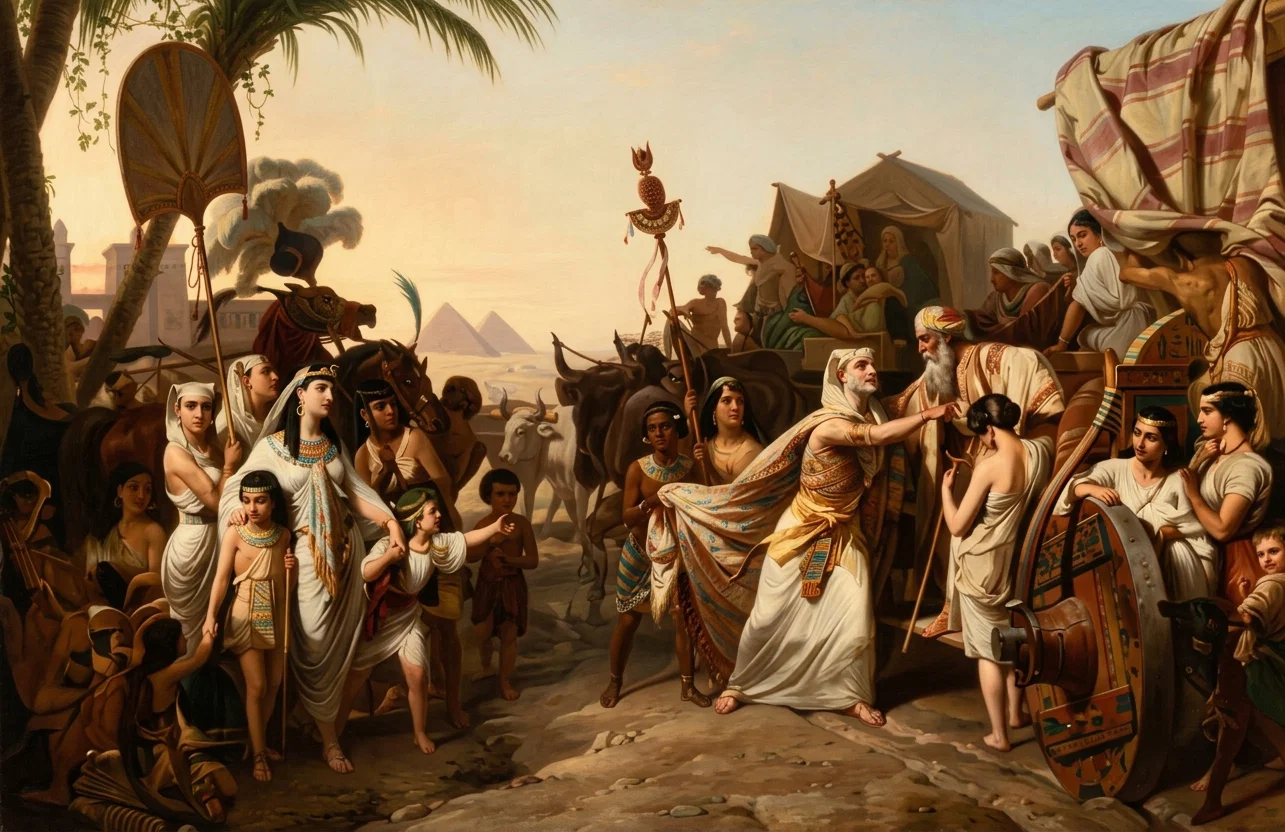
JACOB GOING TO MEET JOSEPH IN EGYPT
Among the fruits of Jacob’s transgression may be counted his unfortunate double marriage, the jealousy of his sons, and his long separation from Joseph. Our picture refers to the beginning of better days.
No truth does the Bible more clearly teach than that what we do is the result of what we are. To a great degree the experiences of life are the fruition of our own thoughts and deeds.
“The curse causeless shall not come.”
“Say ye to the righteous, that it shall be well with him: . . . for the reward of his hands shall be given him.”
“Hear, O earth: behold, I will bring evil upon this people, even the fruit of their thoughts.”
Terrible is this truth, and deeply should it be impressed. Every deed reacts upon the doer. Never a human being but may recognize, in the evils that curse his life, fruitage of his own sowing. Yet even thus we are not without hope.
In Jacob’s Life
To gain the birthright that was his already by God’s promise, Jacob resorted to fraud, and he reaped the harvest in his brother’s hatred. Through twenty years of exile he was himself wronged and defrauded, and was at last forced to find safety in flight; and he reaped a second harvest, as the evils of his own character were seen to crop out in his sons,—all but too true a picture of the retributions of human life.
But God says: “I will not contend forever, neither will I be always wroth: for the spirit should fail before me, and the souls which I have made. For the iniquity of his covetousness was I wroth, . . . and he went on frowardly in the way of his heart. I have seen his ways, and will heal him; I will lead him also, and restore comforts unto him and to his mourners. . . . Peace, peace to him that is far off, and to him that is near, saith the Lord; and I will heal him.”
Jacob in his distress was not overwhelmed. He had repented, he had endeavored to atone for the wrong to his brother. And when threatened with death through the wrath of Esau, he sought help from God. “Yea, he had power over the Angel, and prevailed; he wept, and made supplication.” “And He blessed him there.” In the power of His might the forgiven one stood up, no longer the supplanter, but a prince with God. He had gained not merely deliverance from his outraged brother, but deliverance from himself. The power of evil in his own nature was broken; his character was transformed.
“At eventide there shall be light.” Jacob, reviewing his life history, recognized the sustaining power of God,—“the God which fed me all my life long unto this day, the Angel which redeemed me from all evil.”
The same experience is repeated in the history of Jacob’s sons,—sin working retribution and repentance bearing fruit of righteousness unto life.
God does not annul His laws. He does not work contrary to them. The work of sin He does not undo. But He transforms. Through His grace the curse works out a blessing.
Sowing to Righteousness
Of the sons of Jacob, Levi was one of the most cruel and vindictive, one of the two most guilty in the treacherous murder of the Shechemites. Levi’s characteristics, reflected in his descendants, incurred for them the decree from God, “I will divide them in Jacob, and scatter them in Israel.” But repentance wrought reformation; and by their faithful ness to God amidst the apostasy of other tribes, the curse was transformed into a token of highest honor.
“The Lord separated the tribe of Levi, to bear the ark of the covenant of the Lord, to stand before the Lord to minister unto Him, and to bless His name.” “My covenant was with him of life and peace; and I gave them to him for the fear wherewith he feared Me, and was afraid before My name. . . . He walked with Me in peace and equity, and did turn many away from iniquity.”
The appointed ministers of the sanctuary, the Levites, received no landed inheritance; they dwelt together in cities set apart for their use, and received their support from the tithes and the gifts and offerings devoted to God’s service. They were the teachers of the people, guests at all their festivities, and everywhere honored as servants and representatives of God. To the whole nation was given the command, “Take heed to thyself that thou forsake not the Levite as long as thou livest upon the earth.” “Levi hath no part nor inheritance with his brethren; the Lord is his inheritance.”4
Fruitage of Doubt and Fear
The truth that as a man “thinketh in his heart, so is he,” finds another illustration in Israel’s experience. On the borders of Canaan the spies, returned from searching the country, made their report. The beauty and fruitfulness of the land were lost sight of, through fear of the difficulties in the way of its occupation. The cities walled up to heaven, the giant warriors, the iron chariots, daunted their faith. Leaving God out of the question, the multitude echoed the decision of the unbelieving spies, “We be not able to go up against the people; for they are stronger than we.” Their words proved true. They were not able to go up, and they wore out their lives in the desert.
Two, however, of the twelve that had viewed the land, reasoned otherwise. “We are well able to overcome it,” they urged, counting God’s promise superior to giants, walled cities, or chariots of iron. For them their word was true. Tho they shared with their brethren the forty years’ wandering, Caleb and Joshua entered the land of promise. As courageous of heart as when with the Lord of hosts he set out from Egypt, Caleb asked for and received as his portion the stronghold of the giants. In God’s strength he drove out the Canaanites. The vineyards and olive-groves where his feet had trodden became his possession. Tho the cowards and rebels perished in the wilderness, the men of faith ate of the grapes of Eschol.
OLD GRANARY BURYING GROUND, BOSTON
One of the millions of places where the dead sleep
No truth does the Bible set forth in clearer light than the peril of even one departure from right—peril both to the wrong-doer and to all whom his influence shall reach. Example has wonderful power; and when cast on the side of the evil tendencies of our nature, it becomes well-nigh irresistible.
The Strongest Bulwark of Vice in Our World
is not the iniquitous life of the abandoned sinner or the degraded outcast; it is that life which otherwise appears virtuous, honorable, noble, but in which one sin is fostered, one vice indulged. To the soul that is struggling in secret against some giant temptation, trembling on the very verge of the precipice, such an example is one of the most powerful enticements to sin. He who, endowed with high conceptions of life and truth, does yet wilfully transgress one precept of God’s holy law, has perverted his noble gifts into a lure to sin. Genius, talent, sympathy, even generous and kindly deeds, may thus become decoys of Satan to entice souls over the precipice of ruin.
This is why God has given so many examples showing the result of even one wrong act. From the sad story of that one sin which “brought death into the world, and all our wo, with loss of Eden,” to the record of him who for thirty pieces of silver sold the Lord of glory, Bible biography abounds in these examples, set up as beacons of warning at the byways leading from the path of life.
There is warning also in noting the results that have followed from even once yielding to human weakness and error, the fruit of the letting go of faith. By one failure of his faith, Elijah cut short his life-work. Heavy was the burden that he had borne in behalf of Israel; faithful had been his warnings against the national idolatry; and deep was his solicitude as during three years and a half of famine he watched and waited for some token of repentance. Alone he stood for God upon Mt. Carmel. Through the power of faith, idolatry was cast down, and the blessed rain testified to the showers of blessing waiting to be poured upon Israel. Then in his weakness and weariness he fled before the threats of Jezebel, and alone in the desert prayed that he might die. His faith had failed. The work he had begun, he was not to complete. God bade him anoint another to be prophet in his stead.
But God had marked the heart-service of His servant. Elijah was not to perish in discouragement and solitude in the wilderness. Not for him the descent to the tomb, but the ascent with God’s angels to the presence of His glory.
These life records declare what every human being will one day understand,—that sin can bring only shame and loss; that unbelief means failure; but that God’s mercy reaches to the deepest depths; that faith lifts up the repenting soul to share the adoption of the sons of God.