What Is Death?

5%

Pacific Press Publishing Association · Mountain View, California · Nov 17, 1909

FromSigns of the Times, Vol. 36, No. 45.

Read the full edition

What Is Death?

By C. P. Bollman
To this question various answers are returned by different creeds; but what the believer in the divine inspiration of the Word of God wants to know is, What does the Bible mean by death as applied to man?
The first mention of death in the Bible is in Gen. 2:17. “In the day that thou eatest thereof thou shalt surely die,” said the Creator to our first parents. There is certainly no room for question as to the meaning of the word “die” in this text, for in chapter 3:19 the Lord Himself tells just what He meant by it: “In the sweat of thy face shalt thou eat bread, TILL THOU RETURN UNTO THE GROUND.”
To die, then, as applied to man in the Bible, means to return to the original elements from which man was created; and this process commenced with Adam the very day he sinned, and continued until death was finished in him, at the age of 930 years. The human body is constantly dying. The excretory organs are kept busy throwing off dead matter; and that this is part of the sentence of death pronounced upon man in the beginning is evident from the expression, “In the sweat of thy face shalt thou eat bread, TILL THOU RETURN UNTO THE GROUND.”
Following the sentence of death, which, as we have seen, was explained by the Lord Himself to mean that man should turn again to dust, we read of Adam and his immediate descendants: “And all the days that Adam lived were nine hundred and thirty years: and he died.” “And all the days of Seth were nine hundred and twelve years: and he died.” “And all the days of Enos were nine hundred and five years: and he died.” And from the days of Adam to the present time death, with only two exceptions, has been the lot of all mankind. Every man’s record ends with the words, “And he died.”

Does the Body Alone Die?

It may be said, however, and it is so said by some, that only the body dies. But let us see how this view harmonizes with the Word of God. What was the sentence?—“Thou shalt surely die.” To whom was this spoken?—To man. Then MAN was to die. “And all the days that Adam [the MAN, for that is the meaning of “Adam”] lived were nine hundred and thirty years: and he died.” Gen. 5:5. Then the MAN died; not simply a part of him, but the whole man, for so saith the Scriptures: “Man dieth, and wasteth away: yea, MAN giveth up the ghost; and where is he?” Job 14:10.
We find, then, that death is something which is asserted, not of a part of man, but of MAN; and that this death is not a spiritual change that takes place when man sins, but a physical change which is completed at the close of his earthly pilgrimage; for it is written of antediluvians, patriarchs, and prophets, that they lived so many years and then died.
But it may be said that the death which Adam and his descendants died is not the wages of sin; that this death is still future, and differs from what we call “natural death” in that it is a “death that never dies;” thatit is not like the death that comes alike to all, the return of man to the original elements from which he was made in the beginning, but is, in fact, eternal existence in misery.

The Second Death

It is indeed true that “natural death” is not the wages of sin; for it is written, “As in Adam all die, even so in Christ shall all be made alive.” All lose physical life in Adam, and all are raised again to physical life through Christ; for the Scriptures plainly teach a resurrection both of the just and of the unjust. So then what would be otherwise the wages of sin, becomes a temporary instead of an eternal cessation of existence, described in the Scriptures as a “sleep.” But to those who are out of Christ, and who so remain until their probation closes, death comes the second time, for thus saith the Scriptures: “The soul that sinneth, it shall die.” “When a righteous man turneth away from his righteousness, and committeth iniquity, AND DIETH IN THEM; for his iniquity that he hath done SHALL HE DIE.” Eze. 18:20, 26.
Here is a plain reference to the two deaths; namely, the first or “natural” death, and the second death, the wages of sin. We have seen that the first death, the death that comes to all alike, is, because of the resurrection, only temporary cessation of existence, a return for a time only to the original elements from which man was made in the beginning. Let us now inquire what is the nature of the second death.
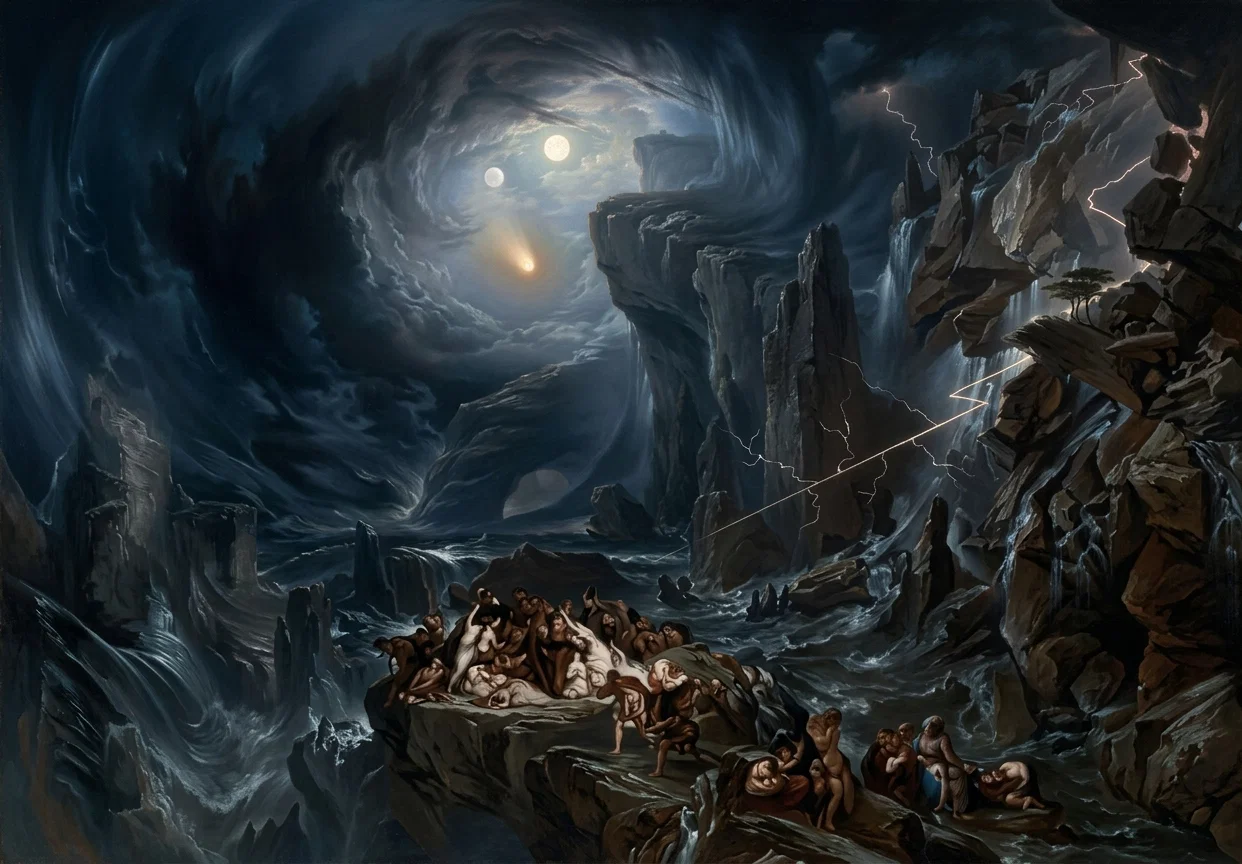
THE DELUGE
The Flood, the apostle Peter tells us, with its destruction of those who had identified themselves with sin, was one of the great object lessons to “those that after should live ungodly.” See 2 Peter 2:4-6; 3:5, 6
THE DELUGE The Flood, the apostle Peter tells us, with its destruction of those who had identified themselves with sin, was one of the great object lessons to “those that after should live ungodly.” See 2 Peter 2:4-6; 3:5, 6
The use of the expression “second death” implies a similarity between the two deaths. Indeed, we shall find that the second death differs from the first death only in the fact that in general the death which we call “natural” comes from a gradual wearing out of the vital forces by disease or exhaustion, while the second death comes as a visible manifestation of the wrath of God against sin. But that the result will be the same, namely, a return to the original elements from which man was made in the beginning, is made very clear in the Scriptures.

What the Word Declares

In Obadiah 16 we read of the heathen that “they shall be as tho they had not been;” and in Mal. 4:1 it is declared that “the day cometh, that shall burn as an oven; and all the proud, yea, and all that do wickedly, shall be stubble: and the day that cometh shall burn them up, saith the Lord of hosts, that it shall leave them neither root nor branch.”
The New Testament is equally clear upon this important subject. Says our Saviour: “Fear not them which kill the body, but are not able to kill the soul: but rather fear Him which is able to destroy both soul and body in hell.” Matt. 10:28. The necessary inference is that He will thus destroy the finally impenitent.
The apostle Paul testifies that “the wages of sin is death” (Rom. 6:23); and again, as touching the nature of this death, he says of the wicked that they “shall be punished with everlasting destruction.” Everlasting destruction is destruction from which there is no return, no recovery. A city may be destroyed and rebuilt; and man is destroyed by the first death, but in the resurrection he is “rebuilt;” but the destruction of the second death is final, or everlasting.
Many other texts might be cited, all testifying the same thing, namely, that the second death results in the utter and everlasting destruction of those who are its unhappy subjects; but one more must suffice, Rev. 20:9, where of the wicked it is said prophetically, “And they went up on the breadth of the earth, and compassed the camp of the saints about, and the beloved city: and fire came down from God out of heaven, and devoured them.”
Truly, “blessed and holy is he that hath part in the first resurrection: on such the second death hath no power.”