Eating and Strength

6%

Pacific Press Publishing Association · Mountain View, California · Nov 17, 1909

FromSigns of the Times, Vol. 36, No. 45.

Read the full edition

Eating and Strength

A RECENT issue of the Detroit News-Tribune has an instructive and interesting article by Gilman Low, who contends that men eat altogether too much, that living expenses are altogether too high. He declares: “I could eat $10.00 worth of food a day, but I would not be so foolish. I can live comfortably on less than 50 cents’ worth every twenty-four hours, and I have just put myself in prime physical condition on an allowance of food which costs exactly thirteen cents a day. That condition isn’t in just feeling well, but it is the condition that the prize-fighter would consider tip-top; in fact, I am in a better condition to-day than the average prize-fighter.”
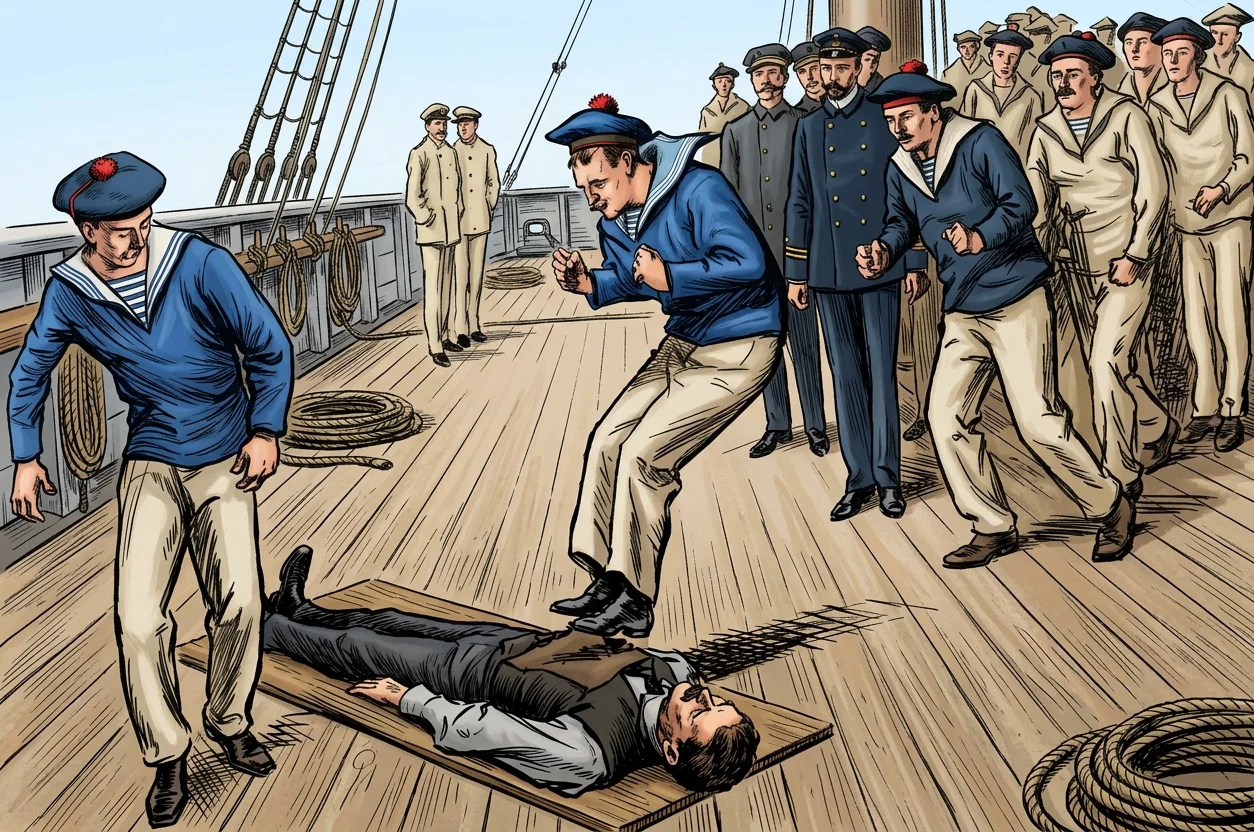
Then he goes on to tell of an experiment that he conducted on the French ship of war Perite, where in two different days 615 men jumped on his stomach—or as he puts it, “solar plexus”—one after the other, without any injury to him at all. It took him some time to get the captain of the ship to consent to the experiment, but after a while he did it in the interests of science.
Several other experiments that were of nearly equal interest were also conducted, which showed the tremendous strength and endurance of Mr. Low.
The first day 250 sailors jumped on him, one following the other in a running jump; and the next day 365. More would have followed, but a boat on the river capsized, and the men rushed to relieve the people in the water. He wished them to continue the experiment, but they refused. Forty-five of the crew signed a certificate testifying to the genuineness of his exhibition, and the chief officer of the ship drew up a paper with the ship’s seal and signed it, giving an account of the tests.
Mr. Low declares that people make the following mistakes: “1. Too many meals daily, and too much food. Too much meat; too much water with meals. “2. Too little oxygen in business offices. “3. Too little exercise daily.
(Continued on next page.)

Eating and Strength

(Continued from previous page.)
“4. Too many cigars daily; too many cigarets, and too much whisky. “5. Too much work, too little rest, and too little sleep.”
He goes on to say that even the hard, simple prison fare has cured severe chronic cases of stomach trouble. He also tells us that fasting has worked beneficially with him. He has fasted fifteen days at a time, taking nothing but water. At the end of that time he had as much physical strength and more mental power, as his muscular power was more responsive to his mind. One time he subsisted on 67 cents’ worth of food for a week without losing an ounce in weight.
He trained especially for the test that he passed through on the battle-ship, eating on the thirteen-cents-a-day plan, his food consisting of the following:
Three eggs, one lemon, quarter of a pound of sugar, one apple, and less than a quart of milk daily; alternating with white bread, graham bread, and rye bread, less than a loaf each day. “My expenses for the whole eight weeks, or fifty-six days,” he says, “were $7.28, and on the last day I had fourteen cents’ worth of food on hand.” Comparing himself after this eight weeks’ dieting with his condition before, he declares that he was much stronger. He says: “I was stronger organically because I was getting all there was to be had out of my food, masticating carefully and with enjoyment—not eating for bulk of consumption, but for nutrition.” He does not recommend any such a diet as a permanent diet however. But during this time, he declares: “I had all the food that is to be had from the air. Deep, slow breathing is a physical duty producing wonderful results. We get a large proportion of our regular food from the air, and we should have fresh air just as we should have fresh food.”
He has no hobby over the food question. He says: “I do not say that the diet I followed is the best for every person. It was best for me, but a variation might be an advantage to another. To me it sufficiently proved that meat is not the necessity that it is commonly believed to be.”
All of which goes to show that the vegetarian diet is not a starvation diet, as those can testify who have followed it for years. One of the great difficulties with vegetarians is that they eat too much. It is better to stop eating while hungry. The appetite usually calls for more than the system demands.