My visit at Samoa would have been incomplete without seeing the volcano on an adjoining island. On the evening of August 16, my brother and I joined a party of excursionists going from Apia, the capital, to Savaii, an island sixty miles west. Five of us were going to visit the volcano, the rest to spend the day merrymaking.
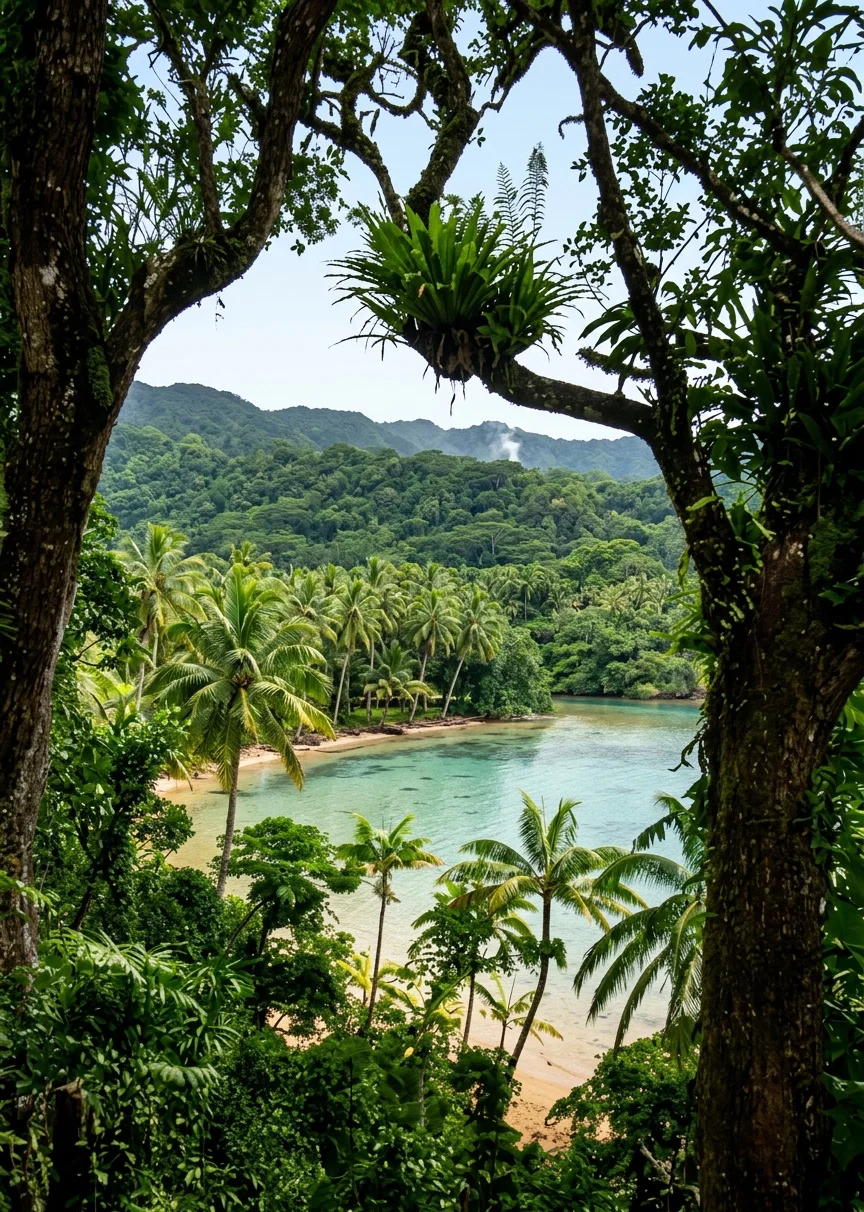
A BEAUTIFUL SAMOAN SCENE
The steamer left Apia Bay at ten o’clock. At three in the morning many of the passengers were on deck to witness the rare and magnificent sight of a smoking volcano. The heavens were all aglow with the light from the boiling lava. On the coast ten miles below we saw two great lights where the red-hot lava pours into the sea, causing it to boil like a pot, and to send up huge clouds of smoke and steam.
At 7 A.M. we were ashore, and with some effort secured the services of two native guides. Few of the natives consent to accompany tourists to the crater, through fear that some evil may befall them. By eight o’clock we were ready for our ten-mile tramp. At a near-by rivulet our guides filled twelve or more bottles with water; for farther up, the lava has dried up all the streams.
We followed the guides through the bush over a foot-path that was at times almost imperceptible, and often obstructed by fallen trees and large stones. We walked through groves of coconut trees, banana plantations, and patches of the taro plant, until one half of our journey had been covered.
On emerging from the bush, from a hillock we found ourselves suddenly confronted by an awful scene of desolation, which we looked upon with wonder and surprise. Behind us were verdure and fruitfulness; before us was a vast waste of black lava, that had been a few months previously a molten mass. As far as the eye could see, there was the same desolation. Valleys have been filled and hills covered with it. Mighty forests have been laid low. Extensive and valuable cocoa plantations and coconut groves have been buried. The lava has covered fifty square miles of territory—the garden spot of the island is lost forever.
Before undertaking to walk on the sharp, brittle lava, our barefooted guides made sandals for themselves from the husks of matured coconuts. Now began the difficult but interesting part of our journey. It was at first with some apprehension that we walked on the lava, fearing that we would unknowingly step on some that was still hot, and burn our shoes; but our brave guides led the way, and we felt safe in following on. In cooling, the lava has formed very strange and fantastic shapes. These would attract our attention, and elicit expressions of wonder and admiration. We climbed on slowly, the lava crackling and crumbling under our feet.
The lava is not now flowing from the mouth of the crater. When the top of the mountain burst forth, in November, 1903, the lava slowly spread over several square miles of territory; and in the course of months it bored a hole through the side of the crater fifty feet below the edge. Thereafter it began forming a channel for itself, and as the top of the lava hardened, the living lava below gradually lifted the crust, until now there is from fifteen to forty feet of it above the stream. There are times, however, when the subterranean channel is choked, and then the liquid lava fills the great caldron, and runs over, so that the land is covered with layer after layer of this melted rock, iron, and brimstone.
In many places the crust that lay directly over the subterranean stream of liquid fire has been forced up several feet, while in other places it has fallen, thus permitting the heat and the sulphur fumes to escape, crumbling and bleaching the dead lava.
We ventured to the edge of great, funnel-shaped holes, from which issued gusts of sulphur vapors that compelled us to lower our heads to the ground to catch a breath of pure air. I thought of how awful it must have been when fire and brimstone were rained down upon the wicked cities of Sodom and Gomorrah. And still more awful it will be when the same elements will consume forever all those who refuse to accept God’s overtures of mercy.
At 12: 30 we found ourselves at the ragged edge of the crater, which is of an oblong shape, 75 by 150 feet. Here we beheld the seething, red-hot lava bubbling up from the bowels of the earth. How puny and insignificant we felt in the presence of so mighty a phenomenon—rock and iron red as vermilion, boiling and bubbling furiously, and rushing on to the sea. I thought of the coming great day of the Lord, as described by the apostle Peter, when the earth shall be melted with fervent heat, and when all the works of men shall be burned up.
For some moments we stood dumbfounded at the top of this gigantic caldron, then gave vent to our feelings in surprised acclamations. It is, in fact, an overwhelmingly magnificent spectacle, the remembrance of which will always remain with us. Again and again we went to the edge of this lake of fire and brimstone that welled up and down within the confines of this giant caldron.
Reluctantly we left this thrilling scene, to find a shady spot in the shadow of a great volcano rock that had been thrown from the crater. Here we rested and ate our dinner before undertaking our long return journey.
No lives have been destroyed by this volcano, for the reason that the lava flows slowly, giving warning to the inhabitants to move on. Six villages have been wiped out, rendering homeless 600 natives, to whom land on another island has been given by the government.