The Light of Prophecy

3%

Pacific Press Publishing Association · Mountain View, California · Nov 24, 1909

FromSigns of the Times, Vol. 36, No. 46.

Read the full edition

The Light of Prophecy

By L. A. Reed
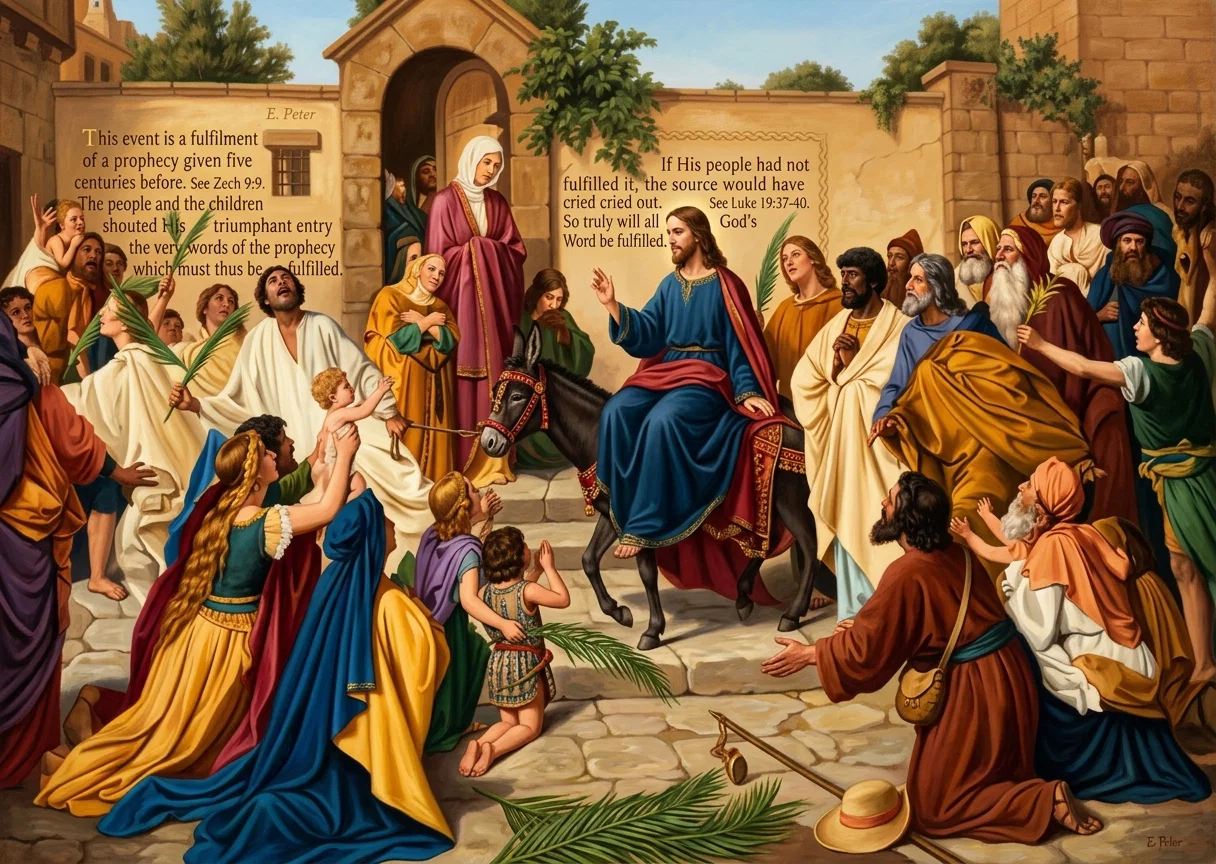
CHRIST ENTERING JERUSALEM
In every age there are those who choose to believe that God does not concern Himself with the affairs of men. Others there are who hardly dare hope that God condescends to give attention to mankind. But there are a few who believe and teach that God takes a deep, all-absorbing interest in humanity, and gives light from His Word for every age.
The Word is very emphatic with reference to this. “Surely the Lord Jehovah will do nothing, except He reveal His secret unto His servants the prophets.” Amos 3:7. The record of the Bible is one vast testimony to this principle.
Before God destroyed the world by a flood, Noah faithfully warned the people then living, and preached to them of the coming of the Deluge, and was occupied in preaching and practising this truth for one hundred and twenty years.
When God was about to destroy Sodom, He informed every person that would in any wise listen to His word, and some were told who laughed at the warning. Every one whom there was the slightest hope of saving was given a warning.
Before the Romans came and besieged and captured the city of Jerusalem, through Christ a warning was sent of the coming event. And not only so, but a sign was given for those in the city, enabling them to escape from the awful doom. That sign was the encompassing of the city by the Roman army; and every believer, when he saw that sign, made ready to escape. The wording of this preconcerted signal had called for haste. “Let him that is on the housetop not come down to take anything out of his house.” Each one who valued his life was to flee when he saw the sign. The Roman army encompassed the city, and then withdrew; and every Christian inside the city fled when that army withdrew, and escaped, not only from Jerusalem, but from the awful calamities that accompanied its siege and overthrow.

Prophecy a Light

So there are many warnings in the Word of God for our own day. There is a word of prophecy for our time, which we, living in this age, should heed. As the Word says, “We have the word of prophecy made more sure; whereunto ye do well that ye take heed, as unto a lamp shining in a dark place, until the day dawn, and the day-star arise in your hearts.” 2 Peter 1:19. There it is plain enough. We “do well” to “take heed” to the “word of prophecy,” just as we follow the light of a lamp when it is shining in a dark place. And thus we are certain of knowing where we are in this dark world. We are able to move unerringly amidst the surrounding darkness, because we have a light. And in so doing we do not “follow cunningly devised fables.” “For no prophecy ever came by the will of man: but men spake from God, being moved by the Holy Spirit.” Verses 16 and 21.
This principle, of God’s announcing the judgment before it takes the world, has been true, not only of those great things in which His power has been visibly manifested, but it has been true as well in the events of the nations where His providence, though often unrecognized, is constantly at work.
About 600 years before the birth of Christ, an outline of the world’s history was given, the number of great universal empires announced, and the order of their succession, with a delineation of their major characteristics, given. One of these, the simplest in its form of all, is given in the second chapter of Daniel.
When the Babylonian empire had reachedthe pinnacle of its glory, and when its power was centralized in its mightiest king, Nebuchadnezzar, God’s providence outlined to him in a remarkable way the history of this world to the end of time, yea, more, into the ages of eternity.

A King’s Dream

The simple story as recorded there, is an intensely interesting one. In the providence of God the king had a dream, and the visions of the night so impressed his heart and mind that it is his all-absorbing desire to know its meaning.
In his perplexity, naturally he turns to the great men, the wise men, the seers of his realm, only to be deeply disappointed. He asks of them the dream, and the interpretation of it. But they ask the king to tell the dream, and then they will put to it such interpretation as they can conjure up. He tells them that only on condition that they tell the dream will he be sure the interpretation is correct; that if they do not do this they will be destroyed; but that if they do it, he will honor them with position and with wealth. And then they flatly tell him that no human being can do it, that only the gods, whose dwelling is not with men, are equal to such a task; thus acknowledging that they have really no connection with divine forces and supernatural agencies. And so the decree of the king goes forth to take all the wise men in the realm, and put them to death. And Daniel and his companions are sought with the rest, to be slain.

The Dream

At Daniel’s earnest request, time is granted. Then he and his three companions join in prayer; and in the night-season the marvelous dream of the king is repeated to Daniel, with a full understanding of all its import. Then, thanking God for the revelation of the secret, and happy and confident because his Maker has thus supported him in the hour of trial, he goes boldly and asks to be admitted to the king.
The dream, we find, was that of a mighty image, a man of majestic form and wonderful glory, with an aspect terrible. The head of this image was of fine gold, its breast and its arms of silver, its body and thighs of brass, its legs of iron, its feet part of iron and part of clay. Then, as the king watched the image, he saw a stone cut out without hands, that smote the image upon the feet, and broke them in pieces; and the whole image, the iron, the clay, the brass, the silver, and the gold, became like the chaff of the summer threshing-floors, and the wind carried them away, so that no place was found for them, and the stone that smote the image became a great mountain, and filled the whole earth.
Daniel, in announcing this dream, this wonderful vision of the king, said that God had revealed it to him, and that it was the “God in heaven that revealeth secrets,” and had made known to the king “what shall be in the latter days.”
In the 29th verse of this chapter, Daniel declares that the king, as he retired for the night, was thinking of the future, wondering what was coming hereafter, and that God had taken this means of answering the questions of the king. Verses 36 to 45 give the explanation of the dream. The different metals represent different kingdoms which were to appear upon the earth, the first one being then in existence. The kingdom of Babylon was represented by the head of fine gold. The breast and the arms of silver represented an inferior kingdom which was to come after the Babylonian kingdom, and which we know by history was Medo-Persia. The body and thighs of brass were to be the third kingdom to bear rule over all the earth, and this every one knows was the kingdom of Greece, headed at first by Alexander the Great.
The iron, the prophecy states, is the fourth kingdom, which should be as strong as iron, forasmuch as iron breaks in pieces and subdues all things; and as iron that crushes all these metals before mentioned, so it should break in pieces and crush. This we know was “the iron monarchy of Rome.” The mixture of the iron and the clay in the feet and toes is explained to mean the divided condition of the fourth kingdom, and is absolutely in accordance with the facts. Rome was broken up during the years from 356 to 476 A.D., and divided into ten, at times less kingdoms; and a number of the modern nations of Europe are the remnants of this divided empire.
In the interpretation, Daniel said that the representatives of these nations would intermarry; they would seek to unite, “but they shall not cleave one to another, even as iron doth not mingle with clay.” Any one who knows anything at all of the history of Europe, knows of the intermarriages, of the efforts toward union, of the struggle for a universal empire; and he knows also that all such efforts have been absolutely futile. Rome once divided is divided still, and divided it will be to the end of time; for the announcement comes, “In the days of those kings shall the God of heaven set up a kingdom which shall never be destroyed, nor shall the sovereignty thereof be left to another people; but it shall break in pieces and consume all these kingdoms, and it shall stand forever.”

The Coming Empire

That last, the fifth great universal empire, is to occupy the same territory occupied by the four preceding empires. That is plain by the dream and the interpretation. The stone that smote the image became a great mountain, and filled the whole earth. It is therefore a universal empire. Hence it is to occupy the territory held by these other empires. And last of all, mark it, it destroys, utterly destroys these preceding nations. They become like the chaff of the summer threshing-floor, and are carried away, and no place is found for them. And the stone that smote the image becomes a great mountain, and fills the whole earth.
This destruction of the nations upon the setting up of the fifth universal and eternal empire of God, is not at all in harmony with that dream of the soothsayers of to-day who talk of peace and safety, and of a gradual dawn of the millennial reign of Christ. The picture in the dream is of a stone striking the image upon the feet, upon the part especially representing the nations now in existence, and crumbling them to dust, sweeping them off the face of the earth, no place whatever being left for them, and the place formerly occupied by them being taken by the empire of Christ. This is plain and explicit.
And since it is plain, since it is clear to all that God’s Word has told the truth, that history has repeated, in fact, what prophecy foretold in the Word, it naturally follows that what is yet to be is as certain as that which has already been fulfilled. And now what is our position in reference to it?
When God sent the message that He would destroy the world with a flood, thousands rejected that message, scorned the warning, and were lost. The few, namely eight souls, believed God’s Word, entered the ark, and were saved.
In the days when God destroyed Sodom, the many remained in the city, and were lost in the fires that consumed it; but the few, Lot and a portion of his family, heeded God’s Word, and just three of them were saved.
In the time of the destruction of Jerusalem, the Jews remained in the city, fought among themselves, and against the Romans, and perished miserably. But the Christians, believing and following the Word, escaped from that awful calamity.
What shall we do in our day? Shall we be among the unbelievers, the scoffers, and be caught in the judgments of God? Or shall we be among the few who believe and are saved? Already the divided kingdoms of Rome have been in existence for years. Other prophecies of the Scripture show us that we have come to the time represented by the hurling of the stone against the image, and the utter destruction of the image; in other words, that we have come to the time when God is about to set up the kingdom of Christ. Are we ready for the great event? Are we already subjects of that kingdom, and thus prepared to enter into that inheritance?
Remember, the prophecy is like a light shining in a dark place. We do well to take heed to it. Rest assured that God will do nothing but He reveals His secret to His servants the prophets. And now that “the lion hath roared; who will not fear? The Lord Jehovah hath spoken; who can but prophesy?”