The Word of Our God

3%

Pacific Press Publishing Association · Mountain View, California · Nov 24, 1909

FromSigns of the Times, Vol. 36, No. 46.

Read the full edition

“The Word of Our God”

By Prof. L. A. Reed
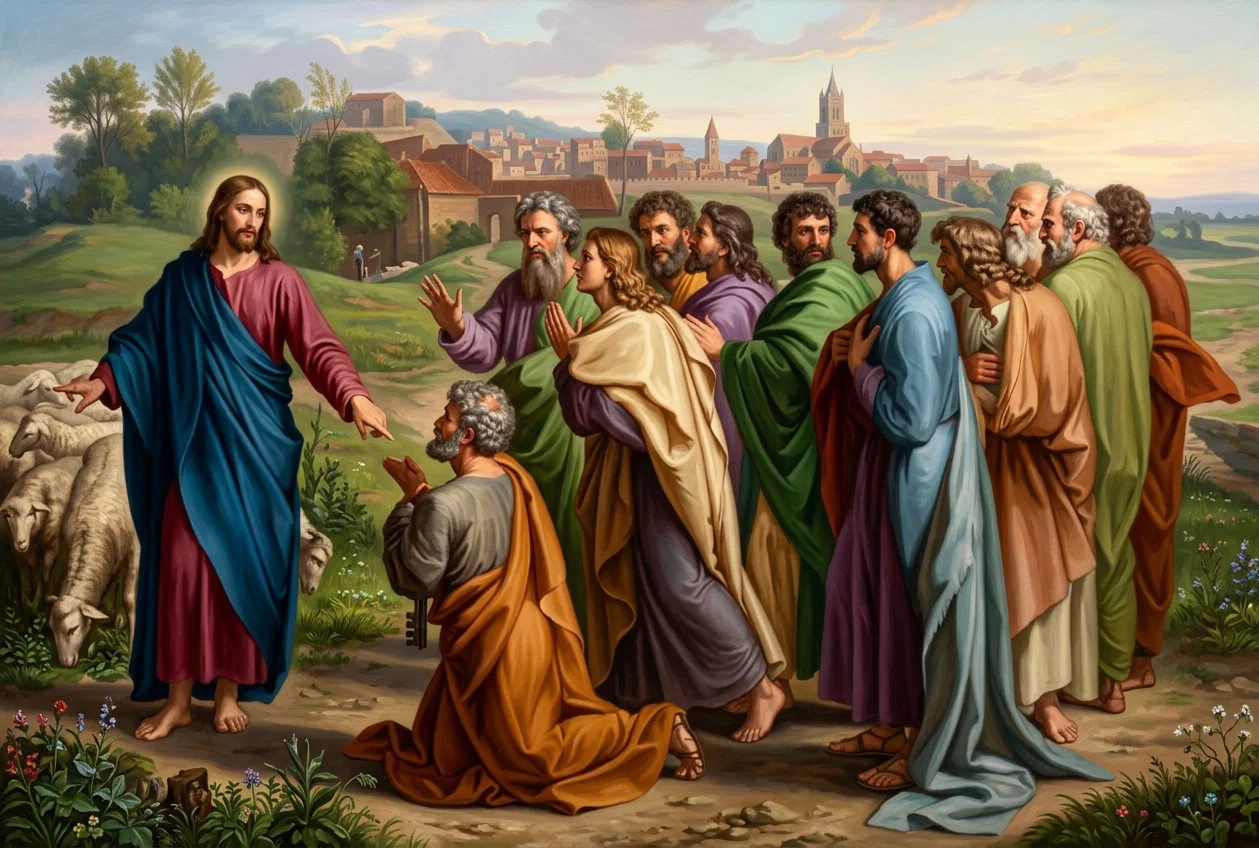
CHRIST'S CHARGE TO PETER

The Reliability of the Book

But abide thou in the things which thou hast learned and hast been assured of, knowing of whom thou hast learned them; and that from a babe thou hast known the sacred writings which are able to make thee wise unto salvation through faith which is in Christ Jesus. Every scripture inspired of God is also profitable for teaching, for reproof, for correction, for instruction which is in righteousness: that the man of God may be complete, furnished completely unto every good work.” 2 Tim. 3:14-17.
These words give what the Mind of inspiration has to say with reference to the credibility of those writings which we call the Bible. There is not the slightest hint of unreliability, but an absolute assurance of their entire credibility and authority, and effectiveness when applied to the life. Those books which Timothy studied were the sacred writings, namely the Old Testament, and this Old Testament had made him “wise unto salvation.” So Paul says that every scripture inspired of God will do this.
If the Old Testament, the Sacred Writings, that is, the Scriptures then in existence, which had been inspired of God, could do this for Timothy and others in his day, they will certainly do the same for those who follow them as he did. There is a great deal of discussion, unprofitable discussion, as to just how and in what way the Scriptures are inspired. But here we have it plainly stated that these writings are sacred, that they are able to make one “wise unto salvation,” that they are “profitable for teaching, for reproof, for correction, for instruction, or discipline, which is in righteousness: that the man of God may be complete, furnished completely unto every good work.” There are no other writings on the face of the earth that even pretend to do this, and there are none, unless based upon this Word, that could even begin such a work.

The Exactness of the Word

Let us take a few instances. Notice the words of the Scripture as recorded in Eze. 21:27. “I will overturn, overturn, overturn it: this also shall be no more, until He come whose right it is; and I will give it Him.” Here are very few words, but they state exactly conditions then existing, and that would continue to be absolutely in harmony with history, for over two thousand years. In the preceding verses, notably from the 18th to the 23d, we note that Israel had already been overturned by the Babylonian power, through its king Nebuchadnezzar. And here the statement is made that this kingdom of Israel is to be yet overturned three times, and then would cease to be a kingdom, “until He come whose right it is,” that is, Christ Jesus, and then the kingdom would be given to Him.
What are these three overturnings? Appealing to history, we see at once that the three overturnings were made respectively by Medo-Persia, Grecia, and Rome; and under Rome the miter was removed, and the crown taken off for the third and last time. Since then the kingdom has been no more; and we believe according to the Word that it will be no more “until He come whose right it is.” Here is a foreknowledge. It comprehends over two thousand years of this world’s history. The words are exactly correct; the statement is historically true. This scripture must have been inspired.

An All-Comprehending Word

In Gen. 12:3 we have the statement made to Abraham, “In thee shall all the families of the earth be blessed.” This very statement shows the all-comprehending knowledge of the inspired Scripture; and we have in the book of Galatians an inspired comment upon its marvelous meaning. We find in this last scripture that to be a child of Abraham is simply to be a child of faith; and then follows the statement, “And the Scripture, foreseeing that God would justify the Gentiles by faith, preached the Gospel beforehand unto Abraham, saying, In thee shall all the nations be blessed.” Gal. 3:8. The statement is that the Scripture foresaw that the Gospel would one day be given directly to the Gentiles, and that this Gospel to the Gentiles was therefore preached beforehand to Abraham in thus saying, “In thee shall all the nations be blessed.” It is easily seen that nothing short of the omniscience of God could write the Bible, and pile it full of such expressions, expressions that it takes ages to unfold and expound fully, and yet in not one single instance make any error, or divergence from historical fact.

The Battle of the Four and the Five Kings

In 1869 the great Semitic scholar, Professor Noeldeke, declared that criticism had forever disproved the claim of the 14th chapter of Genesis to be historical, and the reasons for this were stated. The political situation presupposed by this 14th chapter, he declared, was incredible and impossible. Further, at so distant a date Babylonian armies could not have marched to Canaan, much less could Canaan have been a subject province of Babylon. In fact, the whole story, he said, was fiction, based upon the Assyrian conquest of Palestine in later days. And the names of the princes commemorated in it were etymological inventions. So much for Higher Criticism.
This was in 1869. But now, in this year of 1909, Higher Criticism ought to correct its miserable conclusions of that day; but it is silent, for it never corrects a mistake, for that would show its fallibility, yea, more, its unreliability.
(Continued on page 12.)

The Word of Our God

(Continued from page 8.)
There has been excavation and searching since that day, and the ancient world of western Asia has arisen again from the grave of centuries. As a result, we know almost as much about the Babylonia of Abraham’s time as we do about the Assyria of Isaiah’s time, or about Greece in the age of Pericles.
And now in the light of this flood of historic knowledge, it is the book of Genesis whose credence has been vindicated, and not the work of this modern German critic. Of course these discoveries have been disputed by the critic inch by inch; and altho they are overthrown, he, convinced against his will, maintains the old opinion still.
In the 14th chapter of Genesis four kings are named: Amraphel, king of Shinar; Arioch, king of Ellasar; Chederlaomer, king of Elam; and Tidal, king of nations; and these four made war with five other kings; namely, Bera, king of Sodom; Birsha, king of Gomorrah; Shinab, king of Admah; Shemeber, king of Zeboiim; and Zoar, king of Bela.
Here are nine kings and nine countries mentioned. This involved a good deal of country and a good deal of history. It is like a window through which we look to see what is going on in the world of nations at that time. Let us turn to the monuments of Babylonia, and see what we can find with reference to the history here recorded in the divine Scriptures. We find that Elam had conquered Babylon, and the sovereigns of Babylon had therefore become the vassals of Elam. Along with this conquest, Babylon had been divided into two kingdoms, and Ammu-Rapi was reigning at Babylon, the Biblical Shinar, and Ari-Aku was ruling at Larsa, the Biblical Ellasar. Here we have absolute agreement, as Ammu-Rapi agrees with Amraphel, Hebrew, and Ari-Aku agrees with the Hebrew Arioch.
This is enough to show the absolute agreement between this fragment of old-world history preserved in the book of Genesis, and the revelations of the native monuments. Even the proper names have been handed down in the Scriptural narrative, with but little alteration. For example, in the Babylonian we find Ammu-Rapi’s name sometimes written Ammu-Rapi Ilu, meaning Ammu-Rapi the god, and this Ammu-Rapi Ilu is letter for letter the Amraphel of Genesis.
Again, the word Chederlaomer proves to be a good Elamite name. The father of Ari-Aku, or Arioch, had the name Kudur-Nankhundi, which means, “A servant of the goddess.” Now Lagamar was one of the leading Elamite deities, and therefore Kudur-Lagamar would be letter for letter the Hebrew Chederlaomer. So we might go through with the other names, every one of them; but it is not necessary. Space forbids it. As Sayce says, “We may therefore place the same confidence in the letter (of this text) as we do in that of the clay tablets of Nineveh.”

“Rejoice”

Again, there is a wonderful revelation of knowledge with reference to the inspired words of the Old Testament when we trace out the root meaning of the word “rejoice,” as given in many a poetical expression in the old scriptures. For example, we quote a few of these scriptures to illustrate the point:
“Let the heavens be glad, and let the earth rejoice.” 1 Chron. 16:31. Here the words “be glad” and “rejoice” are in the Hebrew two different words. The same occur in Ps. 96:11: “Let the heavens rejoice, and let the earth be glad.” But looking at the English of these two verses, the words seem to have been interchanged. The word “rejoice,” for instance, in the first passage is connected with “earth,” but in the second reference it is connected with “heavens.” Similarly the words “be glad” in the reference from Chronicles are used with “heavens,” and in the second instance with “earth.” Thus a word used with “earth” in one scripture seems to be used with “heavens” in the other.
But this is not the case in the original. The word used with “heavens” in the one is the same Hebrew word that is used with “heavens” in the other; and in the original the word used with “earth” in one instance is the word used with “earth” in the other. There is in Hebrew no loose interchange of words such as we have in the English.
When we turn to a Hebrew lexicon and look for the inner root meanings of the two words, we are surprised at the result; but we no longer wonder at the selective use of these words. We find that the word used with “heavens” is the Hebrew word sameach (pronounced Saw-may-akh), which means to be blithe and gleeful, glad, joyful. It is from a primitive root samach, which probably means to BRIGHTEN up; hence, to be blithe or gleesome.
Looking for the word that is used with “earth,” we discover that it is the Hebrew word giyl (gheel), a revolution; meaning joy, to rejoice greatly. It is from a primitive root gwl (gool), which means to SPIN ROUND (under influence of any violent emotion), hence to rejoice, be glad. The idea of revolving, of a revolution, is a fundamental idea in the word, and its fitness in connection with the earth needs no comments here.
Other passages where the earth is thus spoken of as SPINNING ROUND WITH JOY are to be found. We give those we have discovered.
“The Lord reigneth, let the earth rejoice.” “Let the earth spin round with joy.” Ps. 97:1.
“Sing, O heavens; and be joyful, O earth.” Isa. 49:13. The word “sing” is translated from the Hebrew word Ranan (raw-nan), to SHOUT for joy, to sing, and has in it the fundamental idea of something AUDIBLE; but the word used with “earth” in this passage is the word Giyl. “Sing, O heavens; and SPIN ROUND WITH JOY, O earth.”
“Fear not, O land, be glad [giyl—spin round with joy] and rejoice [samach—brighten up].” Joel 2:21.
There is another remarkable thing; this word is used ONLY of persons, and in connection with the earth. There are instances where other words meaning praise, rejoice, etc., are used with the word “earth,” but in no instance is the word giyl used with any other of the heavenly bodies.
If the men who wrote the Scriptures were so tainted with astronomical errors as we are sometimes taught to suppose, and these errors crept into what they wrote, why is it that in no instance did they call upon the sun to roll around or revolve (about the earth) with joy? And if they believed in a flat, stationary earth, why is it that in about half the places where the earth is spoken of as rejoicing, it is said to roll, or spin, round with joy?
There are words in Hebrew used to express the idea of being glad or rejoicing, which have in them the root idea of an expanse, of a spreading out, and some with the fundamental idea of binding or fastening. Why is it, if these men believed in a flat, expanded earth, or a solid earth on pillars, that in no case did they use these words with reference to the earth? Let him answer who can.
If space allowed we might go on for pages and give literally hundreds such examples as are here presented. The conviction is forced upon us that the book we call the Bible is from God. Its authority and correctness can not be questioned. May we receive it, not as the word of man, but as the Word of God. So received, it will work effectually in us to make us complete in all knowledge that is worth the while, and in all character that is enduring. 1 Thess. 2:13.