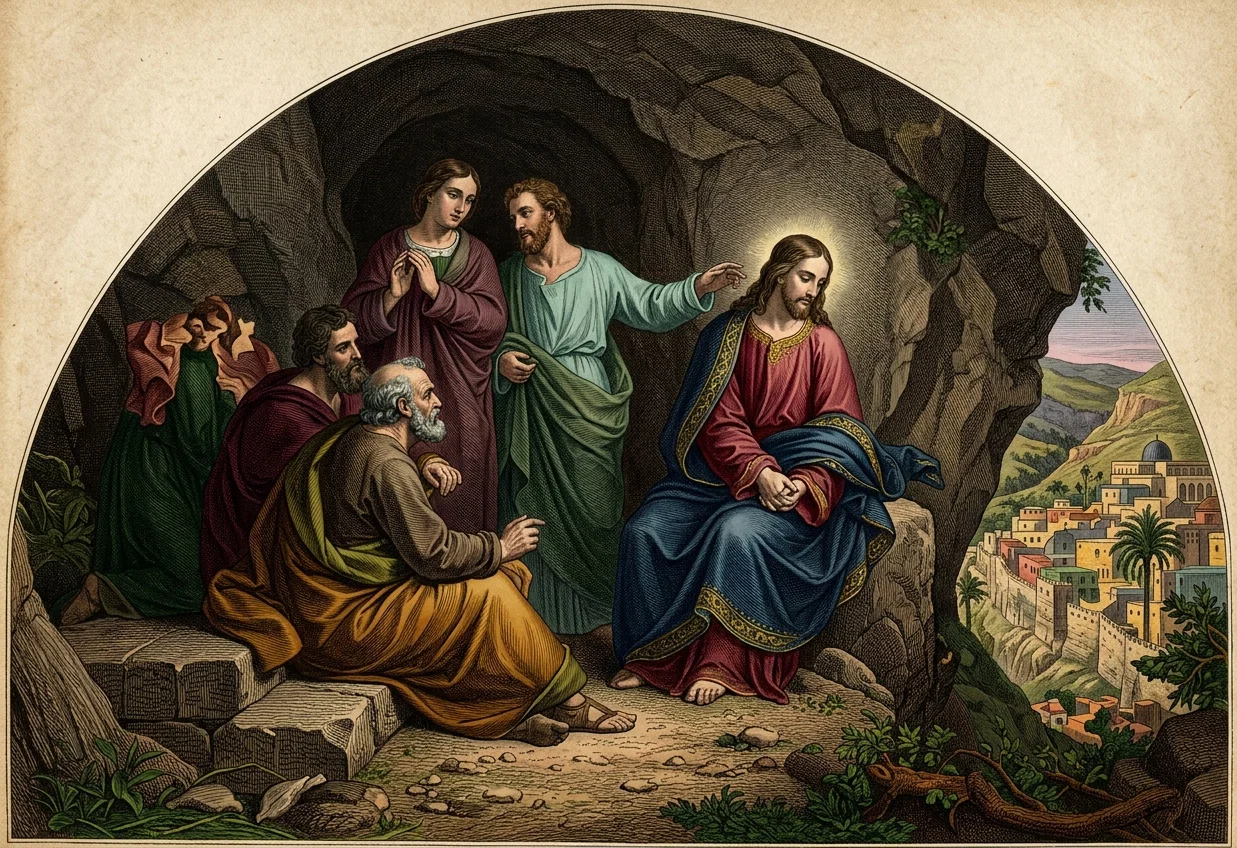
From its sacred summit Jesus foretold the fate of Jerusalem.
Who does not love, if not literally to dwell on the mountaintops, to contemplate the grand and beautiful lessons taught by their lofty heights, reared above rock-ribbed sides and massive foundations?
The Lord, from time to time in the work for His children on the earth, has chosen such sublime sites for His manifestations of grandeur, truth, and love; and it is our purpose in this article to notice some of these eminences which have, in addition to their natural attractions, an historic and sacred interest, because of these associations clustering around them.
See Ararat, standing nearly 18,000 feet high, as a boundary stone between three empires, still called Noah’s mountain.
There disembarked that wonderful company, the saved of the Lord, after that memorable voyage from one world to another, from the world that then was to the world that now is. 2 Peter 3:6, 7. What a train issues forth, as the Captain of their salvation opens the door which He Himself had shut—only eight human souls, followed by birds and beasts of every description, clean and unclean, the former by sevens and the latter by twos. The same Master will cause our bark to ride safely every destructive wave if we but let Him guide the helm.
Mount Moriah
From Ararat let us go to Mount Moriah. At its name what a flood of memories surge upon us! We think of the test of faithful Abraham, to whom the Lord said, “Take now thy son,” and lest he should mistake which son was meant, he specified, “thine only son, whom thou lovest, and get thee into the land of Moriah; and offer him there for a burnt-offering.” Abraham promptly set out with Isaac and two of his young men, doubtless quietly withdrawing without making a full explanation of his mission to Sarah, whose mother-love might have made it very difficult, if, indeed, not impossible, for him to carry out his purpose of yielding implicit obedience to, and faith in, the divine command. That was certainly a solemn journey, if not a sorrowful one, but Abraham, who “staggered
not at the promise of God through unbelief,” must have had a grand experience along the way, recalling the precious promises of the Lord, and, no doubt, instilling into Isaac’s mind and heart valuable lessons of faith and love. As they near the appointed place even the naive query of Isaac does not weaken the father’s purpose. “My father, . . . behold the fire and the wood: but where is the lamb for the burnt-offering?” The answer was, “My son, God will provide Himself a lamb for a burnt-offering.” This is what Moriah means—provided by Jehovah. How could Abraham go so far as to bind that
beloved son, place him on the altar, and raise the knife to slay him!—Because he knew Isaac was to live and become the father of many nations, according to God’s immutable word, and he accounted Him able to raise him up, even from the dead, if need be, that His promise might be fulfilled.
On the same mountain the temple was afterwards built, the pride and joy of the Jewish nation. In its holy precincts the Saviour walked and taught, and from its courts, grieved to see its profanation by selfish, mercenary money-changers, He miraculously expelled those who had made His house a den of thieves. But we must not linger here too long.
Mount Sinai
Let us now take a view of Sinai’s sacred heights, where were enacted the sublimest scenes recorded on the pages of Holy Writ, and no sublimer description can be given than is found therein. “The Lord came from Sinai. . . . He came with ten thousands of saints: from His right hand went a fiery
law for them.” Deut. 33:2. “And it came to pass on the third day in the morning, that there were thunders and lightnings, and a thick cloud upon the mount, and the voice of the trumpet exceeding loud; so that all the people that was in the camp trembled.” “The mount was altogether on a smoke, because the Lord descended upon it in fire.” Do you think, dear reader, if you and I could have heard the law of God uttered with His own mighty voice amidst circumstances of such awful grandeur, we could ever esteem it lightly? On that occasion there was erected the grandest cathedral ever seen by mortal eyes, if, indeed, its walls and dome composed of hosts of shining angels were discerned. Thus and here was given the FIRST sermon on the mount.
Coming down nearly fifteen centuries later, the sermon recorded in Matthew 5, 6, and 7 was given on another mount and uttered by the selfsame voice. Did He retract anything He had said in the previous sermon? Did His words nullify any portion of that law? Listen: “Think not that I am come to destroy the law, or the prophets; I am not come to destroy but to fulfil. For verily I say unto you, Till heaven and earth pass, one jot or one tittle shall in nowise pass from the law, till all be fulfilled.” Matt. 5:17, 18. O, the gracious words that fell from His lips on this occasion!
Read, meditate, and feed upon them at your leisure.
We must leave for the present the precious precepts enunciated from this Mount of Blessing, and go to another, made sacred by the Saviour’s transfiguration. He took with Him that trio who usually accompanied Him on special occasions, and there they saw another trinity, Jesus, Moses, and Elias. The face of Jesus shone as the sun, and His raiment was of a dazzling whiteness. Moses and Elias came to talk with Him of His passion. Luke 9:31. Who more fitting to come on such a mission could be found in heaven? Methinks I can hear them saying the one to the other, “It means everything to us whether the Son of Man successfully carries out the plan of redemption. Let us go down and encourage Him.”
Mount of Olives
There is Olivet. Let us gaze for a moment on this memorable eminence. Will it not be with strong feelings of joy and sadness mingled4From its hallowed summit Jesus foretold the fate of Jerusalem, and doom of apostasy. On its slope lies Gethsemane—that garden where Jesus was wont to go and pray; and how it pains the heart to recall that last—prayer-meeting, I was going to say,—but, alas, Jesus prayed alone! Those who should have watched, and mingled their strong cries and tears with His, were overcome with sleep.
“’Tis midnight; and on Olives’ brow
The star is dimmed that lately shone;
’Tis midnight; in the garden now,
The suffering Saviour prays alone.
“’Tis midnight; and from all removed,
The Saviour wrestles lone with fears;
E’en that disciple whom He loved
Heeds not his Master’s grief and tears.
“’Tis midnight; and for others’ guilt
The Man of sorrow weeps in blood;
Yet He who hath in anguish knelt,
Is not forsaken by His God.
“’Tis midnight; and from other plains
Is borne the song that angels know;
Unheard by mortals are the strains
That sweetly soothe the Saviour’s wo.”
This fearful struggle ended, we see Him on Mount Calvary—the spotless Lamb of God, a perfect sacrifice, acceptable, well-pleasing to the Father.
Forty days later we see Him again on the Mount of Olives with His happy disciples. He talks with them, and while He is speaking His feet leave the earth. They see Him rise higher and higher. With hands uplifted, He pronounces a parting blessing. What does He say? “Lo, I am with you alway, even unto the end of the world.” That promise reaches down to us in this last generation. Not with mourning and lamentations, but with great joy did His disciples return unto Jerusalem. So may we rejoice with joy unspeakable, for that “same Jesus . . . shall so come in like manner as ye have seen Him go into heaven.” He will come as declared in 1 Thess. 4:16, 17, and take His saints to the mansions prepared for them. John 14:1-3. Here they spend a millennium of thrilling interest and immortal joys with their Lord and Saviour.
In the midst of all these are they forever carried away and beyond all these earth scenes the memory of which is still dear to our hearts? Have they no further interest in Ararat, Moriah, Sinai, or Olivet? Let us see.
In Zech. 14:4, we read that the Lord’s “feet shall stand in that day upon the Mount of Olives, which is before Jerusalem on the east, and the Mount of Olives shall cleave in the midst thereof toward the east and toward the west, and there shall be a very great valley.” With the eye of faith we can see those sacred feet which parted from the earth at this very spot, touch Olives’ hallowed brow, and it melts away, so to speak, into a vast, elevated plain, in which are merged all these mountains, the Mount of Beatitudes, the Mount of Transfiguration, Mount Moriah, and even Sinai and Ararat; for on this plain is to rest the New Jerusalem, a city 375 miles square with an extension of the sea of glass, making an expanse of holy ground outside the city sufficient for the assembling of all the redeemed hosts.
This is the city that is to come down from God out of heaven to be the queen city of Christ’s new-earth kingdom. It will rest on a plateau high above the beautiful hills of the new earth seen from a great distance, a dazzling object of inspiration and joy to the nations of the saved, dwelling in all portions of the earth. As saith the Lord, “Beautiful for situation, the joy of the whole earth, is Mount Zion, . . . the city of the great King.” Ps. 48:2.
O, reader, shall we not walk in the light of God’s truth here? Then in that day we shall “walk in the light of the Lord” and bask in the sunshine of His love throughout the ceaseless ages of eternity.