Early in June the Imperial Press Conference convened in London. The delegates were representative men of the press from all parts of the British Empire. On Saturday evening, June 5, the “Daily Press” of the United Kingdom gave a banquet to the delegates from over sea. There were over one thousand representatives of the newspapers of the Empire in attendance. Lord Rosebery, ex-premier, was the orator of the evening. In opening his address he expressed an appreciation of the power of the press by likening it to the cave of King Aeolus of Virgil’s Aeneid. This cave was supposed to embrace all the winds of heaven, and over them King Aeolus held sway. At a touch or sign from him these gales swept out of the cavern—ready either as hurricanes to spread wreck and devastation all over the world, or else, in the form of balmy breezes, to bring blessing and health wherever they might attain.
Lord Rosebery did not show very clearly who was King Aeolus in the present instance, but he did make clear that the press and the influence of the press represented the cave and the winds. And he expressed the belief that this press influence would be exerted for the benefit of the Empire. He spent nearly one half of the time of his address, and all the flowers of his eloquence,—he is one of the best speakers in the Empire,—in invoking the winds to blow for Imperial defense.
Under this division of his address he said (Boldface ours):
Naval Defense
“Now you will forgive me if I come next and at once to what is by far the most vital topic that you will have to discuss at this Conference or which concerns our Empire as a whole—I mean that of Imperial defense. (Cheers.) I do not know that in some ways I have ever seen a condition of things in Europe so remarkable, so peaceful, and in some respects so ominous as the condition which exists at this moment. There is a hush in Europe, a hush in which you may almost hear a leaf fall to the ground. There is an absolute absence of any questions which ordinarily lead to war. One of the great empires which is sometimes supposed to menace peace is entirely engrossed with its own internal affairs. Another great Eastern empire which furnished a perpetual problem to statesmen has taken a new lease of life and youth in searching for constitutional peace and reform.”
Significant War Preparations
“All forebodes peace; and yet at the same time, combined with this total absence of all questions of friction, there never was in the history of the world so threatening and so overpowering a preparation for war. That is a sign which I confess I regard as most ominous. For forty years it has been a platitude to say that Europe is an armed camp, and for forty years it has been true that all the nations have been facing each other armed to the teeth, and that has been in some respects a guarantee of peace. Now, what do we see? Without any tangible reason we see the nations preparing new armaments. They can not arm any more men on land, so they have to seek new armaments upon the sea, piling up these enormous preparations as if for some great Armageddon—and that in the time of profoundest peace. We live in the midst of what I think was called by Petrarch tacens bellum—a silent warfare, in which not a drop of blood is shed in anger, but in which, however, the last drop is extracted from the living body by the lancets of the European statesmen. There are features in this general preparation for war which must cause special anxiety to the friends of Great Britain and the British Empire, but I will not dwell upon these. I will only ask you who have come to this country to compare carefully the armaments of Europe with our preparations to meet them, and give your impressions to the Empire in return. (Cheers.) I myself feel confident in the resolution and power of this country to meet any reasonable conjunction of forces. But when I see this bursting out of navies everywhere, when I see one country alone asking for twenty-five millions ($125,000,000) of extra taxation for warlike preparation, when I see the absolutely unprecedented sacrifices which are asked from us on the same ground, I do begin to feel uneasy at the outcome of it all, and wonder where it will stop, or if it is nearly going to bring back Europe into a state of barbarism (hear, hear), or whether it will cause a catastrophe in which the working men of the world will say, We will have no more of this madness, this foolery which is grinding us to powder.” (Cheers.)
The Message
“We can and we will build Dreadnoughts—or whatever the newest type of ship may be (loud cheers)—as long as we have a shilling to spend on them or a man to put into them. (Loud cheers.) All that we can and will do; but I am not sure that even that will be enough; and I think it may be your duty to take back to your young dominions across the seas this message and this impression—that some personal duty and responsibility for national defense rests on every man and citizen. (Loud and prolonged cheers.) Yes, take that message back with you. Tell your people—if they can believe it—the deplorable way in which Europe is lapsing into militarism and the pressure which is upon this little island to defend its liberties—and yours.”
At the meeting of the Conference on Tuesday Mr. McKenna, First Lord of the Admiralty, spoke on the need of the navy in keeping the seas open for the English Empire. The Empire was a sort of Imperial Venice, the different parts of her dominions being separated by the seas, and so long as the seas were kept open, all the colonies, separated by thousands of miles as they are, remain contiguous. To keep these seas open requires a navy that gives the supremacy of the seas.
Sir Edward Grey, Secretary of Foreign Affairs, followed with a short address, and stated that he indorsed every word Lord Rosebery had said on the gravity of the European situation.
Arthur Balfour, leader of the opposition in the House of Commons, said the MARITIME PREDOMINANCE “was the very essence of our being.” In speaking on the matter of the fate of the Empire depending upon fleet predominance, he declared that the superiority must be shown in home waters. The German Ocean, the Channel, possibly the Mediterranean—these were the theaters on which, if there was to be an Armageddon, the Armageddon would take place.
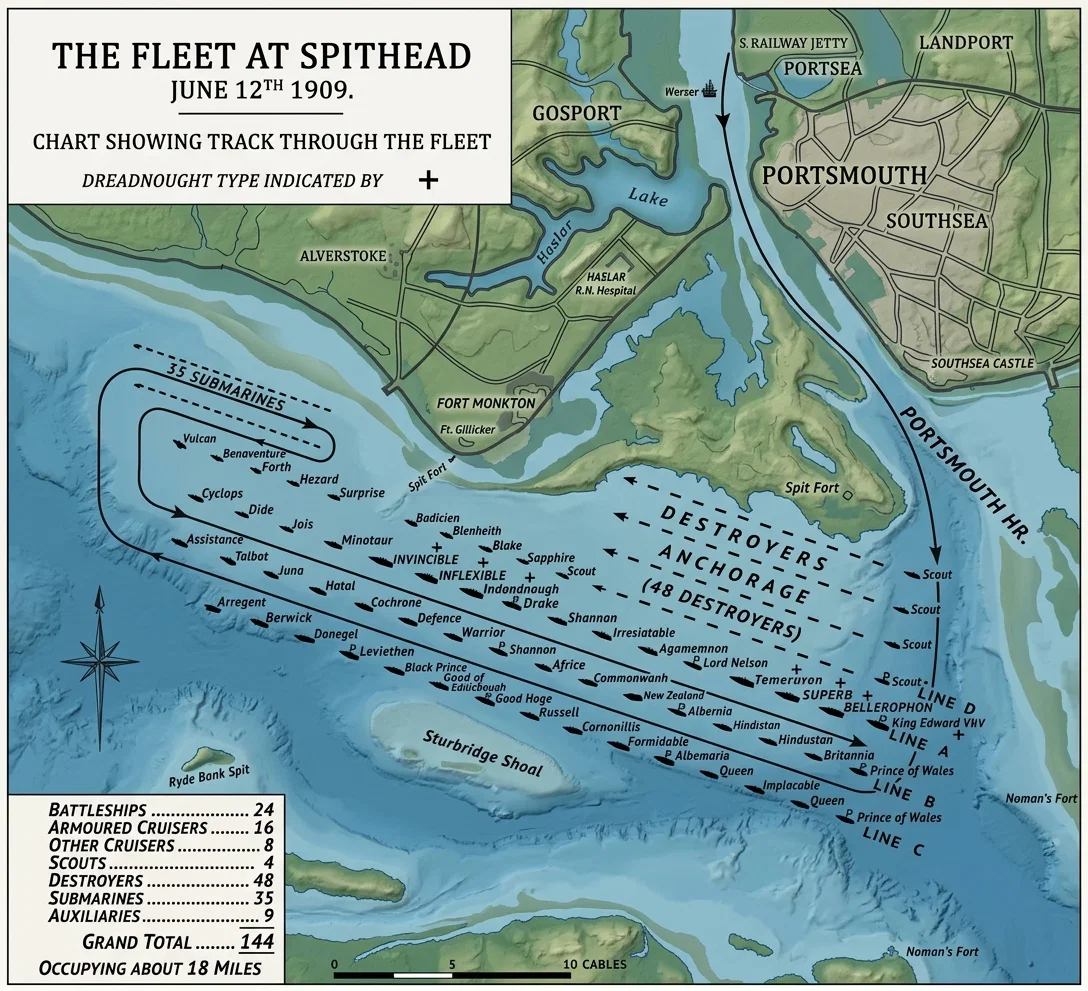
The delegates were taken by the admiralty on an excursion to Portsmouth to inspect the fleet, the most powerful naval force ever brought together in the history of the world. The ships of the Home Squadron numbered 144, the total cost of which was nearly $400,000,000. If placed end to end the vessels would have formed a double line eighteen miles long. R.