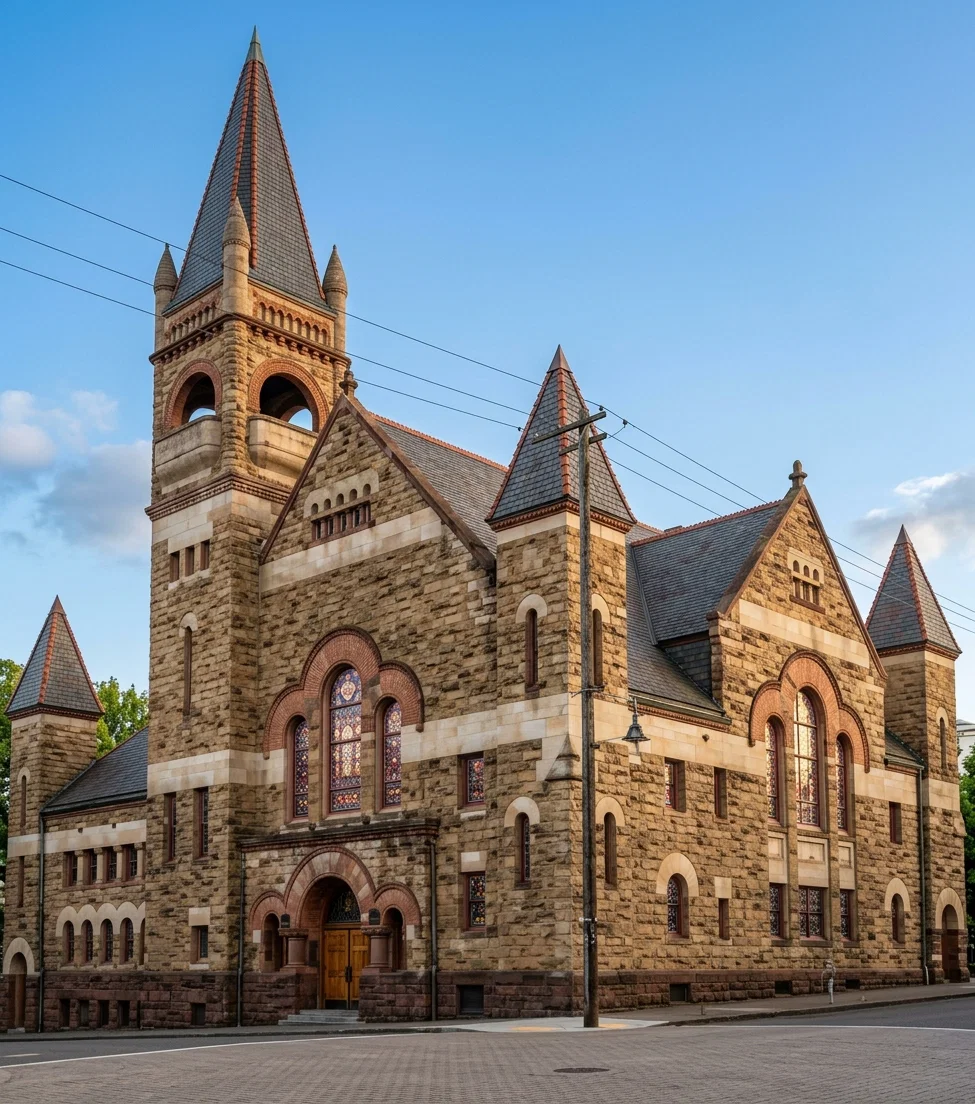
The National Convention of Northern Baptists convened in Portland, Ore., June 24, with thirty-six states represented. There were about thirteen hundred delegates in attendance; the largest number coming from any one state being from Washington, that state having sent a grand total of 208. Oregon with 192, and California with 162, were respectively second and third in the number of delegates represented. The meetings were held in the White Temple at the corner of Twelfth and Taylor Streets.
Missionary Endeavor
Thursday afternoon the Woman’s American Baptist Home Mission Society held its meeting, which was really a preliminary to the regular meetings of the Convention. More than 5,000 roses were used by the decoration committee in adorning the church. In this first meeting the statement was made that in parts of Oregon persons grew to manhood before hearing a Gospel sermon; that one third of the Baptists of Oregon were members of the Portland churches, and that only five per cent of the population of the state were foreigners. It was decided to ask the Home Mission Society to become a cooperating organization with the Northern Baptist Convention, and that $200,000 be asked for this year for the work of the organization. At a later date in the Convention this society was made an integral part of the central organization.
Organization
At the opening meeting of the Convention, President Judson, who, by the way, is also president of Chicago University, stated that the Convention was only formally inaugurated last year at Oklahoma, and that it was the first time in the history of the church as an organization that any scheme of cooperation has existed for the carrying out of the working plans of the three Baptist societies. As a result of this cooperating movement the past year there was, among other things, $200,000 more in contributions than in any previous year, and all three societies, the Publication Society, the Home Mission Society, and the Missionary Union, started the fiscal year free from debt.
R. E. Chambers in his address, Saturday, said that ten years ago the China Baptist Publication Society began its work. It was undertaken by a small handful of earnest men, and to-day had a plant worth $65,000. Many nights last year the four presses ran from twilight to dawn, as well as in the daytime and ten million pages of literature for circulation among Chinese were turned out. By the recent receipt of $1,500 the Society had just begun the publication of a Bible in which baptism is referred to as immersion.
Chapel-Car Work
Tired of a sometimes vain effort to make people go to church, Baptists decided several years ago to make the church go to the people. Now they have six churches on wheels, that are fitted up with organ, hymn-books, pews, and include even a parsonage for the pastor and his wife. They go from one side of the continent to the other, settling down in sage-brush towns, or communities where churches have grown feeble, doing a pioneer or reconstructive work, and this comprises the chapel-car system of the American Baptist Publication Society.
Rev. Mr. Neil, the secretary of this work, said:
“Our chapel-car work is the most spectacular feature of our denomination. We commenced the work seventeen years ago, intending by means of the cars to reach the people in new towns, along the railroads, in mining-camps, and in the shops. We now have six cars in the field. We call them Evangel, Emmanuel, Glad Tidings, Good Will, Herald of Hope, and Messenger of Peace.
“All have justified their names. They have been the means of carrying the Gospel message to thousands of discouraged lives, who otherwise might have died in ignorance of their greater hope. We have stopped the car at the side of a tract where a town was just beginning to build. Our singing service and the sermon attracted the people. We stayed long enough to get them in the church-going habit and left them organizing a new church.
“We have been treated in a wonderful way by the railroad companies, too. During the seventeen years, transportation has never cost us one penny. Our cars have been cared for and kept clean, supplied with fuel and ice-water. Every courtesy possible has been shown us by the railroad magnates. It has given us great encouragement.
“At the present time we are the only Protestant denomination that has attempted chapel-car work. The Catholics are operating one car down in the mountains of Kentucky.”
The Publication Society also operates what are known as Gospel wagons, that travel into the hills and along lonely roads where the whistle of a locomotive is never heard.
Tithing System Considered
One subject of live discussion was the tithing system. But fear of ecclesiasticism (or was it something else?) held the Convention from accepting God’s plan, and the following resolution was adopted:
“That the churches be requested to lead the largest possible number of their members to form the habit of laying aside a definite proportion of their income for distinctively Christian work, and that ways and means be provided by the committee for carrying out this recommendation.”
One of the most important features of the Convention was the adoption of the provision for government proposed by Judge Clinch, a decidedly new departure in Baptist procedure. It takes away from the three great Baptist missionary organizations—the American Baptist Publication Society, the American Baptist Missionary Union, and the American Baptist Home Mission Society—the right to nominate their own boards of managers, as has heretofore been done, but does give each organization mentioned the right to select its own officers from the names nominated by the Convention.
The report makes it possible to incorporate the Northern Baptist Convention under the laws of some states yet to be specified. The names of the missionary organizations are changed to read “society” in each instance, making it more apparent that they are auxiliary members of the central body.
A significant expression relating to these organizations and the perpetuation reads:
“The existence of the American Baptist Home Mission Society, of the American Baptist Missionary Union, and of the American Baptist Publication Society must be preserved. The trusts committed to these societies may be imperiled if the societies themselves are not perpetuated. Nothing must be done to imperil these trusts or that in any aspect may be considered a disregard of the sacred obligations assumed by, as trustees, the funds constituting the trusts.”
Central Body Established
This action makes the Northern Baptist Convention the great central body of the whole denomination as it is represented in thirty-six states, including the District of Columbia.
The Convention hereafter will have supervisory and regulating power over what now becomes Sub-organizations. It will have charge of expenditures, becoming the receptacle for all contributions and apportioning sums for the support of various departments of the work.
Recognition for Women
It gives women prominent place in the work11. An executive board to control the acts of the Convention will consist of seventy-five members, not more than three fifths of whom may be ministers, not less than one fifth women, the president, secretary, two vice-presidents, the presidents ex officio of the Woman’s Baptist Foreign Missionary Society and the Woman’s Baptist Foreign Missionary Society of the West.
Officers Elected
The Convention placed Harry Pratt Judson, president of the University of Chicago, at its head for the ensuing year. Corvin S. Shank, of Seattle; George Edwin Horr, D.D., of Newtown Center, Mass.; and Frank Harvey Field, New York, were elected vice-presidents; George W. Coleman, Boston, Mass.; Rev. W. C. Bitting, D.D., St. Louis, and William E. Lincoln, Pittsburg, were elected respectively recording secretary, corresponding secretary, and treasurer.
The Convention decided to raise one million dollars for the coming year for all departments. The meeting-place decided upon for next year was the city of Chicago, some time in the month of May.
R.
Rev. A. C. Petty, of California, brought the warning before the Convention. With tears coursing down his cheeks he related the indifference with which all evangelizing efforts have been met. “Something must be done and done now,” he asserted. Both speakers were of the opinion that the situation more than warrants a campaign made by united Protestants to save wicked San Francisco.
The Rich and the Poor
The conditions of the poor and the inhuman grasping of the rich were commented upon by Rev. J. H. Franklin, of Colorado, who styled Patten, wheat king and stock operator, a parasite:
“Mothers are groaning under burdens they can not bear,” he said, “and orphans and widows are starving at empty cupboards, while granaries burst because a master of finance—so-called—a parasite in truth—has cornered the wheat market.
“A Christian nation is building dreadnoughts in mortal terror of another Christian nation. Christ said, ‘Put up the sword.’ We are not without danger yet of Christians seeing the spilling of human blood in such fashion as this old world has never known. Has God’s will been done?”