The Turkish Mission

3%

Pacific Press Publishing Association · Mountain View, California · Aug 18, 1909

FromSigns of the Times, Vol. 36, No. 32.

Read the full edition

The Turkish Mission

By C. D. AcMoody
[One of the good reports made at the recent World's Conference of Seventh-day Adventists at Washington, D. C.]
THE Turkish Mission comprises Turkey in Europe, and that part of Turkey in Asia lying north of the Bay of Alexandretta, the country known as Asia Minor and Armenia.

Past History

In presenting a report of the Turkish Mission for the past four years, it may be well to briefly review the way in which the truth entered the Turkish Empire. It first entered Constantinople about twenty years ago. An Armenian brother who had accepted the message in America, returned to his own country to let his light shine, and to disseminate the principles which he had learned to love. In the course of a few months Elder Z. G. Baharian, who at the time was a student in the Aintab Protestant College, became interested in the principles of the third angel's message through literature sent him from Constantinople. After his graduation he came to Constantinople, and studied the truth with this Armenian brother. He was then sent to Basel, where he remained several months studying the principles of Seventh-day Adventists, returning to Turkey as a worker in 1892. His work was confined for several years to the Asiatic coast in the vicinity of Constantinople, where several companies of Sabbath-keepers were raised up.
Some workers were sent into the central part of Turkey in 1904, and Brother Baharian was exiled from Constantinople to the country of his birth, at Aintab. Many of those who hear this report will remember reading an account of the imprisonment of Elder Baharian which followed his banishment, when, for several months, it was thought that he must face the penalty meted out only to anarchists and traitors, which in Turkey means banishment for life or capital punishment; but God delivered His servant.
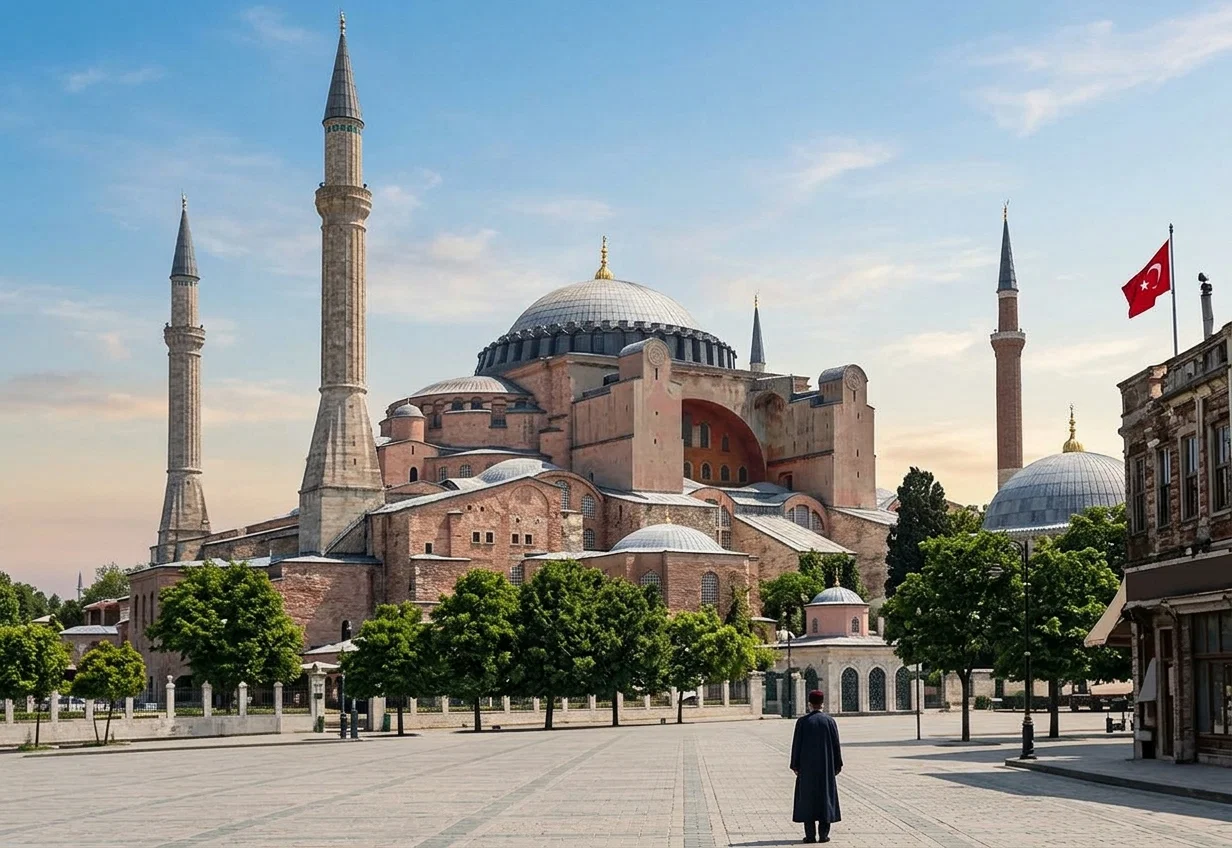
Cathedral of St. Sophia, Constantinople
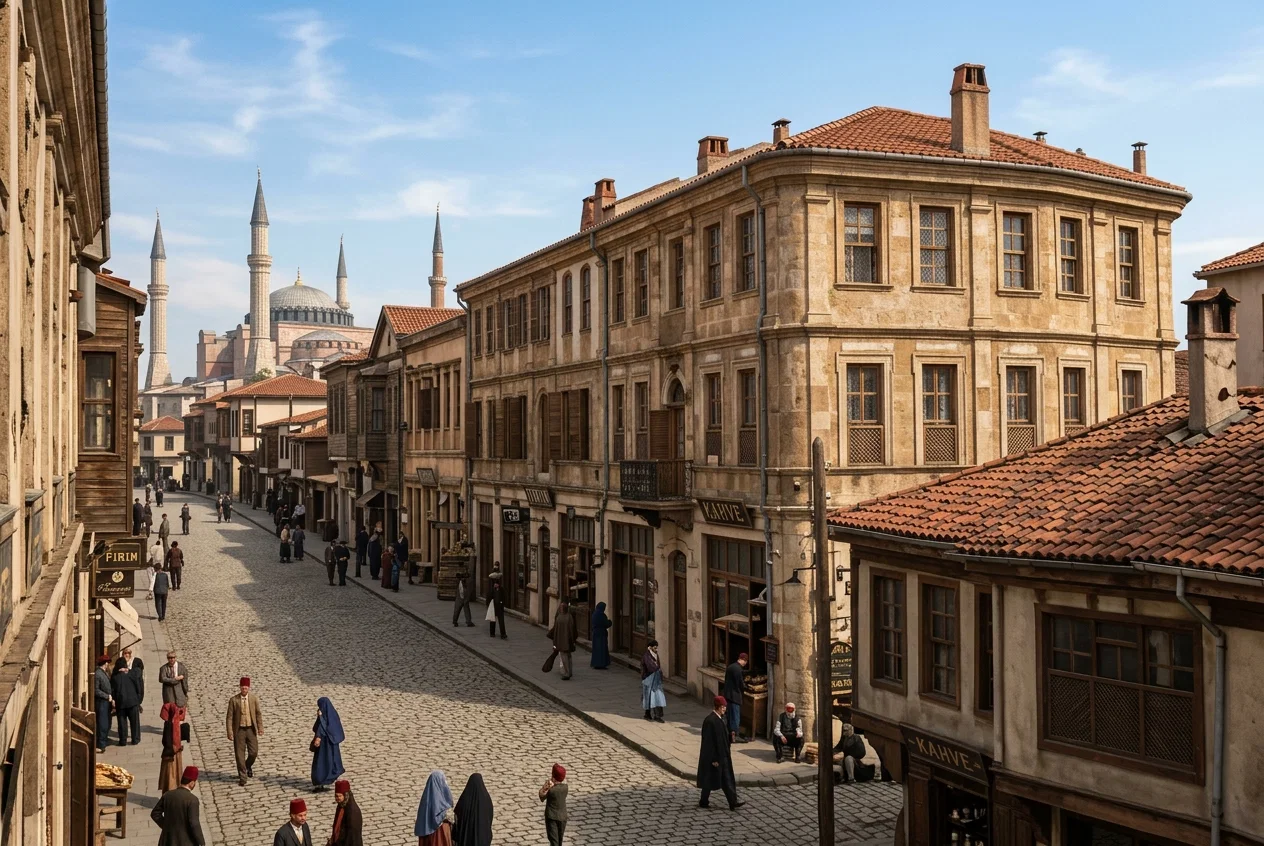
A street in Monastir, Turkey, where the reform movement broke out
The late Doctor George went to Turkey in 1903, and began immediately to prepare himself for work among the people of Constantinople in medical lines. His task was greater than that of the ordinary foreign missionary, as it was necessary for him first to acquire the French language in order that he might pass the medical examination in Turkey. He was successful in passing his examinations, and then devoted his attention to acquiring the Turkish language. He started treatment-rooms in Constantinople after visiting among the churches, and much patient effort in preparing a suitable location. Having thus started his work, he was afflicted with tuberculosis, and was forced to leave the field in 1906, two weeks before my arrival in Constantinople. He went to Switzerland for his health, and later to Germany, where he died in February, 1907.
Too much could not be said in paying high tribute to the character and work of this missionary, who laid down his life in the interests of the third angel's message in the land of the sultan. Tho I was not privileged to meet him personally, I found that he had left behind him, through his earnest work, that which was lasting, and that which was to stand as an encouragement to those who would follow him. In everything he did, persevering effort and painstaking care were shown. He clung to his work too long for the good of his health. When he left Constantinople, he was confined to his bed. His death was indeed a severe blow to such a weak mission field as Turkey. The burden which rested upon all of us as the result of this experience, seemed heavy indeed. The treatment-rooms had to be closed up, and the furniture stored and finally sold, because no one could be found to take his place. This is an appeal to all who love the message throughout the world, and especially to those assembled at this Conference, to place some one in the Turkish Empire to take up the work of him who fell at his post.

Work During the Past Four Years

The chief matter of interest in the years of 1905-6 relates to the establishment of the treatment-rooms in Constantinople, which has already been referred to. During these years, Elder Baharian was not allowed to travel, and was confined almost entirely to the city of Aintab. Here he has not been able to do as much as has been desired, because of the bitter antagonism of the Protestants against his work. Besides, there have been obstacles to meet in Turkey which are met in other field. These I will speak of later.
I arrived in Constantinople, Dec. 3, 1906. My efforts were expended during the following winter in traveling among the churches and companies in the vicinity of Constantinople, as they had not been visited by any minister, either native or foreign, for some time. The summer of 1907 I spent most of my time in the city of Constantinople, traveling again among the churches in the fall.
In the middle of May, 1908, Elder R. S. Greaves and wife arrived in Smyrna to take up work among the Greeks. Smyrna is the second city in size in the Turkish Empire, and is composed of Greeks, who are Turkish subjects. Brother and Sister Greaves have been diligently working upon the Greek language, and hope so to master it as to be able to work to advantage on the west coast of Asia Minor, and in the islands of the Greek Sea.
Prior to July 25, 1908, and especially since 1903-4, our native workers, wherever located in Turkey, have labored under such tremendous disadvantages as in many cases to render their work quite fruitless, as far as securing converts to the faith is concerned. But since the declaration of the Turkish constitution in July, such liberty has prevailed in the Turkish Empire as has never before been known. Perfect freedom of speech and press was granted, and that for which we had prayed many years, and which we had endeavored to secure by various means for a long time, was granted to us in a single day.

Our First General Meeting

A Levant Union general meeting had been planned for, but it had not been decided where it should be held. We were desirous that some of the native workers attend this meeting. The liberty came in time so that the general meeting could be held in Turkish territory. Accordingly, the workers came together at Beirut, Syria, the last week in September, and three of our native workers from the Turkish Mission were able to attend this meeting. For the first time in the history of our work in Turkey we had liberty, and were free to meet together to sing praises to God, and counsel together regarding His work, knowing that we were not infringing upon the tyrannical laws of the sultan. This meeting was a great help to the whole Levant Union, as workers were gathered together from all the various mission fields. Especially was it a great help to the Turkish Mission.
Following this meeting, Elder Baharian and I made a tour throughout central Turkey, visiting the isolated companies of Sabbath-keepers, some of whom had never seen a Seventh-day Adventist minister. Few can appreciate what this meant to the native constituency.God's blessing attended us throughout the trip, most of which was made on horseback, as there are very few roads in that part of Turkey. During the trip, we were ten days in the carriage, and eleven days in the saddle. We visited ten churches and companies.
Upon arrival at Constantinople, the middle of December, I found it necessary, on account of my health, to make immediate plans to come to America, and I accordingly left Turkey, Jan. 10, 1909.

Statistics

I will now give a brief statistical statement of the membership, workers, etc., of this field. At the close of 1908, the membership shows 233 members, with five churches and ten companies; number baptized during the year, eighteen; total workers, ten; total money received, $621.30.
And now when you consider that there are many families who live on from fifty to seventy-five dollars a year, and that out of this must come their living expenses, you can readily see that the tithe must be very small.
Of the workers reported for 1908, there are four ordained ministers, two native workers, two licentiates, one nurse, and one Bible worker.

Freedom for Turkey

Prior to the granting of the constitution, the Turkish field was in many respects the most difficult in the world in which to work. Our brethren were not recognized by the government officials, because our church is not an established church according to Turkish law. If a man be not a church-member of some established church which is recognized by the Sublime Porte, he is not a protected subject under Moslem law. It would take a great deal of space to enter into details to show the embarrassing situation under which our work has been conducted. No meetings could legally be held anywhere. None of our people could become legally married without being baptized according to the rites of the Gregorian or Greek Orthodox churches. Neither could our people secure permission to travel. Our native workers were especially watched, and were not able to do any effectual work for weeks at a time. We sought God earnestly for a door to be opened whereby we might be able publicly to spread the Gospel; and just while we were considering some plan by which we might accomplish this, the hand of God, which rules over the affairs of nations, was manifested in causing to come to pass a complete change in the Turkish Empire. This change will be recorded in history as a miracle in the doings of nations, and we praise God that since July we have had a free hand in Turkey. The problem that now presents itself is not, How shall we secure the right to labor? but How shall we fill the great open door that we now face?

Facing the Future

As distinct and separate from each other are the different languages of Turkey, as the English language is separate from any one of them. There are some nineteen or twenty distinct languages spoken in the empire, besides the various dialects of these languages.
The acquiring of one of these languages is practically of no assistance in acquiring a second. We need workers to master these languages, and to enter into the field to reach the various people with the message.
Whether you consider it politically, religiously, or prophetically, there is no country in the world to-day that occupies a position of so unique importance as does the Turkish Empire.
No longer can we maintain the plea that Turkey is so largely a closed field that it will not pay to spend our energies upon it until the door is opened, for now the door is opened. O, how important that we should be ready to enter the regions beyond at these critical moments!