Our London Letter

3%

Pacific Press Publishing Association · Mountain View, California · Sep 15, 1909

FromSigns of the Times, Vol. 36, No. 36.

Read the full edition

Our London Letter

(From Our Own Correspondent, Editor of “Present Truth”)
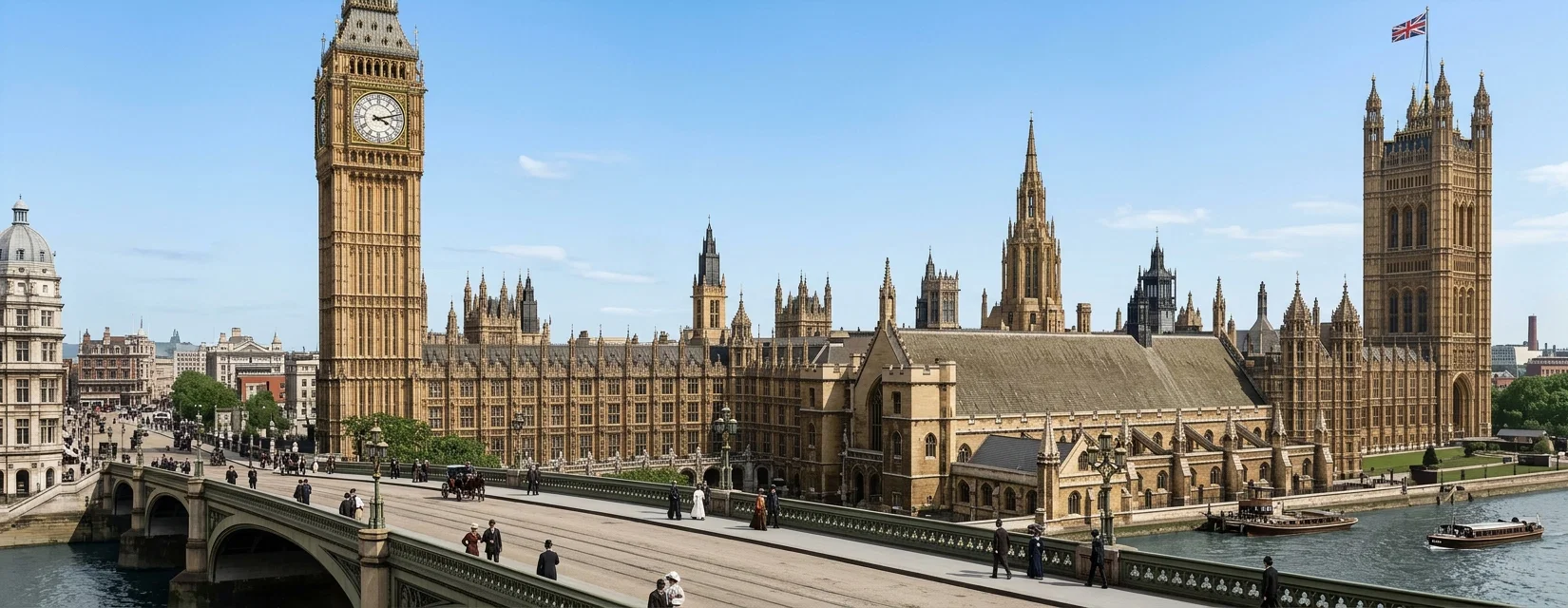
BRITISH HOUSES OF PARLIAMENT
The past few weeks have been interesting ones in this country. Many important conventions have been held, such, for instance, as the International Congress on Alcohol, at which it was made abundantly evident that indulgence in that intoxicant means a lowering of vital forces, both for the individual and for the nation. Important plans also are being laid for the improvement of our educational system, and for the wider extension of its benefits to all classes of the community. But the paramount interest, unfortunately, has been the military one. In a time when science is bringing new and valuable boons to civilization, and visions of advancement open before us in every direction, the spirit of war perverts almost every blessing and fills the nations with suspicion and hatred in the place of amity and cooperation. Public opinion is gradually settling down to an inevitable competition with Germany for the first place amongst the great naval powers. It is a very unfortunate situation, and one extremely likely to precipitate a conflict over the slightest occasion, when each of two nations resigns itself to the settled conviction that the other is its enemy, and only awaits a favorable moment to strike a deadly blow. Such an attitude must necessarily embitter the relations of the two powers in question, and greatly heighten the jealousy and suspicion with which each watches the other. A sinister meaning is read into every move, innocent as its purpose may be.

The Great Military Demonstrations

It was doubtless with a view to increasing the confidence of the people of England, and quickening their ardor to maintain their naval position, that the recent unparalleled demonstration of fighting vessels was made at the mouth of the Thames. One hundred and forty-four of these destructive monsters of every class, ranging from the “Dreadnought” to the submarine,—twenty miles of iron-clads,—were brought together off Southend. The fleet was manned by 40,000 officers and men, and its total tonnage was 771,200. Four hundred and fifty million dollars of the wealth of England had been expended on the construction of this mighty Armada, the most powerful collection of war-ships our world has ever seen. Yet the pride of those who watched these massive engines of destruction was tempered with the thought that the strength they embodied was only a fleeting one. Xerxes, reviewing the mighty forces that he had gathered together for the invasion of Greece, is said to have wept at the thought that within a hundred years the last vestige of his magnificent army would have disappeared. Those who watched the naval demonstration in the Thames, had to reflect that at the present rate of progress in the building of war-ships the newest vessels before their eyes would be fit only for the scrap-heap in another ten years. Yet money is being poured out like water to maintain these transitory defenses.
A few months ago the Prime Minister promised that if it should become necessary, he would ask the House of Commons to vote an additional four “Dreadnoughts” beyond the four then asked for. Now it has seemed imperative to the government that the other four war-ships should be put in hand, and Parliament, with hardly a protest, has authorized the laying down of four more “Dreadnoughts,” at a cost for construction and armaments of nearly forty million dollars.

An Evil Way

In asking for these extra ships, Mr. Asquith did not attempt to conceal his dislike for such barren expenditure. He said:
“I don’t believe there is at this present moment a more unproductive or wasteful form of expenditure going on in the world, or one which in the long run is more likely to arrest the course of progress, and, I am sorry to add, to promote bad instead of good feeling among the nations. That is an opinion which I sincerely hold.”
These are striking words, coming from one who occupies the position of Prime Minister. They are a frank admission that no good can come from this enormous expenditure, but only harm. Mr. Asquith sees in the militarism of the age an influence that will be potent to render null and void all the progress that might otherwise be achieved by reason of the rapid development of science and art and the spread of education. If Mr. Asquith is right in his forecast, there is but a gloomy outlook before the nations, for certainly there never was such an intensity of militarism in time of peace as there is to-day.
Commenting on the words of the Prime Minister, the “Daily News” of the next morning said:
“What road are we traveling? It is certainly not the road to peace. It is a horrible result if the outcome of all our science and material prosperity is only to be a continued increase of all the guns, ships, aeroplanes, and men destined for the slaughter of other peoples. There is no doubt that the spirit of international hostility has developed, not among the races themselves, but among the classes that govern them, within the last forty years.”
Lord Roseberry has also called attention to the same ominous feature of our time in language that will bear repeating. In his speech to the Press Conference, he said:
“I do not know that in some ways I have ever seen a condition of things in Europe so remarkable, so peaceful, and in some respects so ominous, as the condition which exists at this present moment. There is a hush in Europe, a hush in which you may almost hear a leaf fall to the ground. All is peace. And yet at the same time, combined with this total absence of conflict, there never was in the history of the world so threatening and overpowering a preparation for war. That is a sign which I confess I regard as ominous. For forty years it has been a platitude to say that Europe is an armed camp. Now, without any tangible reason, we see the nations preparing new armaments. They can not arm any more men on land, so they seek new armaments at sea, piling up these enormous preparations as if for some great Armageddon. . . . I feel uneasy at the outcome of it all, and wonder where it will stop, or if it is going to lead Europe back into a state of barbarism.”

A Bitter and Exhausting Struggle

Germany and the other nations of Europe are finding the struggle for a place in the front rank an exhausting and bitter one. Mr. J. H. Ross, author of “The Development of the European Nations,” declares that in Germany and in Italy the attainment of national unity has not been attended by the blissful results foretold by the promoters of that unity, and he goes on to point out the principal reason for this disappointment:
“After struggling for a generation through a wilderness of plots and punishments, those two peoplesreached the Promised Land, only to find it a parade-ground.
“Chief among the influences that drain away the vital strength from the brain to the muscles of the body politic, we may reckon that portentous growth of armaments, themselves an outcome of the national struggles of the nineteenth century. No strain is so continuous, exacting, and hopeless as this.”
“Viewing the matter broadly, we must admit that the present state of armed truce combines many of the worst evils of war and of an emasculating torpor. It is neither a state of rest which builds up the fabric of humanity nor a time of heroic endeavor such as sometimes mitigates the evils of war. The powers of the race and of the individual are quickened either by healthful repose or by a strenuous struggle on behalf of some great cause. Neither of these conditions has fallen to the lot of the great nations of Europe since 1878.”
“The newly made peoples, after leaping at one bound to manhood, have had to bow the neck to burdens heavy to be borne, and from which they see no other relief than the far-off glimmering hope that the increase of their own load may perchance discourage their adversary and prolong the armed truce. This state of things begets no joy in life, nothing but a feverish resolve to snatch at passing sensations.”
“The individual is crushed by a sense of helplessness as he gazes at the armed millions on all sides of him. To a free man in the constitutional sense of the term, he has entered into a state of military serfdom. There he is but a bondman, toiling to add his few blocks to the colossal pyramid of war, which imposes respect on some enemy away in the desert. From that life there can come no song.”

The Training of Boys

One of the most popular movements in this country at the present time is the formation of companies of “Boy Scouts” in every district. The boys range in age from ten to sixteen, wear a uniform, and spend their leisure time in mimic military maneuvers. The organization has practically covered the whole land, and is leavening the country with a sentiment that is thoroly preparing the way for compulsory military service. The advocates of this are growing noticeably bolder. The House of Lords lately spent two days in debating a proposal for the introduction of conscription, which shows that the time has quite gone by when the idea of compulsory military service was regarded as absolutely foreign to English conceptions of the rights of free men.
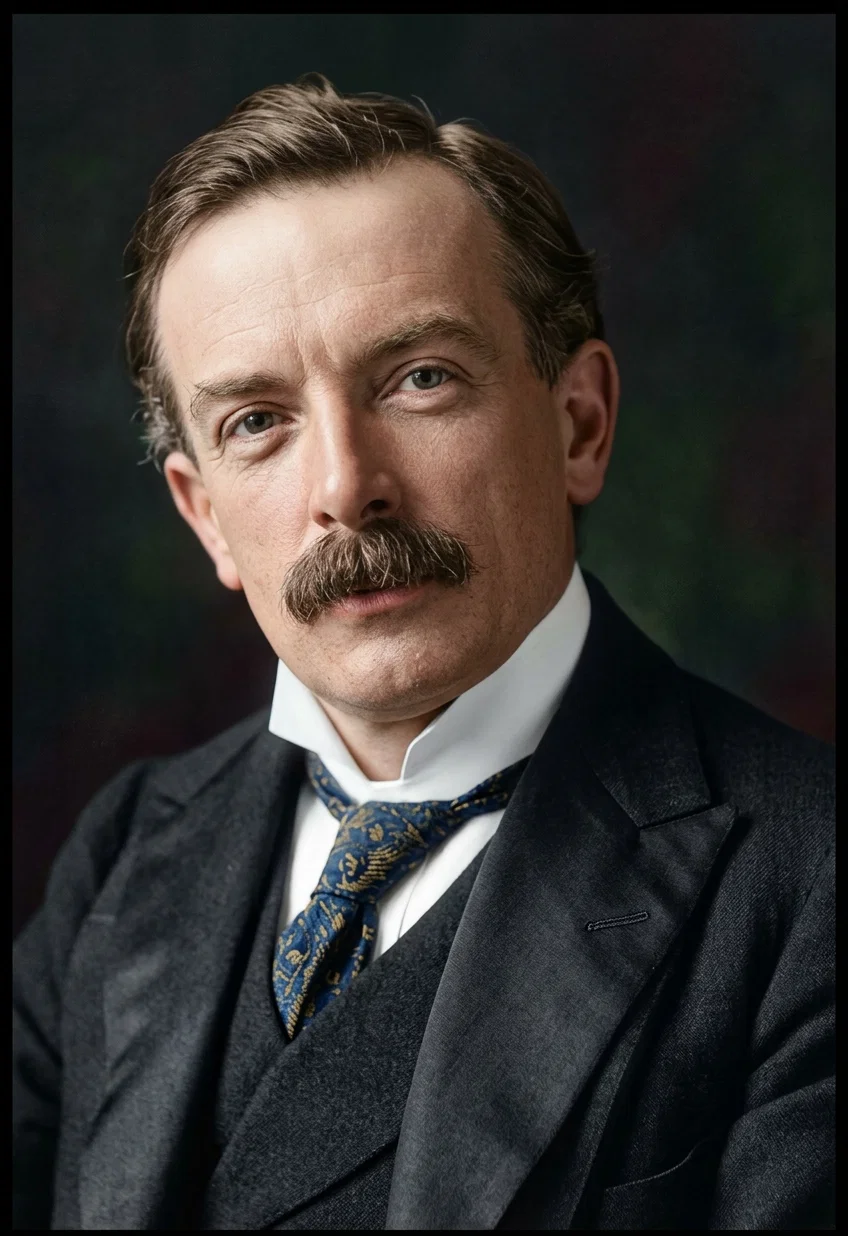
Rt. Hon. David Lloyd-George, Chancellor of the Exchequer.

Additional Fields for Taxation

The heavy increase of expenditure on our navy, with the certainty of still further increase in the future, has made it necessary to find additional sources of revenue. It is true that Old Age Pensions and other excellent reforms have meant an increase of expenditure, but the military burden is by far the heaviest. The Chancellor of the Exchequer, Mr. Lloyd-George, is proposing to find a portion of the required annual income in quarters that have been but lightly tapped by past budgets, and over this policy a great conflict is now raging. Mr. Lloyd-George is planning to place a large additional duty on tobacco and spirits, to increase the tax on unearned incomes, and to place a super-tax of sixpence in the pound on all incomes that exceed £5,000. The features of the budget which are arousing the greatest opposition, however, are the proposals to levy a small tax on the annual value of all land that is not agricultural. This tax would, of course, lead the owners to assess the value of such land at the lowest figure; but the budget also proposes that any increase in the value of such land which is of the nature of unearned increment should bear a tax of twenty per cent. This means that the lower the figure at which the land is valued for the purpose of annual taxation, the greater will be the apparent profit if there is a rise in values and the land is sold; and of this profit twenty per cent will go to the Exchequer. There is also to be a tax of ten per cent on the gains to the landlord by the falling in of leases.

Violent Opposition

The powerful landed interests of the country are violently opposed to these measures, and are using all their influence to enlist popular support for their opposition. But the general public views with complacency an attack on the purses of the wealthy, and is quite content that they should bear a larger proportion than before of the burdens of the country. Since the introduction of this budget, the popularity of the government, which was distinctly on the wane, has increased amazingly. The turn in the tide may be dated from a remarkable speech made by Mr. Lloyd-George. In his eloquent and convincing way, he set before his audience and the nation at large the manner in which great fortunes have been built up through the increase in value of landed estates, at little or no trouble to the owner, but entirely by reason of the labor and intelligence of the masses of the people. Many instances were given of this process. The rise of prosperous towns and cities makes an enormous difference in the value of the adjacent land, and the owners of this land have hitherto reaped all the benefits of the increase in value brought about by the enterprise of others. In his speech Mr. Lloyd-George also cited a number of remarkable and impressive facts to show the rapacity of ground landlords and their readiness as a class to take every possible advantage of those who were in their power. The facts adduced were indisputable, but the landowners of the country stood amazed at the spectacle of a Chancellor of the Exchequer delivering such an onslaught on what they had always regarded as their unquestioned rights and vested interests. Were they not the pillars of the commonwealth? Did not they furnish the capital, without which labor must starve?
There is little doubt that the budget will pass in triumph, and there is also little doubt that the people, having once grasped the idea that landowners may be called upon to contribute according to their wealth to the national revenue, will before long decide that the great fortunes have been too lightly dealt with, and must be made to contribute a little further to the public interests. The result of such a feeling will be a growing embitterment of the relations between the owners of property and the masses whom they employ.
In many lands there seems to be coming a condition of strife, not only between the nations, but also between the different ranks of society that compose the nations, and this condition is growing more and more visible in England. It does not require very much faith to-day to believe that the words addressed by the apostle James to the rich men of the last days are soon to meet their fulfilment: “Go to now, ye rich men, weep and howl for your miseries that shall come upon you. . . . Ye have heaped treasure together for the last days. Behold, the hire of the laborers who have reaped down your fields, which is of you kept back by fraud, crieth: and the cries of them which have reaped have entered into the ears of the Lord of Sabaoth.” James 5:1, 3, 4.

Dark Days Before

In that time the people of the Lord are to be patient, and to look to Heaven for redress, instead of taking matters into their own hands. Verses 6-9. This counsel implies that those who do not submit to the divine guidance will no longer submit quietly to the wrongs that have been inflicted upon them, but will seek by violence to possess the riches held by the wealthy,—riches which the workers believe to have been created by their own unrequited labors.
There are many omens that the days before us will be dark and full of trouble. It is high time that every servant of the Lord was at his post, doing with all his might the work entrusted to him, before the winds of strife shall be loosed and the day of human probation come to its close. While we pray that the winds may be held yet a little longer, we should show the sincerity of our prayers by using well the precious moments that remain to finish the work committed to our hands. Rev. 7:1-3. W. T. BARTLETT.