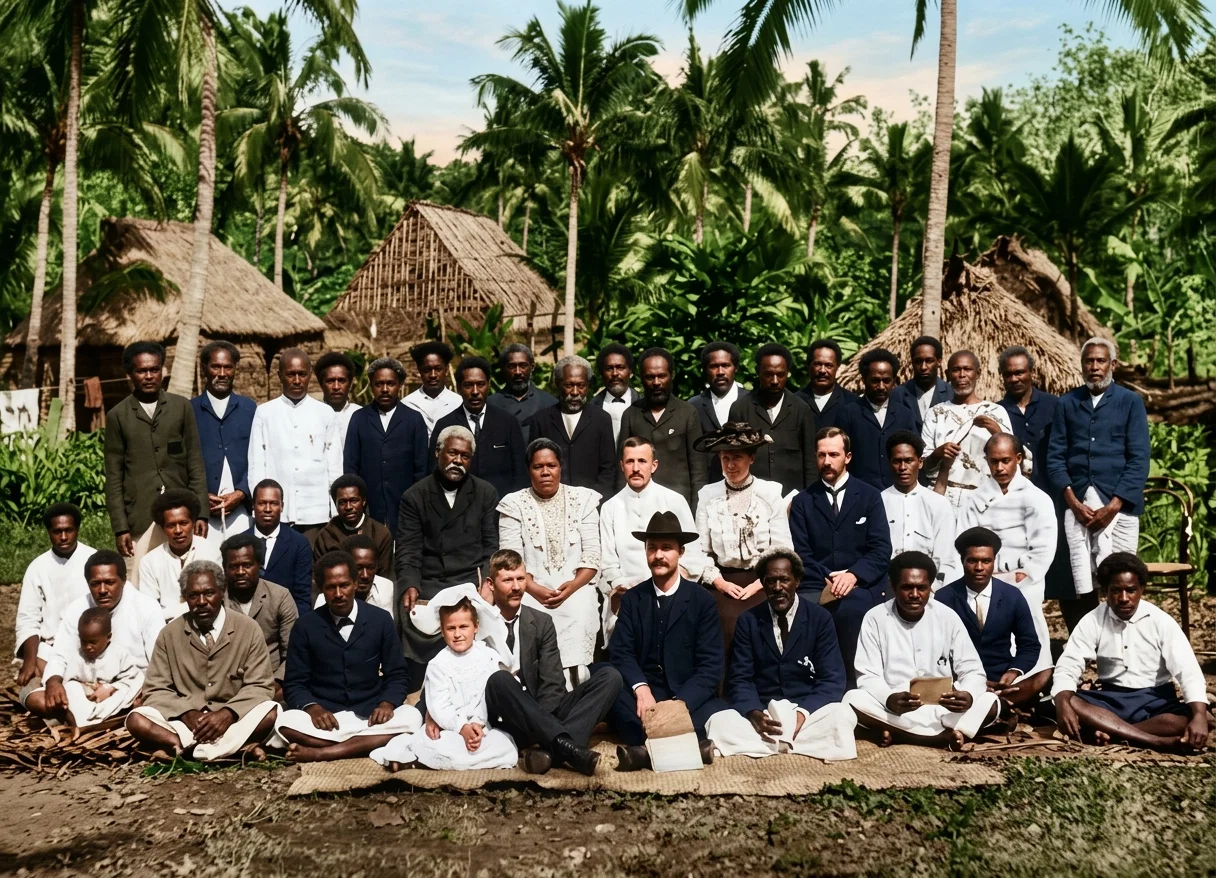
A Day at Suva, Fiji

8%

Pacific Press Publishing Association · Mountain View, California · Sep 15, 1909

FromSigns of the Times, Vol. 36, No. 36.

Read the full edition

A Day at Suva, Fiji

At five o’clock Monday morning, February 22, we were in sight of some of the high, mountainous outlines of the Fijian group of islands. They were on both sides of us, and the visitor is at once impressed with the extensive and elevated lands connected with this group. As we sailed toward Suva the view became more interesting and charming. Sailboats gliding swiftly over the waters, and beautiful white cottages or villas nestled in the hills, presented a pleasing picture. We reached Suva about 10:30 A.M., just in the wake of the “Maitai,” the old “Mioweara” rechristened “Maitai,” which had arrived from New Zealand with a large number of passengers for our vessel, bound for Vancouver and the States.
The sight we most enjoyed was that of the group of our dear and tried friends and fellow workers upon the wharf. There we saw Brother C. H. Parker and Romona, Brother and Sister Andrew Stewart, Brother and Sister G. E. Marriott, and several native boys and men, among whom were Alapati and Methusala, and Rose and Ruth, native girls. These were all soon with us on the deck of our good ship “Makura,” and hearty greetings were exchanged, for we were quite as glad to see them, right on their field of labor, as they were to see us.
After viewing the vessel, and getting the many parcels and letters we had for them, we accompanied them to the town of Suva and posted our letters back to Australia. And how we wished they weighed more, for here we could post one ounce for a penny. This is how it should be all over Australia and the world of universal postage.
Mission Workers and Native Fijians
After a short walk through the town and up some of its very picturesque streets, we took a rowboat out to our own sailboat and sailed across the bay to Suva Vou (new Suva), where our mission is healthfully and pleasantly located. Here we had the experience of being carried ashore on the backs of our dear native brethren, who would not permit us to walk over the sharp coral, altho we desired to do so, for fear of cutting our feet. The water where we left the rowboat was about knee deep. We enjoyed the experience, however, only one feels so very heavy when being carried by another.
The walk from the landing up to the mission house where Brother and Sister Marriott live, is one of the prettiest we ever saw. It is only about six or eight feet wide, but so grassy and so lined on both sides with shrubs and flowers and fruit trees that it seems a veritable Eden way. We were very pleased with the location of the mission and the church. It presents a delightful appearance, being surrounded by a rich growth of hybiscus, banana, and breadfruit trees, loaded with their fast ripening fruit, and beneath our feet a rich carpet of grass.
The native village was the next item of special interest, and here we were introduced to mothers and children and men in their native life. We were surprised to see their grass houses so near together, and yet it all seemed very nice. We met one of the most aged of the brethren, a man of seventy-five, who carries, in his face, the credentials that he has met and become acquainted with Jesus of Nazareth. He at once wished to know our choice as to the place we would have the native dinner served, which they had prepared for us. We told them our preference would be to set it where they would select, and they at once decided on one of their largest houses. And here we ate taro (boiled), and yam, and a dish of the finest greens, made from taro leaves and cocoanuts, which, with the addition of a little salt and lemon juice, was to be preferred to any dish of spinach we ever tasted. We thought they had given us too large a helping, but we asked for more, which it gave them great pleasure to help us to. We ate in native fashion, sitting down on the clean mat floor, the table also being on the floor. Two of the brethren insisted on keeping the fans going to keep off any flies that might get in. All waited until our party had finished eating; not one mouthful would they take until we had finished, for that is their custom. Then the men ate, and the women and children waited until they had finished. One of the most impressive scenes we have ever witnessed was their reverent and quietly bowed attitude while Brother Parker offered thanks in their language. All bowed their faces between their hands to the very mat before them.
We expressed the wish that we might have had a snap-shot of the company at dinner, and Brother Parker at once assured us that that was possible as there was a camera at the boat. One of the boys soon brought it, and the photo was taken, which I am sure we shall prize.
At the vessel we met a number more of the boys from the Buresala school; also the son of Ambrose, who with his father is one of the Rombolas, or governors. God has given him a kingly bearing, and we urged him to meet us at the gates of the New Jerusalem, where as princes we shall all enter in, and he said he would try to meet us there. As the company of workers left us, we could but express gratitude to God that He had raised up such faithful and experienced workers for this field. May His richest and choicest blessings rest upon them all, and upon Fiji.
We must not omit to mention the after-dinner song-service, in which we sang to them with the guitar accompaniment, which they seemed to enjoy. They sang their native song, which we enjoyed. We also appreciated their gift to us of the best bananas they had, and young cocoanuts, to take on shipboard, and also the fine large bunch of bananas which the brethren brought us from Buresala. All we had to give in return was our love and all the apples we had, nearly a half bushel, which the brethren had given us. As we had apples on board, and were going where there were plenty more, we felt we could do no less than to let those have them who lived where apples were threepence each, and scarce at that.
G. B. Starr.