The Temple Cleansed

4%

Pacific Press Publishing Association · Mountain View, California · Aug 4, 1909

FromSigns of the Times, Vol. 36, No. 30.

Read the full edition

The Temple Cleansed

By Mrs. E. G. White
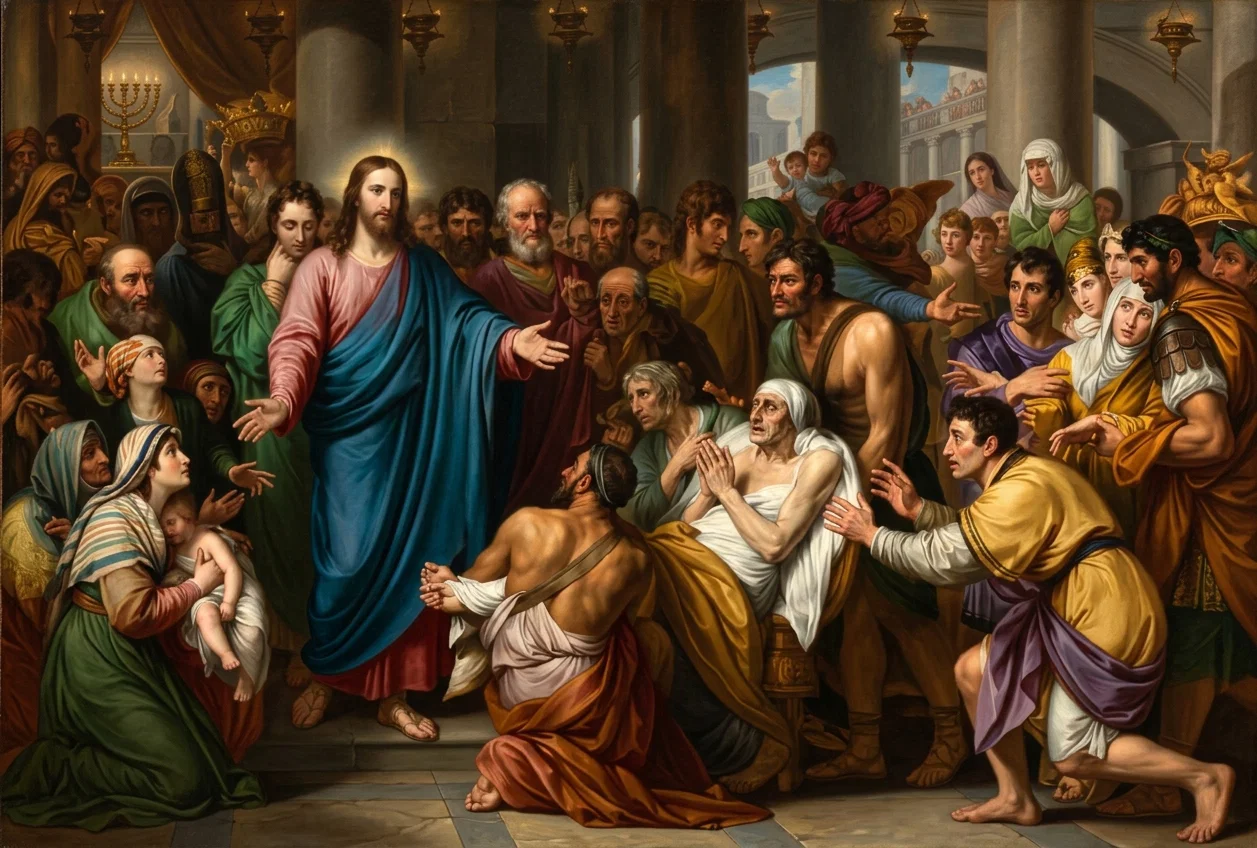
“The people pressed into Christ's presence with urgent, pitiful appeals” — Benjamin West, R.A.
Overpowered with terror, the priests and rulers had fled from the temple court, and from the searching glance that read their hearts. In their flight, they met others on their way to the temple, and bade them turn back, telling them what they had seen and heard. Christ looked upon the fleeing men with yearning pity for their fear and their ignorance of what constituted true worship. In this scene He saw symbolized the dispersion of the whole Jewish nation for their wickedness and impenitence.

Why They Fled

And why did the priests flee from the temple? Why did they not stand their ground? He who commanded them to go was a carpenter’s son, a poor Galilean, without earthly rank or power. Why did they not resist Him? Why did they leave the gain so ill acquired, and flee at the command of one whose outward appearance was so humble?
Christ spoke with the authority of a king, and in His appearance and in the tones of His voice there was that which they had no power to resist. At the word of command they realized, as they had never realized before, their true position as hypocrites and robbers. When Divinity flashed through humanity, not only did they see indignation on Christ’s countenance, they realized the import of His words. They felt as if before the throne of the eternal Judge, with their sentence passed on them for time and for eternity. For a time they were convinced that Christ was a prophet; and many believed Him to be the Messiah. The Holy Spirit flashed into their minds the utterances of the prophets concerning Christ. Would they yield to this conviction?
Repent they would not. They knew that Christ’s sympathy for the poor had been aroused. They knew that they had been guilty of extortion in their dealings with the people. Because Christ discerned their thoughts they hated Him. His public rebuke was humiliating to their pride, and they were jealous of His growing influence with the people. They determined to challenge Him as to the power by which He had driven them forth, and who gave Him this power.

As a Deliverer

Slowly and thoughtfully, but with hate in their hearts, they returned to the temple. But what a change had taken place during their absence! When they fled, the poor remained behind; and these were now looking to Jesus, whose countenance expressed His love and sympathy. With tears in His eyes, He said to the trembling ones around Him, Fear not; I will deliver thee, and thou shalt glorify Me. For this cause came I into the world.
The people pressed into Christ’s presence with urgent, pitiful appeals, Master, bless me. His ear heard every cry. With pity exceeding that of a tender mother, He bent over the suffering little ones. All received attention. Every one was healed of whatever disease he had. The dumb opened their lips in praise; the blind beheld the face of their Restorer. The hearts of the sufferers were made glad.
As the priests and temple officials witnessed this great work, what a revelation to them were the sounds that fell on their ears. The people were relating the story of the pain they had suffered, of their disappointed hopes, of painful days and sleepless nights. When the last spark of hope seemed to be dead, Christ had healed them. The burden was so heavy, one said; but I have found a,helper. He is the Christ of God, and I will devote my life to His service. Parents said to their children, He has saved your life; lift up your voice and praise Him. The voices of children and youth, fathers and mothers, friends and spectators, blended in thanksgiving and praise. Hope and gladness filled their hearts. Peace came to their minds. They were restored soul and body, and they returned home, proclaiming everywhere the matchless love of Jesus.

The Responsibility of the Priests

The crowd that had fled from the temple court, after a time slowly drifted back. They had partially recovered from the panic that had seized them, but their faces expressed irresolution and timidity. They looked with amazement on the works of Jesus, and were convicted that in Him the prophecies concerning the Messiah were fulfilled. The sin of the desecration of the temple rested, in a great degree, upon the priests. It was by their arrangement that the court had been turned into a market-place. The people were comparatively innocent. They were impressed by the divine authority of Jesus; but with them the influence of the priests and rulers was paramount. They regarded Christ’s mission as an innovation, and questioned His right to interfere with what was permitted by the authorities of the temple. They were offended because the traffic had been interrupted, and they stifled the convictions of the Holy Spirit.
Above all others the priests and rulers should have seen in Jesus the anointed of the Lord; for in their hands were the sacred scrolls that described His mission, and they knew that the cleansing of the temple was a manifestation of more than human power. Much as they hated Jesus, they could not free themselves from the thought that He might be a prophet sent by God to restore the sanctity of the temple. With a deference born of this fear, they went to Him with the inquiry, “What sign showest Thou unto us, seeing that Thou doest these things?”

The Sign

Jesus had shown them a sign. In flashing light into their hearts, and in doing before them the work that the Messiah was to do, He had given convincing evidence of His character. Now when they asked for a sign, He answered them by a parable, showing that He read their malice, and saw to what lengths it would lead them. “Destroy this temple,” He said, “and in three days I will raise it up.”
In these words His meaning was twofold. He referred not only to the destruction of the Jewish temple and worship, but to His own death,—the destruction of the temple of His body. This the Jews were already plotting. As the priests and rulers returned to the temple, they had proposed to kill Jesus, and thus rid themselves of the troubler. Yet when He set before them their purpose, they did not understand Him. They took His words as applying only to the temple at Jerusalem, and with indignation exclaimed, “Forty and six years was this temple in building, and wilt Thou rear it up in three days?” Now they felt that Jesus had justified their unbelief, and they were confirmed in their rejection of Him.
As referring to the temple at Jerusalem, the Saviour’s words, “Destroy this temple, and in three days I will raise it up,” had a deeper meaning than the hearers perceived. Christ was the foundation and life of the temple. Its services were typical of the sacrifice of the Son of God. The priesthood was established to represent the mediatorial character and work of Christ. The entire plan of sacrificial worship was a foreshadowing of the Saviour’s death to redeem the world. There would be no efficacy in these offerings when the great event toward which they had pointed for ages was consummated. When the Jews sealed their rejection of Christ by delivering Him to death, they rejected all that gave significance to the temple and its services. From that day sacrificial offerings and the service connected with them were meaningless.

Coming of Better Things

“In three days I will raise it up.” In the Saviour’s death the powers of darkness seemed to prevail, and they exulted in their victory. But from the rent sepulcher of Joseph, Jesus came forth a conqueror. “Having spoiled principalities and powers, He made a show of them openly, triumphing over them.” By virtue of His death and resurrection, He became the minister of the “true tabernacle, which the Lord pitched, and not man.” Men reared the Jewish tabernacle; men builded the Jewish temple; but the sanctuary above, of which the earthly was a type, was built by no human architect. “Behold the Man whose name is the Branch; . . . He shall build the temple of the Lord; and He shall bear the glory, and shall sit and rule upon His throne; and He shall be a priest upon His throne.”
The sacrificial service that pointed to Christ passed away; but the eyes of men were turned to the true sacrifice for the sins of the world. The earthly priesthood ceased; but we look to Jesus, the Minister of the new covenant, and “to the blood of sprinkling, that speaketh better things than that of Abel.” “The way into the holiest of all was not yet made manifest, while as the first tabernacle was yet standing; . . . but Christ being come an high priest of good things to come, by a greater and more perfect tabernacle, not made with hands, . . . by His own blood He entered in once into the holy place, having obtained eternal redemption for us.”