A Sunday in Tahiti

7%

Pacific Press Publishing Association · Mountain View, California · May 13, 1913

FromSigns of the Times, Vol. 40, No. 19.

Read the full edition

A Sunday in Tahiti

By Pastor A. W. Anderson, Editor Australian (Melbourne) “Signs of the Times”
HALF way between Sydney and San Francisco, on the route followed by the New Zealand mail steamers, lies the island of Tahiti, one of the most charming spots in the Pacific Ocean. The mail steamer spends twenty-four hours at Papeete, the capital of the Society Islands, and thus a good opportunity is furnished to the traveler to see something of Tahitian life. As the ship enters the Society group, the towering peaks of Moorea and Tahiti afford a welcome sight to the traveler.
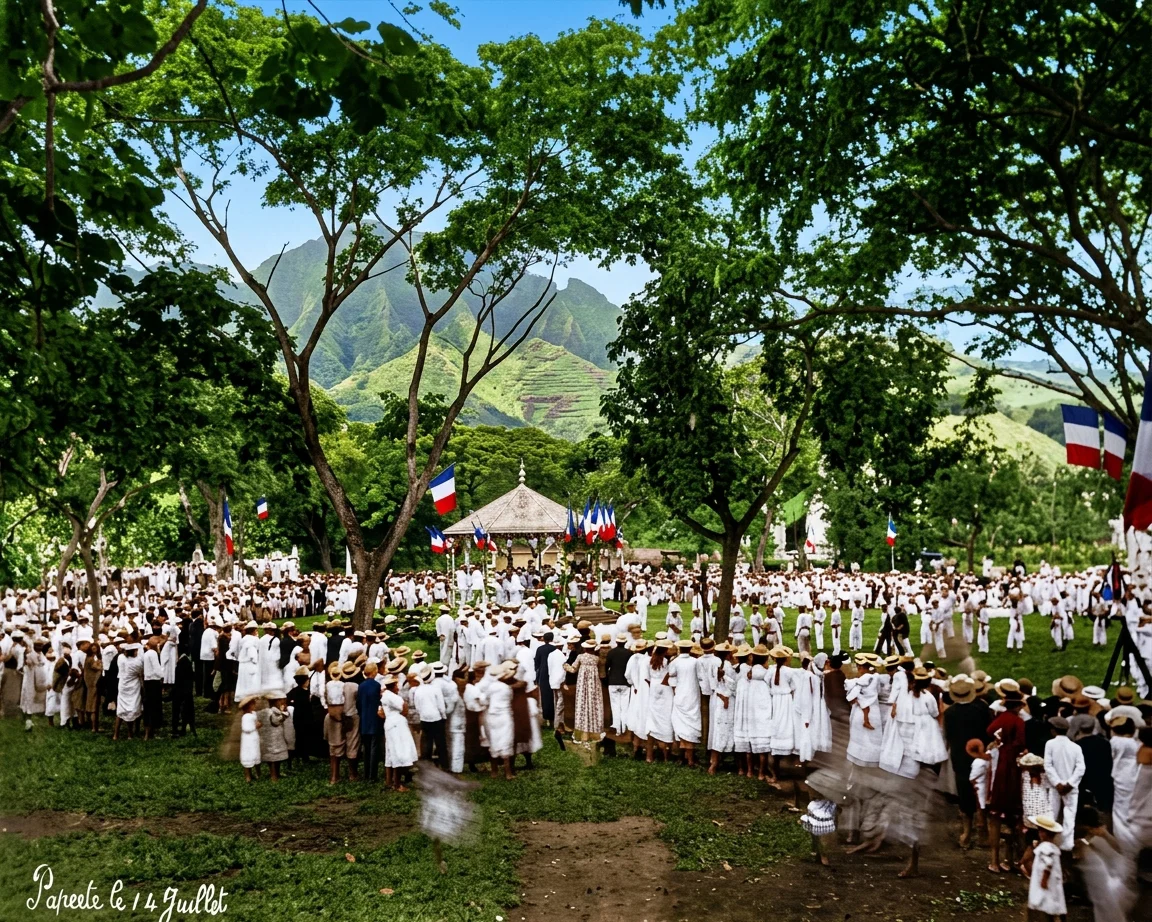
The celebration of the 14th of July. As the French rule Tahiti, the native Tahitians celebrate the great day of the French republic.
As the ship plows her way through the rolling ocean toward these two islands, the loveliness of the scene becomes enchanting. The azure sky and the deep blue of the ocean, relieved only by a few banks of cumulous clouds, and the white foam of the breakers as they dash on the reefs, contrasted with the luxuriant verdure of the tropical vegetation, interspersed with patches of rich chocolate soil which marked the spots where landslides had occurred, and the gray volcanic rocks which pushed their sharp points through the great banks of fleecy clouds that enveloped the lofty mountain peaks in their watery embrace, formed a color scheme such as no artist could ever succeed in reproducing on canvas.
Gradually the tower of the castle of the late King Pomare, various church steeples, the dome of the Observatoire de Papeete, and other public and private buildings, came into view as the vessel was steered between the two islands.
Just inside the entrance to the harbor lay a little islet on which was erected the quarantine station; while along the shore of the mainland, about a mile away, could be descried the wharves, at which were lying a few small vessels. In close proximity to these lay a French war-ship keeping guard over the port. As the Aorangi steamed leisurely up the harbor, the road skirting the beach presented a busy scene. Motor-cars, bicycles, and vehicles of various descriptions were hurrying along toward the wharf to meet the incoming mail steamer. As the vessel was slowly hauled alongside the wharf, numbers of natives, dressed in all manner of hues, patiently watched the proceedings, curious to see something of the new arrivals as they should disembark. Sundry French officials, with the effusive demonstrations for which their nationality is noted, shouted words of welcome to a few French passengers on board who were about to take up their residence in this center of French activities in the Pacific.
Having descended the gangway to the wharf and walked a couple of blocks into the town, we found ourselves amid scenes quite distinct from anything in Australia. Altho the streets of Papeete are extraordinarily narrow, yet the roadways are well constructed and kept in good repair. Numerous motor-cars flitted noiselessly past the horse-drawn vehicles which are still a predominating feature of the street traffic; but as most of the carriages were fitted with rubber tires and the roads were exceedingly smooth, very little noise was created even in the busy thorofares.
A few blocks from the wharves we came to the market square, the center of Tahitian commerce; but at that evening hour the place was almost deserted. Five o’clock on Sunday morning, we were told, was the time to see the market at its best. Inwardly we made up our minds to rise in time in the morning to obtain a little acquaintance with Tahitian life. Some of the chief shopkeepers of Papeete are Chinese, who form a considerable portion of the population of the town.
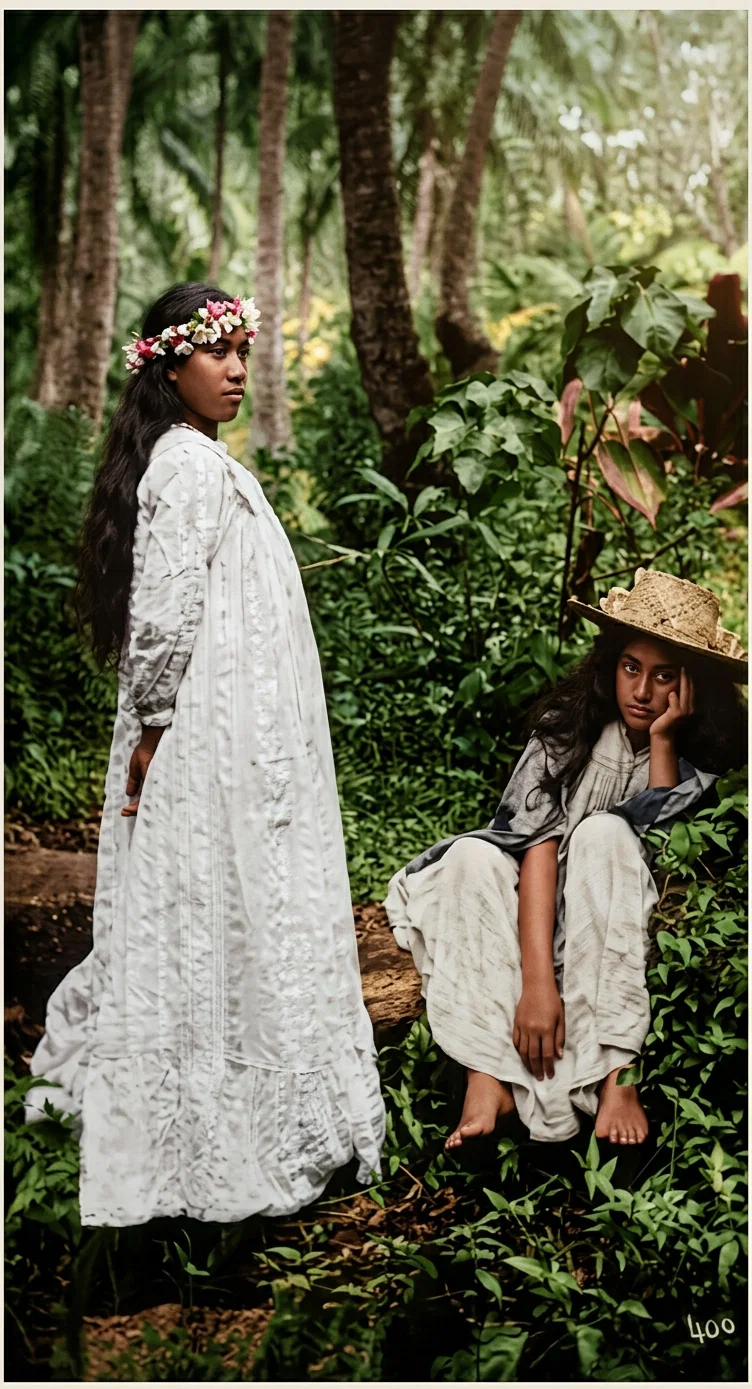
Native Tahitian girls
A few minutes’ further walk brought us to the home of Brother and Sister Johnson. After our long ocean voyage, we were glad indeed to enjoy once more the hospitality of home life, and to mingle our songs and prayers with theirs at their family altar. As Pastor Lyndon and his wife and family were also present, together with Brother and Sister Adams, who have recently joined the band of mission workers in the Society group, Brother and Sister Johnson had the privilege of entertaining the largest number of Adventist white people that had gathered together for a long time in Tahiti. While they expressed the greatest pleasure in experiencing this little break in the monotony of island life, it was indeed a most pleasurable experience to the eight Adventists who were traveling by the Aorangi to America. Three of the visiting ladies, Sisters Graham, Gregg, and Sandberg, remained at Brother Johnson’s home for the night, while Brethren C. A. Brandstater and Westby Amyes returned to the boat. Pastor Fulton and the writer and his wife, together with Pastor Lyndon and his family and Brother and Sister Adams, drove to Arue, a district lying about four miles out of Papeete, where our mission church isthings provided by Sisters Lyndon, Johnson, and Adams, there were also a number of tropical fruits cooked for the occasion by the natives. Beneath the shade of huge coconut palms a table-cloth of large banana leaves was spread, upon which were laid all manner of quaint dishes,—breadfruit, fei (cooked mountain plaintain), pawpaw, or mummy apple, mangos, oranges, guavas, bananas, and other products of the vegetable kingdom. An abundance of coconut milk was furnished by one of the native brethren, who, with wonderful agility, climbed up the smooth trunk of a huge palm to the plentiful crop of coconuts that hung amid the graceful leaves about forty feet from the ground. For a few moments it fairly rained coconuts, the ground being literally strewn with them. Quickly descending, the native tore off the husks for us, and unbottled the refreshing milk which nature so bountifully provides for the use of man in the torrid zone.
Just as we were commencing our open-air repast, a tropical shower burst forth, causing us to run for shelter, carrying with us, however, the good dishes, to which we all did justice. The rain continued to pour down as it can do only in tropical regions, until it was time for us to leave for the boat.
A drive back to Papeete of four miles through the rain concluded our very enjoyable visit to Tahiti, by which, short as it was, we were able to appreciate to some extent at least the difficulties which beset our missionaries in such places. Under ideal conditions we had the pleasure of meeting with Tahitian brethren and sisters who, through the faithful labors of our devoted missionaries, have been converted to present truth. But the contrast between these God-fearing Christians who delight in singing hymns to the praise of God, and the crowds of ungodly people who thronged the marketplace on Sunday morning, was very great. Truly our brethren and sisters in Tahiti need our prayers, for they are surrounded by the most immoral environments, and it is therefore little wonder that our laborers meet with so many disappointments in their work. Nevertheless the truth is making progress, despite all obstacles; and if our missionaries would consent to adopt the questionable expedient of lowering the high standard set for church fellowship, doubtless they would have greater numerical results to show for their labors. But this they can not consent to do, for no good reason is afforded to lower the Christian code of morality in Tahiti, because the Tahitian code of morality is low.
While the natives have been made subject to the laws of a civilized power, yet it is questionable whether they are not more difficult to reach with the simple truths of the gospel now than they were before they were brought within the pale of civilization and contaminated with the vices of the white man. Catholic churches, with their attendant priests and nuns, are to be found all through the island; and as these are largely patronized by the French civil authorities, it is only to be expected that they will exert a powerful influence over the native mind. This, of course, only tends to increase the difficulties—which already face the Christian missionary. Many of the numerous Chinese traders are intermarrying with the native women, and this is another factor which impedes the work of the missionaries. With all these conflicting interests, the missionary finds his work much hampered; for while the native is clever in many things, yet he has not a discriminating mind with which he can reason out subtle differences of principle in religious matters. Nevertheless the promises of God stand sure, and we may rest content that if we are faithful in sowing the seed, God will give the increase, for where sin abounds, grace doth much more abound.