How Questionable Laws Are Being Secured Through “Riders” to Various Bills
From Our Washington Correspondent
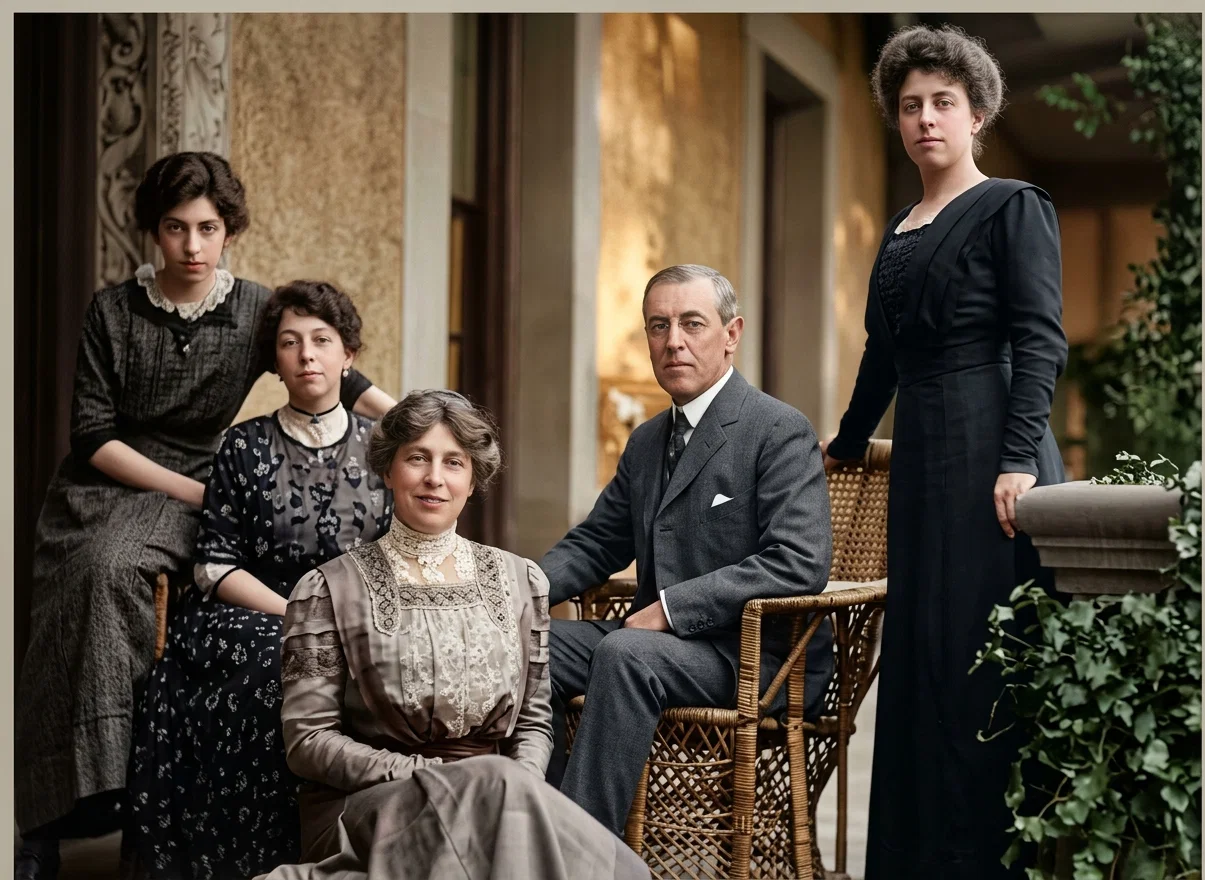
PRESIDENT WOODROW WILSON AND FAMILY
THE sixty-second Congress, which closed March 4, 1913, should be marked, and must go down in history, as a notable one for having taken some advanced steps in the matter of Sunday legislation.
During the month of August, 1912, near the close of the second session of this Congress, a law was passed closing all first- and second-class post-offices throughout the country on Sunday. An account of the enactment of this measure, the passing of which reversed the long record of Congress in refusing to enact such a law, was given in the “Signs” of September 24, 1912.
During the closing hours of the last session of this Congress another piece of Sunday legislation was passed, this time in the form of a law prohibiting the sale or supplying of liquor in hotels, restaurants, and clubs, in the District of Columbia, on Sunday.
Both laws were introduced and passed as “riders” to other bills; the first as a rider to the post-office appropriation bill, and the second as a rider to the District excise bill, regulating the sale of liquor in the District of Columbia.
Section 9, paragraph 2, of this excise law provides that “not more than three saloons or barrooms other than in hotels or clubs shall be permitted on one side of a street between intersecting streets.” In other words, by this law, not more than twelve saloons to the square block (three on a side) are allowed in the District of Columbia, the capital of the nation.
The Sunday-Law Rider
Paragraph 6 of this same section of this law says:
“No licensee under this section shall sell, give away, or dispense any intoxicating liquors to any person between the hours of one o’clock A.M. and seven o’clock A.M., nor on Sundays or Inauguration Day; and between said hours, and on Sundays and Inauguration Day, every barroom and other place where intoxicating liquors are sold shall be kept closed.”
The law of which this is a part was approved March 4, or just shortly before the hour of the final adjournment of this Congress, and goes into effect July 1, 1913.
It is no doubt a good thing to have in Washington, the capital of the nation, a “safe and sane” Inauguration Day, which occurs but once in four years. Secured upon its merits apart from religious bias, it would doubtless be well also to have a sober, safe, and sane day in Washington once a week, which would mean fifty-two such periods in a year, or two hundred and eight in four years. But granting the wholesomeness of these things, why would it not be a splendid thing also to have EVERY DAY of every year in Washington, a sober, safe, and sane one?
And if Congress has the right and the power to forbid the sale and the serving of intoxicating liquors on ONE day in the week, why has it not also the right and the power to prohibit the sale and the serving of such liquors altogether on ALL days? Why prohibit it simply on SUNDAY? To prohibit the sale and serving of liquor on SUNDAY ONLY, is virtually to SANCTION its sale and serving on EVERY OTHER DAY. And this is what this law actually does in fact, even to the allowing of as many as twelve saloons or barrooms, besides hotels and clubs, in a single block in the business section of the city, and limiting the number of places in the District where intoxicating liquors may be sold, to “three hundred” by November 1, 1914. Evidently it is the DAY rather than the DEED that such legislation as the Sunday clauses here referred to is chiefly concerned with.
Those who oppose Sunday legislation upon principle, have sometimes been accused — tho wrongfully so, we are glad to say — of being in league with the saloon element; but it can not be denied that the Sunday legislation here quoted is very closely linked with legislation which actually permits and authorizes the running of saloons and barrooms, and the public sale of intoxicating liquors. It is certainly found in bad company in this instance.
Prohibition One Day in Seven
Commenting upon this latest Sunday legislation on the part of Congress, the Washington “Evening Star” of March 6, 1913, under the caption “Sunday to Be Dry,” says:
“Washington will be a prohibition city one day out of seven after July 1 next. With the going into effect on that date of the District of Columbia’s new excise law, hotels, restaurants, and clubs will be prohibited from serving drinks with meals Sundays. This is one of several radical changes provided for by the law. Officials of the excise board were surprised to-day to find how far-reaching the legislation is.”
Thus, by piecemeal, and by riders adroitly attached to various bills, Congress is now being committed to Sunday legislation.
The Insidious “Rider” in Disfavor
Like the barnacle on the ship, the insidious “rider” is frequently attached to measures to the general character and object of which it is quite foreign, and legislation is thus secured which could not be obtained if allowed to stand alone and upon its own merits. For this reason the “rider,” like the proverbial “joker” in bills, is very naturally and very properly looked upon with suspicion and disfavor. The merits and the propriety of any legislation which is dependent upon such means for enactment may well be questioned.
An editorial in the Washington “Herald” of March 12 comments upon this subject thus:
“It is gratifying to perceive that President Wilson has expressed himself as strongly averse to ‘riders’ on appropriation bills. This he made clear in a conversation with Mr. Fitzgerald, chairman of the House Committee on Appropriations. Mr. Taft had to veto three of these supply bills because of general legislation attached to them in the shape of ‘riders.’”
It would have been well if the two measures passed by the last Congress, containing Sunday-law riders, had been held up until these insidious and unconstitutional “riders” had been unhorsed.
An Interesting and Illuminating Incident
On Monday, February 24, only a few days before Congress adjourned, an interesting incident occurred in the House of Representatives, which forcibly recalled the passing last August of the rider amendment, introduced by Mr. Mann of Illinois, closing the post-offices on Sunday, and clearly demonstrated the fact that those who are foremost in prescribing the religious conduct of others by law, are not always careful to practise what they preach.
A measure appropriating $10,000 for experiments in the development of aviation for naval purposes was being discussed in the House on the Monday here referred to, when the following conversation took place:
Mr. Mann: I noticed in one of the Washington newspapers yesterday what purported to be a statement made by Captain Chambers, which is impudent and impertinent to the highest degree. I do not know whether he made the statement or not; but if he made the statement attributed to him he ought to be court-martialed and dismissed from the navy.
Mr. Roddenbery: Did I understand the gentleman from Illinois to say that he read the Washington Star yesterday?
Mr. Mann: I did.
Mr. Roddenbery: On Sunday?
Mr. Mann: I did. I read the Post too.
Mr. Roddenbery: On Sunday?
Mr. Mann: Yes; and then afterward I read the Times.
Mr. Roddenbery: When we had up the bill to prohibit the delivery of mail at the post-office on Sunday, I thought I heard the gentleman from Illinois say he did not read any mail on Sunday, and that he did not even read the newspapers.
Mr. Mann: I did not read any letters yesterday, and I did not open any mail yesterday; and if the gentleman should spend no more time reading the papers than I do on Sunday, he would not spend very much.
Mr. Kendall: That was Sunday’s Star, but it11was read this morning before breakfast. The gentleman misunderstood the gentleman from Illinois.
Mr. Mann: I did not so state. Being a man who is not afraid of what he has done, however foolish it may be, I read the Star, in the way that I read the papers, and afterward I read the Post, and then by inadvertence in the afternoon I read the Times.—“Congressional Record” for February 24, 1913, page 3952.
Congress in Session All Day Sunday
Another item of interest in this connection is the fact that this very Congress which thus twice committed itself to the enforcement of Sunday observance upon the part of others by law, spent the whole of the last Sunday of its closing session at its usual work of making laws for the people. An article in the Sunday afternoon Washington “Times” of March 2, was headed, “Congress Holds Sunday Session—Both Houses Wrestling with the Rivers and Harbors and Public Buildings Bills.” Another article in the same paper shows that the very bill which contained the Sunday-closing rider for the District of Columbia, was passed by the House on this day.
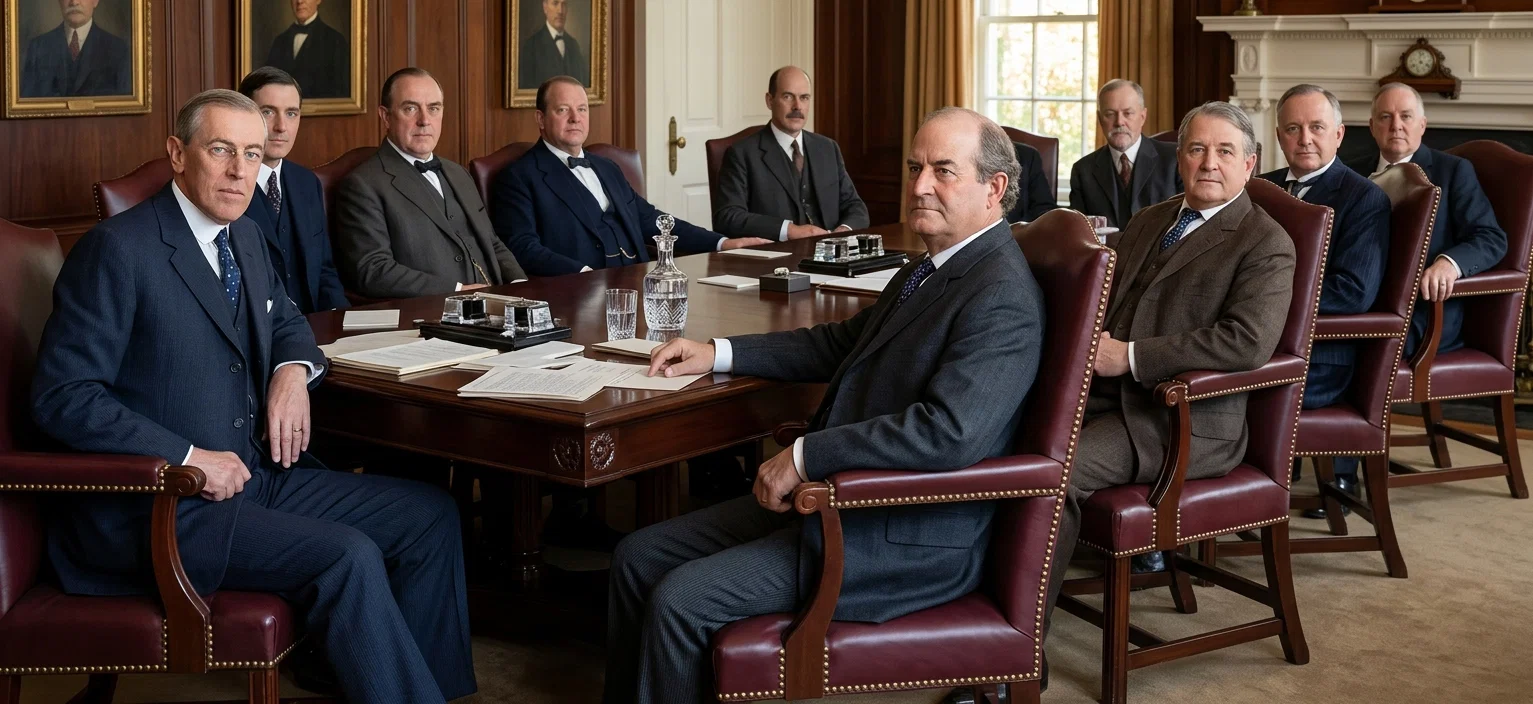
President Wilson and his cabinet. From left to right around the back of the table: President Wilson; William G. McAdoo, secretary of the treasury; James C. McReynolds, attorney-general; Josephus Daniels, secretary of the navy; David F. Houston, secretary of agriculture; William B. Wilson, secretary of labor; William C. Redfield, secretary of commerce; Franklin K. Lane, secretary of the interior; Albert S. Burleson, postmaster-general; Lindley M. Garrison, secretary of war; William J. Bryan, secretary of state.
The first paragraph of the article reads thus:
“After a battle which has lasted for nearly a year, and a fight which was one of the most bitterly contested in the history of Congress, the House at an early hour this morning adopted an amended form of the Jones-Works excise bill, inserted as a rider by the Senate on the District Appropriations Committee, and sent the district budget to conference with a definite agreement on the form which the new excise law should take.”
It would be well to remember this, when, as we may expect in the near future from the present trend of affairs, Congress enacts still more stringent legislation requiring men generally, either in the District of Columbia or elsewhere, to cease their ordinary work on Sunday, and observe it as a day of rest and worship. If it is proper for Congress, at its own pleasure and discretion, thus to continue at its ordinary work on Sunday, why should not every citizen in the country be accorded the same right to decide for himself whether he will do the same? What right has a legislative body which WORKS on Sunday, to require men to REST upon that day?
What the President and President-Elect Did on Sunday
Not only were both houses of Congress busily engaged in the work of lawmaking on this last Sunday of the session, but from the following items taken from the Washington “Herald” of Monday, March 3, it would appear that both the president and the president-elect spent at least a portion of the day in a similar manner.
Taft’s Last Sunday at the White House
“7:30 A.M.—The president arose. “8:30 A.M.—Took breakfast. “9 A.M.—Went to work in the library, and put in time until 10:45 A.M. reading his mail and considering a small grist of bills.
“Princeton, N. J., March 2.— . . . Sunday was a busy day for the president-elect and his family. The little cottage was thoroly dismantled by evening. Everything but the carpets and furniture had been packed in trunks and valises and hand-bags, and express wagons ran back and forth to the railroad station all afternoon. The president-elect packed everything he had in the line of clothing in bags and wore a frock coat all day, even when assisting in the packing.”
Attention is called to this, not to question the right of either of these honored men to do as he did, but to ask why every other citizen in the country should not be granted the same right and privilege to follow the dictates of his own conscience as to what he does or what he does not do on Sunday. No one for a moment would think of either of these men being fined or imprisoned for doing what he did on Sunday. Why, then, should laws be enacted, either by state or by nation, fining and imprisoning men in the humbler walks of life for engaging in honest work or business on Sunday?
District Sunday Barbers’ Law Declared Void
The matter of Sunday legislation for the District of Columbia has been made a still further subject of agitation by the law closing barber shops in certain sections of the city of Washington on Sunday having recently been declared void by Judge Pugh, of the District Police Court. As a result of this decision, nearly all the barber shops of the city were open on the first Sunday after inauguration. This will doubtless be made the occasion for a demand for still further Sunday legislation from Congress.
All these perplexities and inconsistencies are but the natural results of men’s attempting to legislate for God in religious things. If the question of Sabbath observance were left where God Himself has left it—with the law of God, the Bible, and the individual conscience—no occasion would be found for calling upon the state to enact laws compelling men to observe Sunday. Men would soon discover that Sunday is not the Sabbath of divine appointment, and that even tho it were, its proper observance could not be secured by the enactment of human laws.