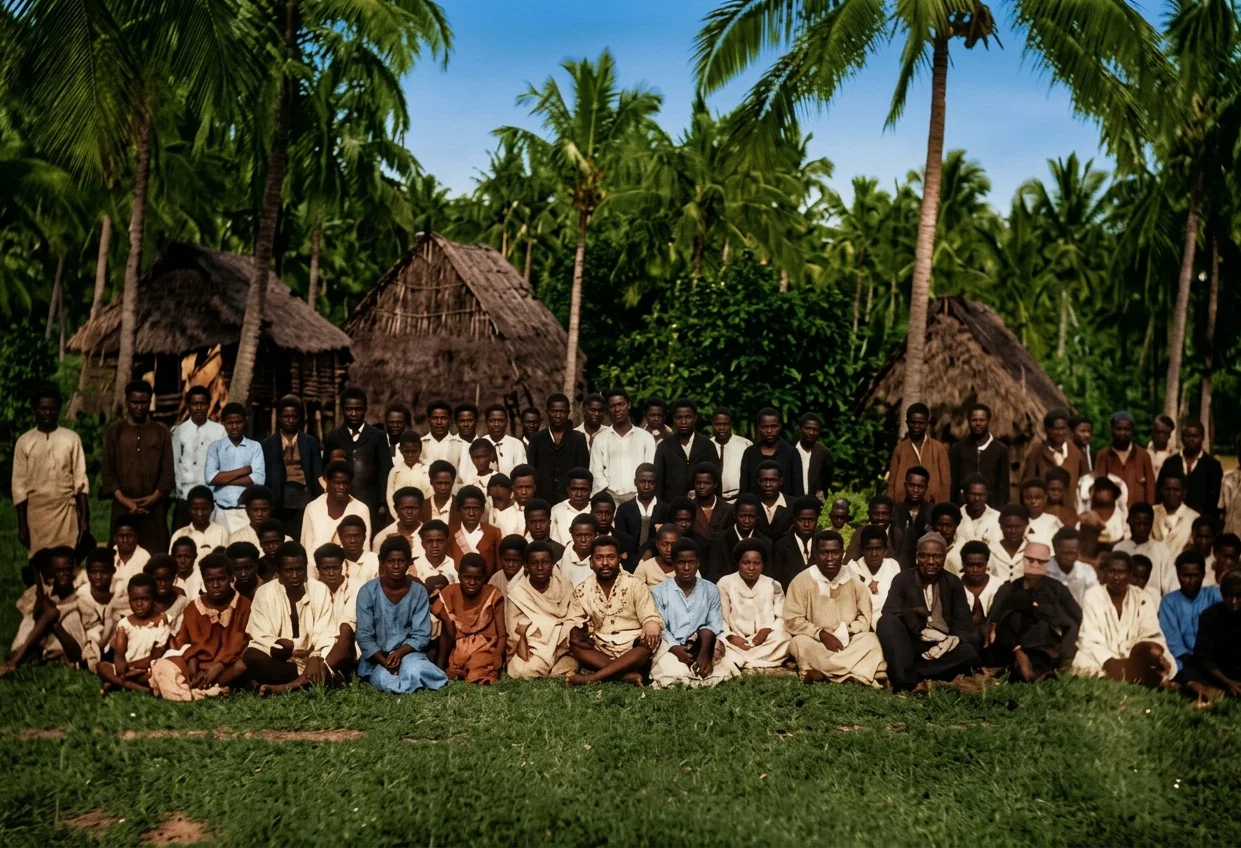
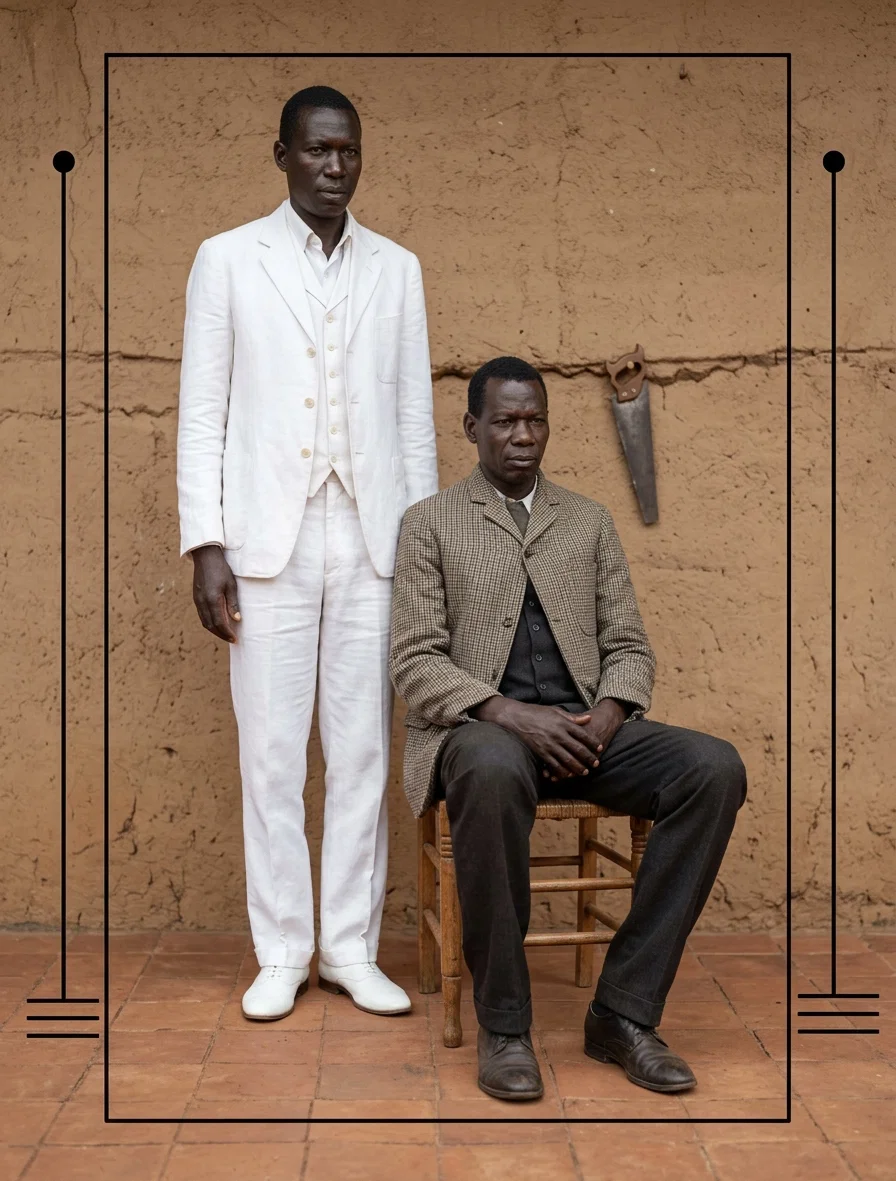
At our recent baptismal service in April, seventeen natives from three tribes received the ordinance, administered by the writer in a pool of a small stream crossing the mission. One of the candidates was a chief of local prominence in the Angoni Tribe. He is a skilled carpenter, and is doing the wood work on our church building, now nearing completion. Twenty other candidates who had been at the mission only one year were deferred for more instruction. These are now in a special Bible class receiving necessary instruction.
The new building is a combined school and church. Its dimensions are 28 by 60 feet, having two class rooms at the rear, 12 by 16 feet. It is made of brick, the material of which is taken from one ant-hill found one hundred yards from the building. Already over one hundred thousand good bricks, 3 by 9 inches, have been made from this ant-hill, and it is not quite exhausted. While the workmen were digging one day, I found the queen (white ant) larva, measuring one and one-half inches long. The age of these ant-hills is unknown, but I would estimate it at many hundreds of years. The brick is made by native brickmakers, one by one, with the hands, in a wooden mold. A good workman makes 1,000 a day and his wage is ten shillings ($2.50) a month of 27 days.
Native Students and Teachers, British Central Africa
Native Africans
The floor is of tile, made in the same way. The walls are plastered with sand found on the mission, with only water added, and looks like the best rough cement plaster of America. The outside is pointed with lime and sand, a little Portland cement being used on foundation and chimney.
All wood used grows on the mission land. Door and window frames and beams to strengthen the walls are sawn by natives with pit saws from the Mbawa-tree, African mahogany. One log of this tree sold in Liverpool in 1903 for 1,046 pounds sterling, a little over $5,000. It contained 1,647 sale feet, bringing $3.00 a foot. But the report fails to say how much it cost to transport and market it.
The rafters are poles from another native tree, as also the braces. The roof is thatch, supported on the rafters by bamboo tied with bark of another tree. The only imported articles are nails, glass, and locks.
Malamulo Mission School holidays are May 1 to July 31. During the holidays many of our boys and some families walk to their home villages, distant 100 to 300 miles. This year a teachers’ summer school was held during July for our sixteen native teachers. The subjects taught were Bible, reading, writing, arithmetic, and school methods.
The school opened August 3, with an enrolment the first week of 124.
By August 16 the enrolment of our school was 142, the daily attendance 139. The proportion of attendance will be some less in the rainy season. Last term the average attendance in all our schools was 300.
It is a peculiar fact that the attendance at Sabbath-school is less than at the day school. Evidently some village children are not so much interested in the Sabbath-school as in the day school. But in an attendance of 119 at Sabbath-school, 76 had verses memorized.
We have constant opportunities of opening village schools far and near. At present we have only four village schools and two small out stations. We should have scores of them. Our great need is well-trained native teachers for the village schools, and converted, soul-loving European overseers for out stations. Africa awaits the coming Saviour’s message. Our teachers who went out to hold village meetings last Sabbath, reported 184 in attendance at the several meetings held in seven different villages. At our Monekera out station, north of Blantyre, the Sabbath attendance is about 100. Malinki, our head teacher there, has just reported two schools with 91 enrolled. Another school in that district is to be reopened, with an attendance of fifty or more. All being well, I shall spend next Sabbath at that station, where a Bible class of 21 are preparing for baptism.
Three new boys have just come to Malamulo School from the Kirk Mountains whose homes are near our Matandane out station. This out station is 100 miles from our main station at Malamulo. As soon as we have a European teacher for that out station, it will not be necessary for them to come so far.
Last month, a chief came to Malamulo from Angoniland, some two hundred miles away, begging us to send a teacher who would teach his people the word of God. On inquiry of him, I found that other missions have schools not far away from his villages and they have asked his permission to open schools for him. He told me that he declined because he has been waiting several years for a teacher of the Sabbath truth. He heard this truth of a former Sabbath missionary, and has patiently waited for a teacher ever-since. It was hard to put him off still longer, but we have not one teacher to spare from our schools already open. May the Lord of the harvest soon give us more reapers!
Our hearts were refreshed last Sabbath by having three young men, for whom we have worked and prayed for a whole year, come to us to confess that they want to give their hearts to God. This is the one thing above all others that keeps the worker’s courage up in a field like this. The people do seem to desire to know God’s word and to serve Him. The change from heathenism to Christianity is a great one and few of us can grasp the mighty work of God required to bring about this change. It is beyond mortal comprehension. But God is doing the work, and we praise His name. I often13wonder that such wonderful changes can be wrought in one generation.
Sleeping sickness has made terrible havoc among the natives of Uganda on our northern border. Reliable authority states that already two hundred thousand out of the population of three hundred thousand are dead, and the end is not yet. It is moving southward and nobody knows where or when it will stop. It has no known remedy at present. May God give power to His word to turn many heathen hearts to Him before this plague is upon them!
We need health for the work; we need money; we need men.