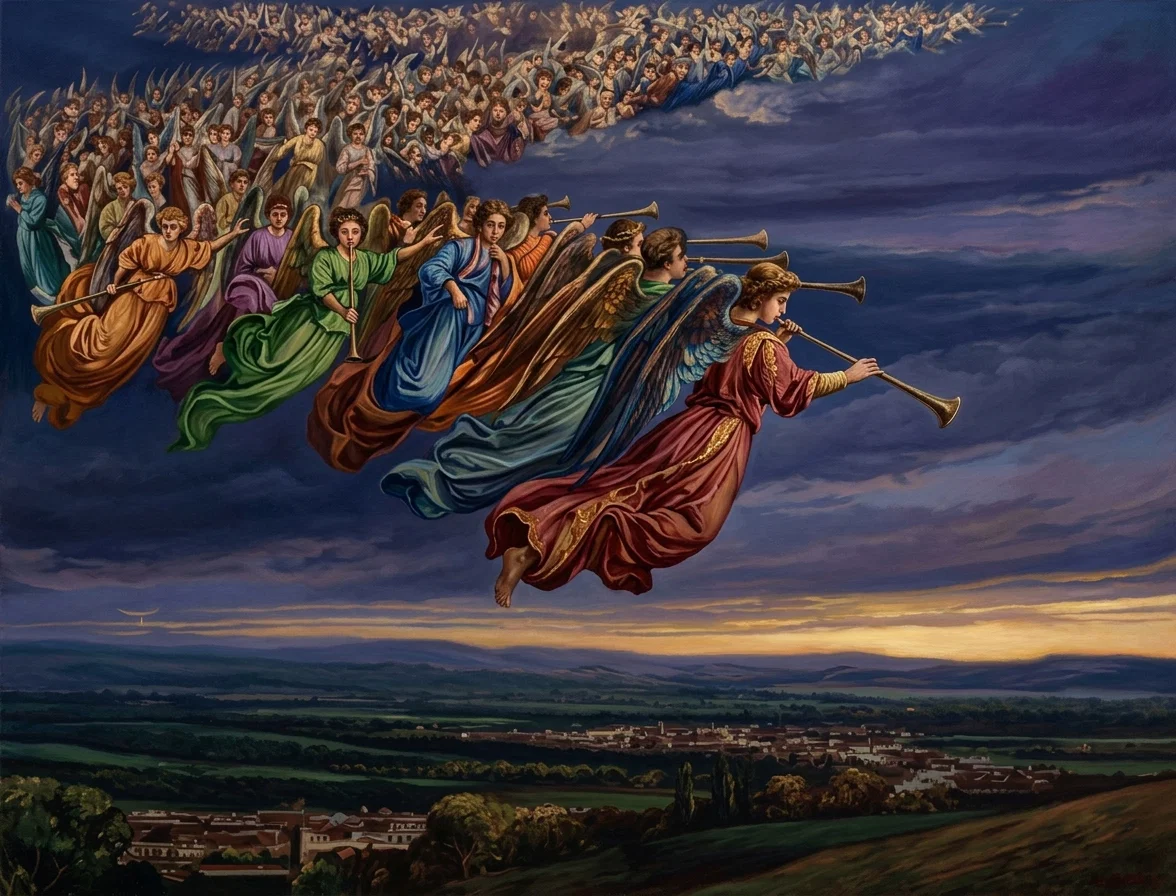
The church of God has ever looked forward to the glorious appearing of the Saviour as the crowning event of her earthly pilgrimage. Enoch stands out as a shining example among the first of those who were called out from the world to walk with God, and of him we read, in Jude 14, 15, that he prophesied, saying: “Behold, the Lord cometh with ten thousand of His saints, to execute judgment upon all.”
The scope of God’s promise to Abraham, according to Rom. 4:13, was that he should be heir of the whole world; and in Acts 7:5, Stephen declares that Abraham, in his lifetime, received “not so much as to set his foot on” of the promised inheritance. Abraham was promised that his seed should number as the stars of heaven, or the sand of the seashore; and in Gal. 3:29, we read: “If ye be Christ’s, then are ye Abraham’s seed, and heirs according to the promise.” Millions of God’s children have fallen asleep in death since that promise was made to Abraham, and they are all “heirs according to the promise.” In 1 Thess. 4:13-18, we learn that at Christ’s second advent all that countless multitude of saints who are sleeping in the dust will be roused by the trumpet blast of the Archangel, and with the living saints caught up to meet the Saviour in the air.
Then, and not until then, will Abraham see the fulfilment of the promise that his seed should number as the stars of heaven. Then, and not until then, will that countless company of the redeemed of all ages be marshaled upon the fields of glory, and raise the anthem of victory that marks the beginning of their entrance upon the long promised inheritance of the seed of Abraham. Then, and not until then, will the high hope of the church of God meet the beginning of its full fruition. If it were not for the second coming of Christ and the resurrection of the righteous, the hope of the church would be only a shadowy dream.
In 1 Cor. 15:16-18, we read that if the dead rise not, “then they also which are fallen asleep in Christ are perished.” The hope that is grounded upon Christ’s coming and the resurrection will carry the old ship of Zion over the harbor bar into the haven of rest at last. Any other hope will leave its devotees helplessly strewn upon the ragged rocks of despair.
If we should expunge from the New Testament every passage that breathes the blessed hope of immortality at the second advent, we would have little left but cheerless history. Paul stood before Felix and confounded his accusers by affirming his hope “that there shall be a resurrection of the dead.” Before Agrippa he declared: “I stand and am judged for the hope of the promise made of God unto our fathers: unto which promise our twelve tribes, instantly serving God day and night, hope to come. . . . Why should it be thought a thing incredible with you that God should raise the dead?” Who would presume to blot from the apocalyptic scroll the vision of those white-robed armies of the upper kingdom that form the shining escort of the King of Glory on His triumphal return to the earth?—Not one; for “if any man shall take away from the words of the book of this prophecy, God shall take away his part out of the book of life, and out of the holy city.” Rev. 22:19.
No true follower of the Lamb can fail to echo back the thrill of joy that runs through the testimony of the beloved disciple when he says: “Beloved, now are we the sons of God, and it doth not yet appear what we shall be: but we know that when He shall appear, we shall be like Him; for we shall see Him as He is. And every man that hath this hope in him purifieth5himself, even as He is pure.” 1 John 3: 2, 3. As the mind becomes imbued with this hope, ardent activity in preparing to meet the Saviour takes hold of every faculty of our being, and we become like running water—self-purifying. “The grace of God that bringeth salvation hath appeared to all men, teaching us that, denying ungodliness and worldly lusts, we should live soberly, righteously, and godly, in this present world; looking for that blessed hope, and the glorious appearing of the great God and our Saviour, Jesus Christ.” Titus 2: 11-13.
The apostle Paul, when nearing the close of his life, expressed his hope of future reward thus: “I am now ready to be offered, and the time of my departure is at hand. . . . Henceforth there is laid up for me a crown of righteousness, which the Lord, the righteous Judge, shall give me at that day: and not to me only, but unto all them also that love His appearing.” 2 Tim. 4: 6-8. This bright hope gives to every dark cloud of earthly sorrow a tinge of heavenly light. Even from death’s dark valley the eye of faith can discern the beams of the morning above the mountain barrier. Around the bedside of one of God’s dying children gathers the weeping family longing for one last look of recognition; but from the wreck of failing faculties there comes no response. Just as the shadow of death is stealing over the scene the mother tenderly says to the children, “He will know us when Jesus comes.” The dying man’s features light up as with the last gleam of day, and with a smile upon his countenance he exclaims: “Come, precious Jesus! Come quickly!” Thanks be unto God for that blessed hope which still abides when every other hope is forgotten, and every other name is written in the dust.