KAFFRARIA is located in the eastern portion of Cape Colony and lies south of Natal, bordering on the Indian Ocean. There is a colored population in Cape Colony of nearly 2,000,000, and about half of these are in Kaffraria. There are several tribes in this section, but all speak one language. The soil is fertile and generally well watered, hence it is a good country in which to grow grain and graze stock. Here, as elsewhere, the natives’ wealth consists largely in cattle, sheep, and goats. Many of them have horses, but these are rarely used for any other purpose than to ride.
I will confine my remarks to a consideration of the southern portion of Kaffirland where our mission is located. In this section corn, wheat, oats, barley, and vegetables are grown, also an abundance of apples, peaches, pears, plums, oranges, lemons, and pineapples. In fact, this is a healthful and fruitful section, and with a moderate amount of rain the country yields an abundance of cereals, fruits, and vegetables. There are but few of the natives, however, who have planted fruit-trees, altho they are very fond of fruit.
There are large sections of the country that have been reserved for the natives, and these are thickly populated. In fact they are so crowded that thousands of them seek homes among the white farmers and gladly pay a good rental for land upon which to grow their food and graze their stock. Large numbers of the men go to Johannesburg and Kimberley to work in the mines where they receive good wages. As a rule they remain but a short time, five or six months, and then return home and buy cattle with their money.
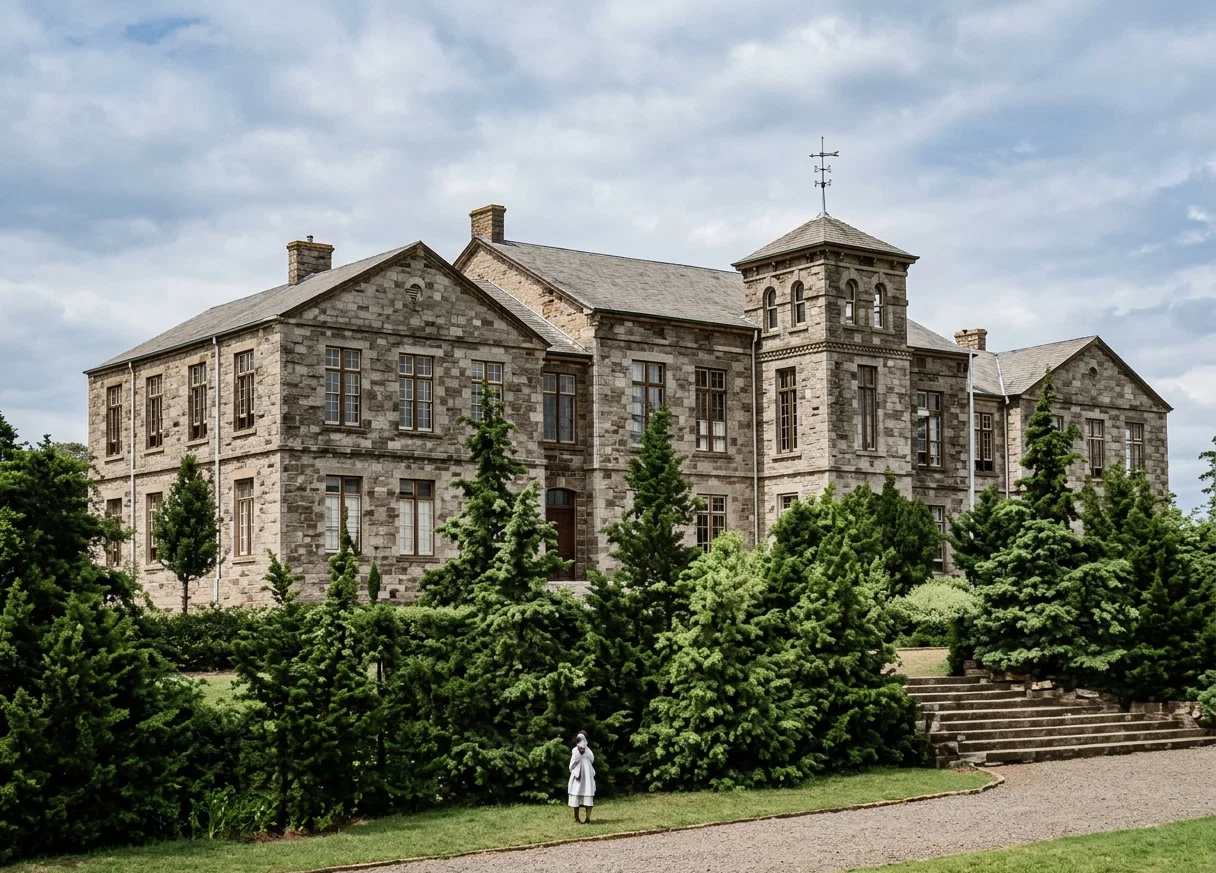
Lovedale Institute
There are two tribes, the Amaxosa, or Kaffirs, and the Fingoes, for whom we have begun to labor. Among these tribes are two classes, commonly called “the school Kaffir” or the Christian native, and “the red Kaffir” or the heathen native; and these two classes are nearly equally divided in numbers. The “red Kaffirs” are so called because they paint their faces with clay which makes them look hideous, and wear red blankets. They are among the most degraded human beings it has ever been my lot to meet. Altho there are schools in abundance, very few have any interest to send their children to them. They live to eat, drink, and find pleasure. They are not allowed to work on Sunday, so they spend the day largely in drinking native-brewed beer and in dancing.
As before stated, schools are plentiful. The villages, which are usually but three or four miles apart, have one or more schools in them. These schools are under the supervision of the various churches, and are aided by the government. The children are taught from the beginning in both the English and the native languages, and their education is carried on in these schools till they complete the fourth standard, and then those who desire to do so enter the Lovedale Institute and there complete the seventh standard. This prepares young men and women to be teachers and to fill many other positions of usefulness. All the village schools are conducted by native teachers.
It is not uncommon to find three or four denominations in each village. Each of these has its own church, and often sectarian lines are quite sharply drawn. The Christian native has great respect for the Bible, and a “Thus saith the Lord” is usually the end of all controversy with him; for he accepts the Bible just as it reads. Unfortunately some translators have put some of their own ideas of the Scripture into their translations, rather than the text as it is.
The earliest missionaries who came into South Africa began their work in this section. Just prior to this time a prophet arose among the natives by the name of Ntsikana. His life and prophecies were written out, and we have been able to secure a copy. He prophesied that the white men would come into their country, and said, “This is a wise race; but be careful not to take all their wisdom. The main thing for you to receive from them is the word of God. Take care of the button that has no hole [money], it will mislead many.” And again, “to show that sin will have increased in the world,” he said, “Even a small child will smoke.” He prophesied that the railway train, “wagons with fire and smoke,” would pass through that country, and to-day the trains are running there. His last words were an exhortation in behalf of his children. “Do not allow my children,” said he, “to return to red clay and heathenism; take them to Gwali mission station. I am going home to my Father.” So saying he died. This was in the year 1821.
So far as I have been able to learn, all the natives have great respect for this prophet and believe his sayings to be the truth. We find them a great help when speaking on the signs of the times. When we present the theme of the coming of the Lord, they are deeply impressed. We have sold fully 3,000 pamphlets on the subject of the coming of the Lord in the native language, besides a large number in the English, which has caused many of these people to begin to think. Truly the Gospel of the establishment of the kingdom of Christ is being heard by all nations, and soon will “the end come.”