The Bible in Greece

3%

Pacific Press Publishing Association · Mountain View, California · Jun 2, 1909

FromSigns of the Times, Vol. 36, No. 22.

Read the full edition

The Bible in Greece

(From Our Own Correspondent)
OLGA, QUEEN OF THE GREEKS
G. THEOTOKIS
G. THEOTOKIS
N. LEVIDIS
N. LEVIDIS

V. The Episode of 1901

AFTER the mass-meeting at Zeus Olympus, the students, tradesmen, and citizens returned in a body to University Square, bearing an old national flag and a picture of the Ecumenical Patriarch before them, their spirits more inflamed than ever.

Riot and Bloodshed

From the beginning the students were much irritated by the presence and frequent interference of the police in their movements, and once or twice already had thrown stones at them and fired their revolvers threateningly into the air. They sent a deputation to the king to ask the removal of the police from the university and its approaches, as their movements were all in the interests of the state and the church. A mob attacked the Prime Minister with stones and revolvers as he alighted from a carriage at his house, but he escaped injury as if by a miracle, and is the present Prime Minister of Greece.
Soon after their return from the meeting at Zeus Olympus, a body of students and citizens started for the office of the Metropolitan again to deliver a copy of their resolutions, and to bring further pressure to bear on the Synod to take immediate action to excommunicate. This body was met at a corner of the principal street of Athens by police and soldiery. An open fight ensued, resulting in the death of eight and the wounding of twenty-eight. The newspapers and the public then started an agitation for the immediate resignation of the Metropolitan as being primarily responsible in the countenance he gave the queen’s translation and in his slowness to make public the decision of the Synod before the students and police were incited to act. The removal of the chief of police and his deputy were also demanded on the ground that they had exceeded their authority in allowing the shooting to be done, altho there appears to be ground for believing that it was begun by the agents of unscrupulous politicians of the opposition to the party then in power, to secure a pretext for seeking the downfall of the ministry, in which they finally succeeded.

Resignation of the Metropolitan

So great was the pressure that the government asked the resignation of the Metropolitan. He was succeeded later by a shrewd politician, said to be much inferior in character to his predecessor, but still in office to-day. Concerning the resignation of the Metropolitan, the “Onward” says:
“The Greek people desire the preservation of a religious system that has been venerated for twenty centuries and which has saved Hellenism in times of the greatest danger. Now that the Metropolitan has resigned as an unworthy guardian of the inviolable usages and traditions of the church and the nation, the chief culprit in creating the present situation has suffered a just penalty.”

Interment of the Dead

The funeral of the victims took place the next day. The students, in accordance with Greek custom, posted notices in public places inviting all the people to attend. An editorial says:
“Surely Athens never saw, and perhaps never will see again, a more touching, more impressive, and more fully attended funeral than that of yesterday. One phrase, and one only, served, in the minds and mouths of all, to characterize the dead—‘Martyrs for the Faith.’ As the procession passed along it was remarked, ‘They are gone, poor fellows, martyrs to the faith. Immortal be their memory.’”

Funeral Eulogies

Two speeches were made at the funeral, the first by our professor of theology. He said in part:
“There are two foundations to every nation—faith and patriotism. That indignation was just which seized the people, especially our noble academic youth, when it became known that the sacred Gospel—that cradle of existence to our nation and to our hopes for the redemption of our beloved fatherland—was incurring danger. The people came together and expressed their indignation against those who dared touch this sacred treasure; and when necessity arose, bared their breasts in behalf of their convictions. Do not weep for the dead. Tears are not appropriate for martyrs to the faith. But, as the ancient Spartan mothers received joyfully their dead sons who had fallen in battle, so let us also rejoice that through the precious blood of these martyrs we have saved our faith. We have saved our Gospel, which was exposed to danger, thus showing that in us there is ever cherished the instinct to defend the faith, ready to break forth into action whenever the latter is in jeopardy.”
The second address was by a member of parliament, who is at present secretary of the interior. He said:
“In this place where our beloved brothers are lying, let us, through a general subscription, raise a mausoleum of marble, magnificent and stately, imperishable in glory and renown; and let us inscribe upon it the names of these noble martyrs to the Christian religion and the inalienable rights of the Greek people. These rights are already engraved in marble, so to speak, and teach all, whoever they may be, in however high a position they may stand, that you may take away everything from the Greek people, even their daily bread, but their ancestral language and their ancestral religion—never.
“Rest in peace, O noble souls! The very heavens mourn with us at this moment [it began to rain], with your fathers and your brothers. The memory of you will never fade from the inmost depths of the Greek heart. Cursed be the assassins [the translators]!”
Here followed, according to Greek custom, the kissing of the dead by thousands of the multitude present.
As from this point on affairs take a more decidedly political turn, the rest of our story can be briefly told.

Anathema and Excommunication

In joint session with the Holy Synod the government confirmed the decision alreadygiven out by that body, which remains in force to-day. No measures were taken to anathematize the translations already produced, for reasons that our professor of theology can better explain than I. Hear him:
“The Holy Synod has not anathematized the translations already produced, for they conscientiously believe that such a course would constitute a condemnation of the Gospel itself.
“Another reason for not anathematizing is this: The church has anathematized and still anathematizes only heresy, only what in reality perverts the Scripture. But when a translation is made from good intentions and in good faith, anathema is not necessary, simple prohibition suffices.”
Response of the students:
“What does the word anathema or excommunication enunciated by four or five priests amount to anyway in comparison with the general proscription which is now imposed by the conscience of every Christian? Be assured that after what has happened it is impossible for any one to dare undertake a translation of the Gospel in the future.”

Queen Olga Again

The chief reason for not excommunicating those who were in any way responsible for a translation, lies in the fact that it would necessarily include Queen Olga, one of the leaders in the movement. And “who knoweth whether [she is] come to the kingdom for such a time as this?” “If [she] altogether holdeth [her] peace at this time, then shall there enlargement and deliverance arise from another place.” One thing is sure, Queen Olga has not altogether held her peace on this matter of bringing the Bible within reach of the common people. Being of the strong religious conviction that she is, shall we not expect that in the fulness of time the Lord will use her influence still further to break down the barriers that have been built up around the word of God?
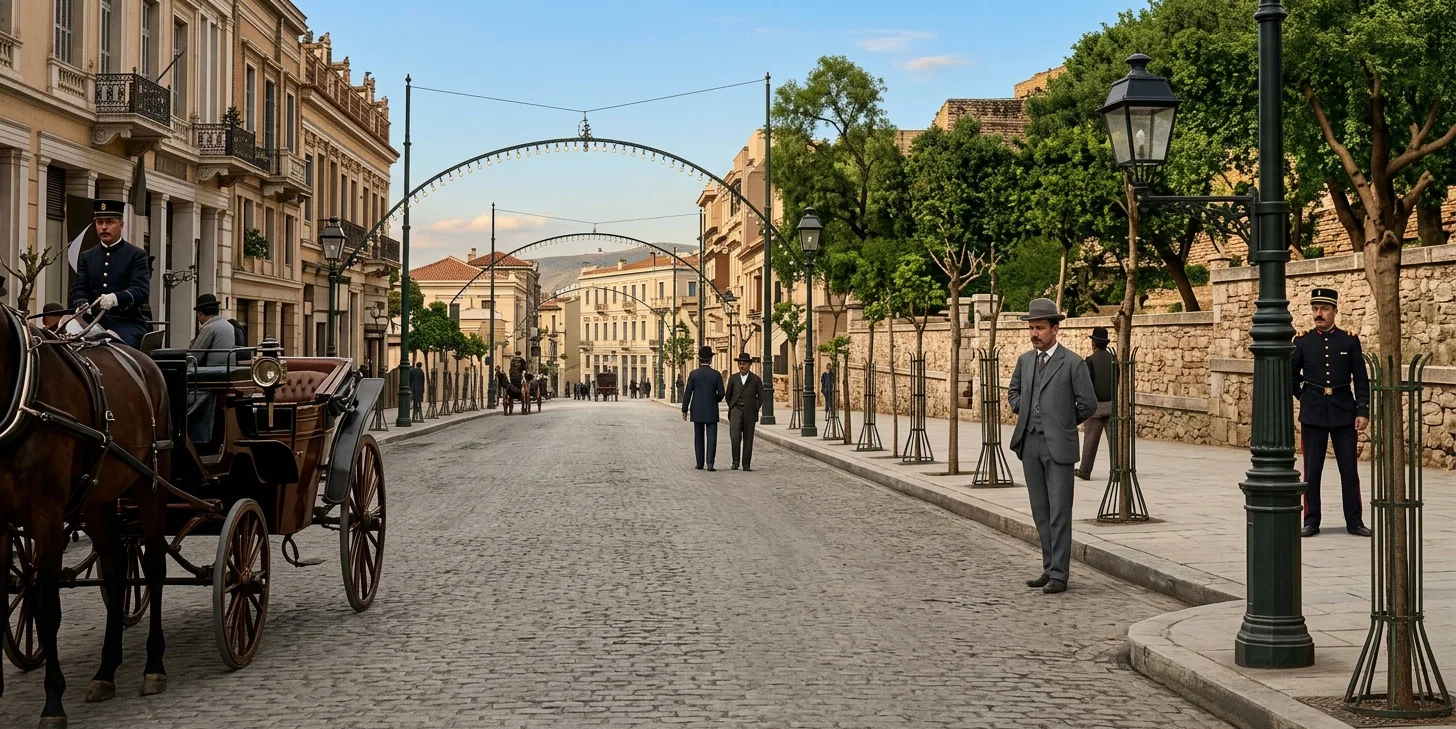
STADIUM STREET
The principal street of Athens, where the riot of 1901 took place. This street is said to be exactly one ancient stadium in length connecting the two principal squares of the city.
STADIUM STREET The principal street of Athens, where the riot of 1901 took place. This street is said to be exactly one ancient stadium in length connecting the two principal squares of the city.

Rays of Hope

One ray of hope that such may be brought about proceeds from Queen Olga’s practise of spending three or four months each summer in Russia, which nation has surpassed Greece in giving free course to the word of God outside of certain arbitrary, stereotyped lines. The example of Russia, whose state church is the same as that of Greece, is not likely to set the queen’s spirit at rest on this question.
Another ray of hope lies in the gratifying consideration that we are just going to press with our first literature in Greek, and it is not impossible that in the providence of God, some of the saving truth of this last message, either in Greek in Greece or in Russian in Russia, may come to the attention of this one of His zealous handmaids among the crowned heads of Europe. It is not the first time the Lord has used a queen to forward His cause in the earth, and why should He not do greater things in these momentous times than ever in the past?
Yet another, and the brightest, ray of hope comes to us from the truth that every time the word of God comes into conflict with tradition, bigotry, and political intrigues, it is sure to make progress toward its rightful place. The status quo in Greece on the Bible question can not continue forever. Altho the word of the Lord has been locked up in an antiquated tongue now for the past eight years, yet those copies of the translation distributed gratuitously by the queen, have not all been destroyed. And the faithful colporteurs of the Bible Society had a free hand for a number of years prior to 1901 in selling Bibles and portions of it up and down the land. Here and there the seed remains, waiting to be ripened by the droppings of the latter rain. “It [My word] shall not return unto Me void, but shall accomplish that which I please, and it shall prosper in the thing whereto I sent it.”
Yes, some fruit has already begun to appear. Since beginning these articles it was the writer’s privilege to find far up in the snow-capped mountains of Albania, a Greek and his wife living up to all the light they had, he having kept the Sabbath of the fourth commandment for seven years, and she for four, without either having ever seen the face of any other Sabbath-keeper, except the Jews. The only reading-matter they had in their possession was an old, backless, incomplete copy of the Bible Society’s translation of the Bible in modern Greek, and a little eight-page tract on the Sabbath. They received joyfully other points of present truth as fast as they were presented. Without a doubt, other copies or portions of the word are doing their work elsewhere, and it only remains for us to search out those who are blessed with its presence, and to minister the word more fully.
And finally, altho in “Free Greece” the entrance of that word which giveth light is thus obstructed by decree of church and state, and altho proselyting is forbidden by law, yet the same God who has opened to the Gospel such unpromising countries as were Russia and Siberia and China, and Bavaria and Turkey, and who is opening Tibet, will in His own time, and that we believe right early, bring into line with His providence the little, refractory, independent kingdom of Greece.
W. E. HOWELL.