As Brother and Sister Emmerson were passing through Cape Town en route to Basutoland, their future field of labor, I decided to visit that country with them. We were nearly two days by rail and one by ox wagon in reaching the mission, and were glad to find a pleasant house with enough furniture in it to enable us to be comfortable. Our native missionary, Murray Kalaka, and others gave us a hearty welcome into their midst. For nearly a year this mission had been without a European missionary, the work being left entirely in the hands of our native worker, and now there was rejoicing to know that help had arrived.
This mission station is located on the western slope of Mount Kolo, and there is a beautiful view extending far over into the Orange River Colony. Basutoland is a country of mountains and valleys. The Maluti Mountains are in the northern part, and some of the peaks are from 10,000 to 12,000 feet high. Many of the large rivers of South Africa have their source among these mountains and flow out in all directions.
Basutoland has frequently been called the Switzerland of South Africa. The scenery in many places is grand. The water at the Maletsunyane Falls takes an unbroken leap of 600 feet. The climate is keen and invigorating during the winter. Snow is to be seen most of the season on the mountains, but in the summer it is delightful, since they get the southeasterly breezes and usually an abundance of rain. There is no malaria, hence a good place for missionaries to recruit who live farther inland where fever abounds. We are thankful to say that here in the midst of South Africa is a country where such can regain their health and strength. Consumptives find this among the best climates in the world.
The valleys and mountainsides are very fruitful, and horses, cattle, sheep, and goats abound everywhere. The native's wealth consists of his ponies, and herds of cattle, and flocks of sheep. He cares but little for money except to increase his stock. If he wants a wife he must pay from ten to fifteen head of cattle for her if among the common people, but for a chief to get a wife of the royal blood he must give from fifty to seventy-five for her. When a man is brought before the paramount chief for a misdemeanor, he is usually fined a large number of cattle, and these the chief takes for his services. A misdemeanor on the part of a chief may cost him several hundred head of cattle. Altho they have an abundance of stock, they seldom use them for food, in fact, they say that meat does not make them strong. They usually have a feast once each year, and seldom eat flesh at other times. We found that a good native cow in milk was worth from $50.00 to $65.00.
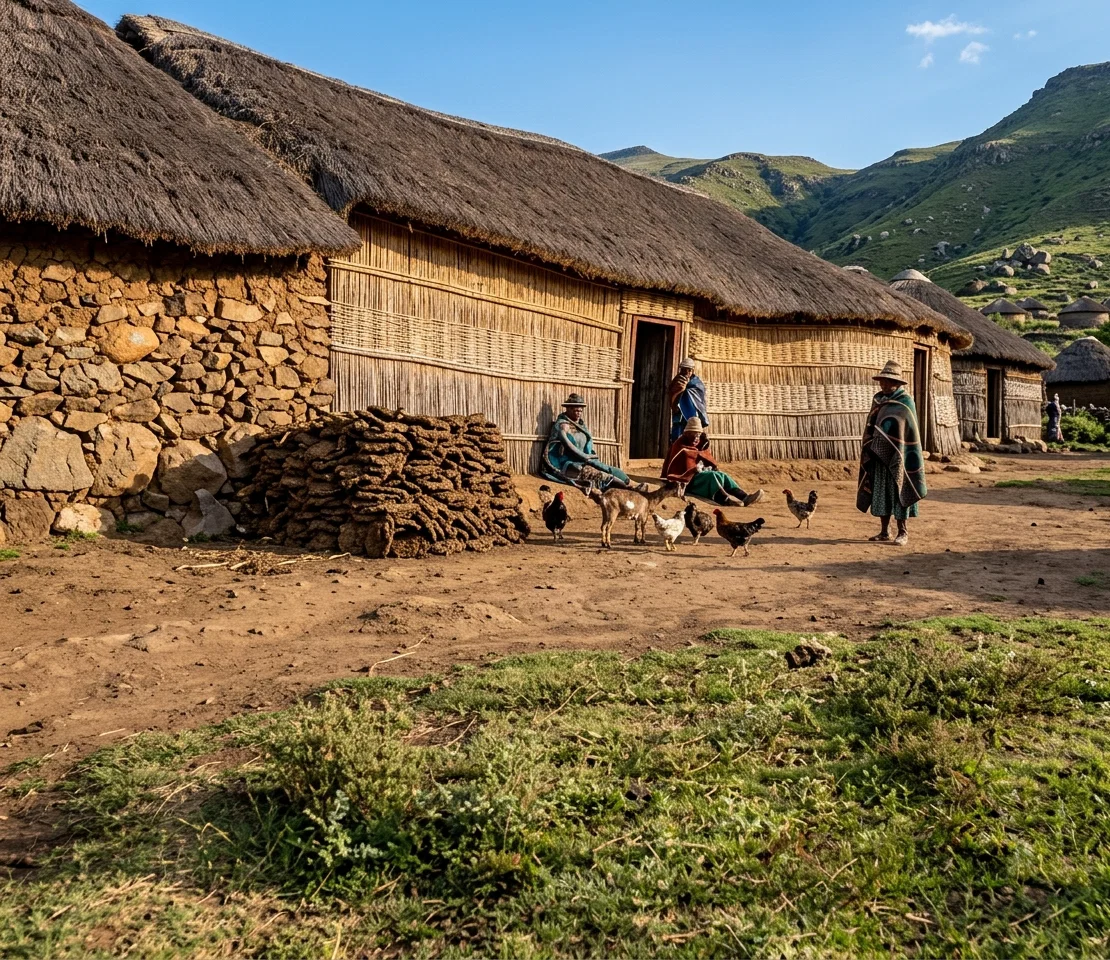
Scene in a Basuto Village
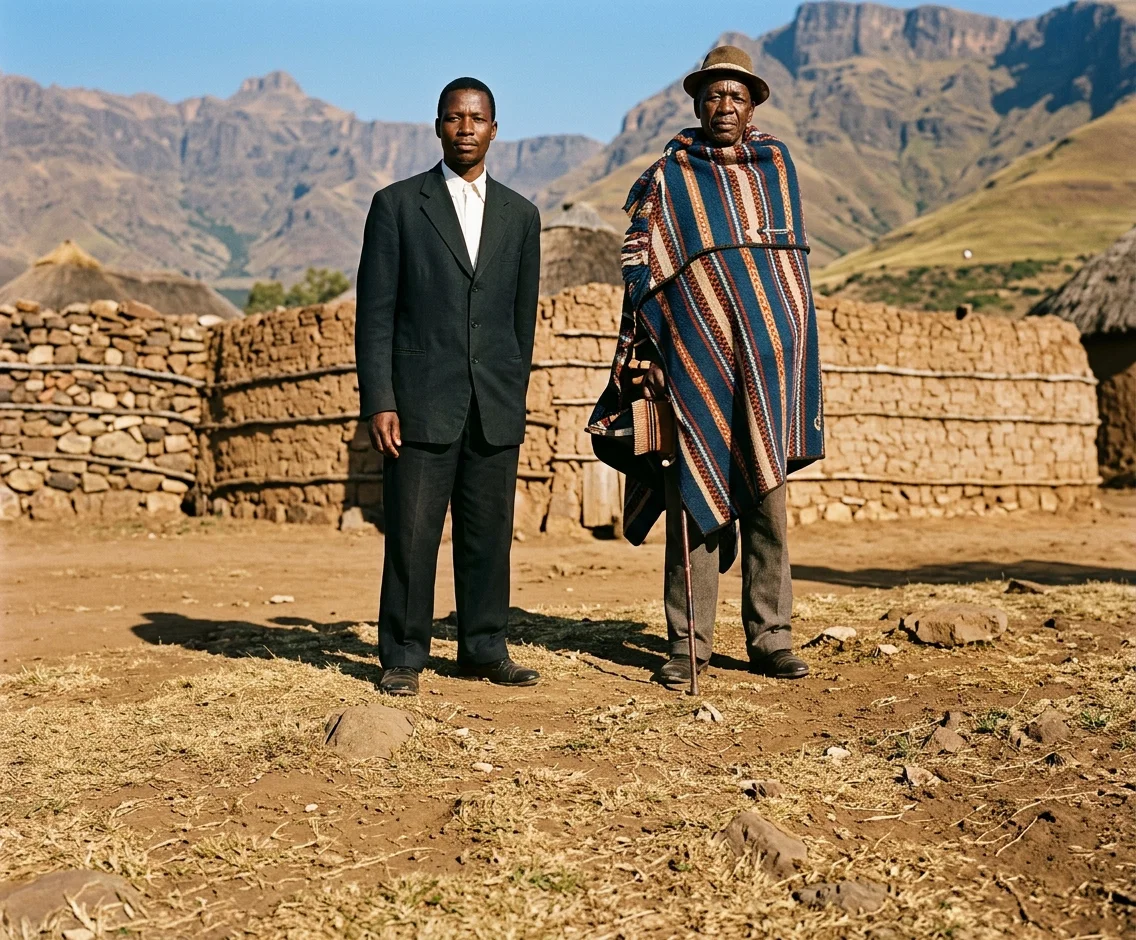
Murray Kalaka and the village chief in the blanket, which is the common manner of dressing.
The tillable land is divided up into plots of from four to eight acres, and each family is supposed to have four of these, one each for wheat, oats, kaffir and Indian corn. The valleys are dotted with these plots; and, as there are no fences, the cattle must always be in charge of a herd boy. With a moderate amount of rain good crops are grown. In fact, Basutoland is called the granary of South Africa. Possibly many of my readers would be surprised to find the natives using the best American plows, but such is the case, as this is no uncommon sight. They sow their Indian corn and plow it under. I do not remember of ever seeing a native planting in rows and cultivating it. They do not get as good crops as they would if they worked on better methods, but when there is no drought they have an abundance. The wheat is cut with the sickle and thrashed or trodden out by the cattle on earthen floors which they have prepared.
At the time of our visit the country was looking its best. The spring showers were springing up rapidly. At the mission the peach and apple-trees were in full bloom. The strawberries were white with blossom, and the grapes were putting out their fruit. We are thankful to say that this mission is well supplied with fruit, and pipes bring down a good supply of water from far up on the side of Mount Kolo. From this supply they are enabled to irrigate a portion of their garden during the dry season, and at this time it is no uncommon sight to see native women coming to the mission with water-pots on their heads and getting water for cooking purposes.
The first Sabbath we were there the little church was well filled with natives, who listened attentively to the words spoken. During my stay we held a few services with the magic lantern. They had never seen anything of the kind before and often expressed their appreciation. They had often heard the Gospel story, but to see it all pictured out before them and carefully explained made a deep impression on many minds. The people came in crowds, and at times we had to have a second service for the benefit of those who came long distances and could not get into the church.
Thousands of the Basutos can read, in fact, many have a fair education. In 1905 the report shows that there were over 200 schools in that country with an attendance of between 14,000 and 15,000 scholars. The government spent nearly $20,000 in helping the schools of the country. This makes it possible to reach and influence the people with our literature. They know our wagon, and always expect that we will have some books to sell to them. While on our way to the railway station we saw a boy running toward us from a village far up the mountainside. He said that his father wanted a book, and while selling to him, another came and bought two more. We feel our need of funds with which to print more books for this people.
There are many encouraging omens in this field. The father of the present paramount chief located our mission and was very kind to our missionaries. The present one offers help in any way he can grant it. He has been known to take his Bible and defend the Sabbath, altho he is a heathen. Several of the leading chiefs have read our literature, and are now believers in the coming of the Lord. We feel sure that from this land there will be many jewels gathered by and by to shine in the crown of our Saviour.