The present situation in English politics is peculiarly interesting and significant. In some respects it is without parallel in English history. The Liberals have now been in office some four years, and have had the advantage of a very large majority in the House of Commons, and yet they have not been able to carry a single party measure of first-class importance. Their Army Bill was of a non-controversial character; so also the Old Age Pensions Bill, prominent conservatives, among them Joseph Chamberlain, having advocated such a measure for years past. The other legislation which has been enacted has been either unimportant, or of a non-partisan nature.
The two first-class measures which this Parliament was elected to put on the statute-book, they have utterly failed to pass. And why? The answer will be, Because the House of Lords has stood in the way. But the real reason lies deeper. The Peers agreed to old age pensions, not because they really favored the bill, but because they knew the people wanted it. They have thrown out the Education Bill and the Licensing Bill because they do not believe the country as a whole favors these measures. Moreover the heads of the present government are not sure that the people will back them up in these reform measures; therefore they are unwilling to appeal to the country. They have boasted great things against the hereditary chamber, but they have actually done nothing, and the House of Lords has not weakened but has gained strength and prestige as a result of its successful defiance of the lower house.
The Churches in Politics
“But how is it possible,” some one will ask, “for the hereditary body to represent the people more than the present House of Commons, elected by popular suffrage?” The answer lies in a proper understanding of the election of four years ago, which was notable in two ways. While it was in progress the Non-conformist clergy took a more prominent part in politics than clergymen either of the establishment or of the dissenting churches ever had done before. When it was over, it was found that there was an unusually large proportion of Non-conformists on the benches at Westminster. It was said at the time that it might be called a Non-conformist Parliament.
It is not my intention to find fault with the mere electing of an unusually large number of dissenters as members of Parliament. It is the way in which this was brought about that is significant. In the election that placed the present government in power, the clergymen were not active merely in their capacity as citizens; but in one way and another they used the influence attaching to men who are regarded in a special sense as messengers of God, to forward political ends. For the time being the preaching of the cross was put aside as of less importance, and the leading divines scoured the country in motor cars denouncing not the sins of mankind, but the sins of the Conservative government, and making use of language in no respect marked by its sobriety and strict accordance with truth. Not only did the preachers go on extensive political tours, and preach the advantages of a liberal government with far greater enthusiasm than they had ever preached the Gospel of peace, but the rank and file of the Non-conformist churches rose en masse and gave their votes for a new government. Church organization was utilized to the full, churches and chapels were employed for electioneering purposes, and no pains spared to rout the Conservatives.
It is only fair to state that the Anglican clergy did not at that time show anything like the same activity in working for the interests of their natural allies, the Conservative party. Their turn came later, as I shall presently show.
Class Legislation
The new members took their seats, then, with very lively feelings of gratitude toward the Non-conformist churches. They knew who had sent them to Westminster, and what they were there for. They had been well instructed. Their first important piece of legislation was a drastic Education Bill, which the House of Lords refused to pass except with such wholesale changes that it would entirely lose its character. So it had to be abandoned, and later attempts to solve the question have been abortive.
Why did the Lords dare to oppose a bill backed by the largest government majority of modern times? Because they regarded it as a piece of class legislation, got up for the special benefit of Non-conformists. Furthermore, about this time the bishops and other clergy of the Anglican Church, following the example set by the Non-conformists, began to make themselves felt as a political power. They held enormous mass-meetings in the cathedrals and churches, and pointed out in the strongest terms the moral danger that confronted the nation if the new system of education were to pass into law.
A Religious Issue
What was the real situation? Simply this: English education as it now stands and has stood for a long time past, is more or less permeated with the principles of the Anglican Church. Non-conformists do not have equal rights with Anglicans. But neither do Non-conformist churches enjoy the financial support given the state establishment; neither do their leading clergymen sit in the House of Lords as do the bishops of the Anglican Church. To Americans, who are accustomed to consider the public schools as quite apart from religious or sectarian associations, the situation may seem anomalous; but it must be remembered that in England there is a union of church and state, and this union affects the system of education. The English political constitution as we see it to-day is a compound of modern and medieval ideas; and the same is true of English social and religious life. This becomes evident when we realize that both Non-conformists and Anglicans wish to have religion taught in the public schools. The only question is as to the particular brand. The Non-conformists say it should be of a non-sectarian character, but their opponents reply11that that is equivalent to making it essential of the Non-conformist type.
So we have in reality a struggle between the two chief religious bodies of England, as to which shall put its stamp upon the rising generation. The Non-conformists have gained in numbers and influence in the last half century or so, and now represent something like half the population. The Roman Catholics have in this matter, however, thrown their influence on the side of the Anglicans. Thus the two forces are about equally matched, with perhaps a slight advantage on the side of the Anglicans. The English people, furthermore, are at heart Conservatives, and judging by the results of by-elections, if there should be an appeal to the country to-day, the Liberals would have to give way to their rivals, and then there would be no more talk of reforming the House of Lords.
What Has Been Gained?
What is the lesson to be drawn from the present situation? The answer in one word would be, that nothing is gained in the long run by a church entering politics.
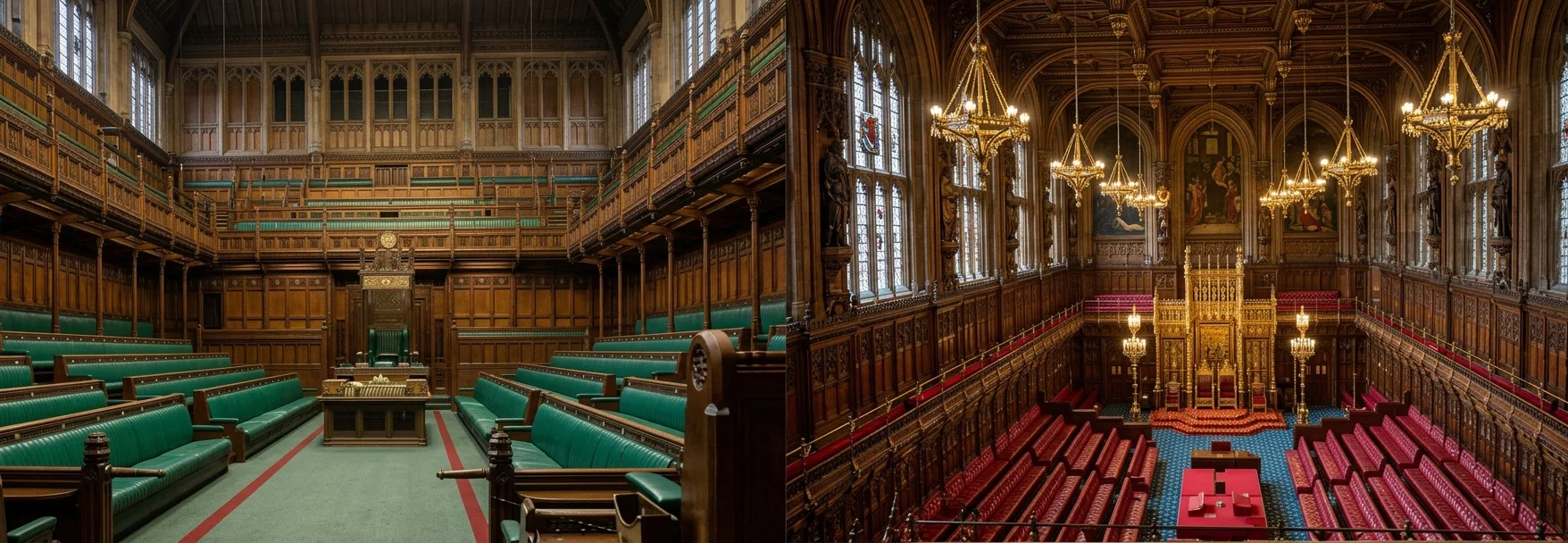
House of Commons. House of Lords.
The Non-conformists undoubtedly had a real grievance in the old Education Bill passed by the Balfour government, but it was a grievance which to some extent naturally grew out of the fact of a state church. Had they recognized this and employed moderate and legitimate means, there is little doubt but that they would in time have secured relief. But when their preachers took to the stump and elected a House of Commons which felt in duty bound to pass a radical bill, they roused the clerical party of the other side, and opened the way for the House of Lords to throw out the bill as a form of class legislation.
The Licensing Bill
The case is much the same with the Licensing Bill. That the country would profit by a strong temperance measure few right-minded men will deny; but many think that the country is hardly ready for it. Moreover, there is honest difference of opinion as to what form legislation should take to accomplish the most good. The country needs to be educated. To work up enthusiasm for a new set of men at Westminster is not very difficult when politicians and clergymen set out together to do it; it is quite another thing to educate public opinion by meetings and the spreading of suitable literature, and then leave it to make itself felt in electing the right men for Westminster; this, however, is the way to accomplish permanent reforms.
In the United States, too, the churches are forming a federation in order that they may make themselves a power in politics. They may in time devise as perfect a political machine as the Free Church Council showed itself at the English election of four years ago, but their efforts permanently to affect the laws of the country are likely to prove as abortive as those of the Non-conformists in England. The reason is that moderate men of all parties strongly dislike to see religious bodies fighting for political power. The minister of the Gospel undoubtedly has political rights and duties as an individual; but his relation to his flock is wholly spiritual. The pastor of a church is not in the remotest sense the political leader of that church. When he poses as such, he is denying his divine calling, and rendering himself unfit to lead his congregation in spiritual things.
History shows that great and beneficent reforms have not come through religious bodies entering the realm of politics. The church will become an increasing moral force in a community not as she endeavors to pull the political wires, but as she keeps absolutely aloof from them in her corporate capacity.