The writer left Singapore for Sumatra December 12, and for the first time in his life was compelled to travel by a steamer owned by a company who do not use the English to any extent. The name of the company betrays its foreign speech: “Koninklijke Packetvaart Maatschappij.” One fears to attempt to speak even a part of the name lest his tongue get into a hopeless tangle. But these are among the easy words; when one strikes the “g” and “ch” sounds in Dutch, he wonders where they are coming from. They are guttural, we are told, and we are sure they must be, but the throat has seemingly to make such an awful effort to produce them that we almost wonder at its endurance as it continues constantly to use them. Suffice it to say that we did not appear over-sociable on the trip.
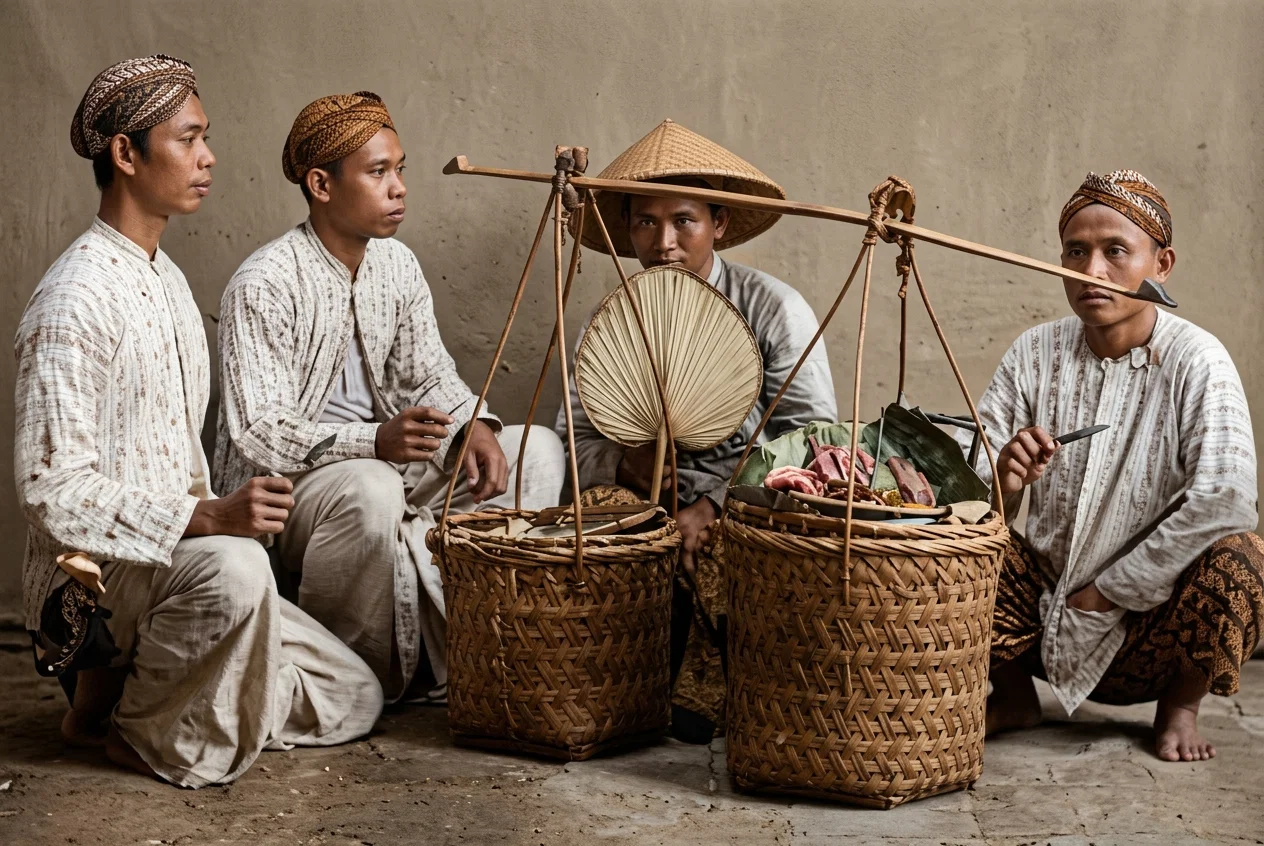
Javanese Meatseller.
Chinese Girl born in Padang.
Orders at the table had to be given to Malay-speaking waiters. But having acquired a small stock of Malay, I got on fairly well in ordering, especially when, under the stress of circumstances, I used the index finger. The food on the ships is liberal, but as foreign as the language. I think if I had the powers to digest what they seem to expect one to eat, I would certainly become as corpulent as some of the owners of these ships. One scarcely knows what food to try, and when he has tried something he is sorry that he didn’t try something else. After having taken some rice and a certain vegetarian-appearing sauce, I spent the rest of the meal sipping ice-water to cool my tongue. Hot peppers enter into many of their mixtures. But I got on better than I at first expected, and found many of the officers agreeable men, and ready to give information. Most of them speak English. On this trip I traveled on four steamers, and have had an abundance of experience, all of which has not been unpleasant by any means.
The trip from Singapore to Padang, Sumatra, was made by way of Batavia, Java. Batavia was reached in three days, stopping on the way at an island by the name of Riouw. Here the natives swarmed about the vessel while we were discharging cargo. Batavia is the capital of the Dutch East Indies and contains a population of about 180,000 souls, the Malays, who have settled along the coast of most of the Indian Islands, constituting the chief part of population. There are also a large number of Soendanese, Bantamese, and Javanese, all inhabitants from different parts of Java. Batavia is a very interesting place in many respects, and we have no doubt that it will play an important part in the work in the Dutch East Indies. For the student of the earlier history of these islands there are a number of old buildings, forts, etc., which are of interest in and about Batavia.
Leaving Batavia by another steamer, we were four days on the way to Padang, Sumatra. The first day out from Batavia brought us to the island of Krakatau, which contains the famous volcano by that name. The sun was just setting behind this huge, barren mountain island as we approached, and the clouds were lighted in the most gorgeous colors, as tho to remind us of the awful fire which belched forth from this monster volcano on Aug. 27, 1883, repeating the experience of Pompeii to the inhabitants of the village Sebesi. And not only that, but the tidal wave that accompanied it, sent forth wide-spread destruction and misery for many miles abroad. This fearful tidal wave rose to the height of seventy-eight feet, carrying a steamer at anchor two miles inland. On the coast of Java over 36,000 people were swept away by this awful besom of destruction.
As we passed along we came to Benkulen, a town dating back to the British occupation of Sumatra, and which still in architecture, pavements, and parks betrays its English origin. A high range of mountains at the back, the lower lands covered with tropical vegetation, and the white sand beach, make a pleasing picture from our ship. One of the peaks, Kaba by name, sends forth vaporous clouds at intervals of about every ten minutes. The open roadstead with the heavy swells coming from the Indian Ocean, make Benkulen a difficult and unpleasant landing. None of the harbors were good till we reached Emma Haven, the port of Padang.
Padang is the chief city of the West Coast, and the residence of the governor, and this is the place of greatest interest to us because our mission is located here. It was first maintained under the charge of Pastor Munson, and later under Pastor Wantzlick. On arriving at Emma Haven, Brother Wantzlick was on hand, and very soon I was conducted to his hospitable home, where I spent a most pleasant time with Brother and Sister Wantzlick, and Theodore, their little son. We visited some places of interest, counseled over the work, and held a few meetings. Thus the time passed too quickly, but we had an interesting and we trust a profitable time. The city of Padang has a population of about 30,000, nearly two thirds of which are Malays, 10,000 are Chinese, and about 2,000 are European. We like Padang much. It is nicely situated, and altho so nearly under the equator, has a pleasant climate, and in point of health much better than many cities in the East Indies.
We thought that we detected a certain degree of fierceness in the natives, so foreign to the humbler appearing Javanese. But as Padang is related to the Malays, we think that it presents great opportunities for labor. From here we can reach into the far-distant interior where some of the inhabitants are wild, warlike, and many not yet brought under subjection to government.
Sumatra has a population of about133,000,000. The people of Acheen, the far northwest of Sumatra, have really never come under Dutch rule, and they have given much trouble. Of late they have been unusually restless and warlike. The Bataks of the interior country of Sumatra are a very interesting people. They were formerly a very wild and ferocious people, cannibalism being common among them. Under the German missionaries many of these heathen people have become Christians, and have been taught many useful trades. A few have been led to the observance of the Bible Sabbath. Many of them show a characteristic independence of mind. We are hopeful soon to have some literature in the language.
At Padang we visited a Mohammedan mosque. We desired to enter and were informed that we were welcome to do so if we should take off our shoes. This we did, not out of respect to Islamism, but because it was the toll, and we were anxious to see what was inside. But there was little there to see. It is a large, square building without any seats, only as the cement floor furnished them, and there were of course no pictures to ornament the great high walls. There were within a few apparently reverent worshipers, bowing down in old-fashioned style. Mohammedanism has apparently a strong hold upon the inhabitants of Sumatra. May the beauties of the Gospel in the preaching of the third angel’s message be made so manifest here that the power of this false and blasting doctrine may be broken in the sight of all!