A Brief Sketch of the Origin and Progress of Seventh-Day Adventists.
Our field of inquiry leads us back only to the great Advent movement of 1840-44. Respecting that movement it is presumed that the public are more or less informed; but they may not be so well aware of the causes which have led since that time to the rise of a class of people calling themselves Seventh-day Adventists.
THE DISAPPOINTMENT.
Adventists looked for the end of the world in 1844, because of the prophecy in Dan. 8: 14, which says that at the end of the prophetic period of 2300 days the sanctuary should be cleansed. They computed that time to end in that year. They held that the earth was the sanctuary then to be cleansed, and that its cleansing was to be accomplished with fire which would accompany the manifestation of the Lord from heaven. Hence they supposed the Lord would then come. There were, of course, many other facts and arguments in support of the view that the second coming of Christ was near, but what we have stated was the principal argument for fixing upon that particular time for the occurrence of the event.
The time passed, and the coming of Christ did not take place as was expected. It then became apparent that a mistake had been made in one or both of the following points: either the period of 2300 days did not end at that time, or the cleansing of the sanctuary was not to be the burning of the earth by fire at the second coming of Christ. While there was a possibility of their being mistaken on both these points, a mistake on either one would be sufficient to account for the fact that the Lord did not then appear.
A movement which had enlisted the whole interest of thousands upon thousands, would not, of course, be abandoned without reflection. The ground was looked over, and two methods adopted for explaining the disappointment. One class jumped to the conclusion at once that they were wrong on time, and the prophetic periods had not ended. Another class, on a careful survey of the whole field, impressed with the strength and harmony of the argument on chronology, saw no ground to change their views upon that point, but became satisfied that the mistake lay in the subject of the sanctuary and its cleansing. This class are the ones now known as Seventh-day Adventists.
SEVENTH-DAY ADVENTISTS SET NO TIME.
They do not believe that any prophetic period given in the Bible reaches to the coming of Christ, or was designed to mark the day or year of that event. As already mentioned, they believe the chronological argument of the great Advent movement of 1844 was all right, locating the termination of the longest prophetic period, the 2300 days, in the autumn of that year. The prophecy said that then the sanctuary should be cleansed. That sanctuary they found to be, not the earth, which is never so called, but the sanctuary of which Paul so fully and definitely treats in his epistle to the Hebrews, "the sanctuary" and "true tabernacle" in Heaven, "which the Lord pitched and not man," of which Christ, our great High Priest, is minister while "on the throne of the Majesty in the Heavens." Heb. 8: 1, 2. The tabernacle erected by Moses in the wilderness of Sinai about 1500 years before Christ, Ex. 25 and onward, which was the sanctuary of the first covenant, Heb. 9: 1, from that time till the first advent, was a type, figure, or pattern of this heavenly sanctuary of the new covenant. Heb. 9: 9, 23, 24. The ministration of the sanctuary consisted of two grand divisions, which were accomplished every year; the daily ministration, and a brief service in the most holy place, or second apartment of the sanctuary, which completed the yearly round of service. This latter work was called the cleansing of the sanctuary, and was performed by the priest. So, likewise, the cleansing of the heavenly sanctuary, Heb. 9: 23, must be performed by Christ while yet a priest, before he takes his kingdom and appears in his glory.14
The view we take of the prophecy, consequently, is that the termination of the 2300 days in 1844 brought us to the commencement of this last portion of Christ's work as priest in the true tabernacle above, called the cleansing of the sanctuary; not a cleansing from physical impurities, but from the presence of our sins, imparted to it through the blood of Christ there ministered in our behalf. This explains at once the mistake in 1844, and shows our present position. We are now in the time of the cleansing of the sanctuary; a period of brief but indefinite duration, reaching to Christ's coming.
While, therefore, we do not throw away the prophetic period, we believe they are to be understood, we believe also that they have been correctly interpreted, and have all terminated; so that now we have no data from which to reason respecting a definite time for the Lord to come.
THE SEVENTH DAY.
Two causes have operated to introduce the observance of the seventh-day Sabbath among Adventists, and thus to develop that class known as Seventh-day Adventists.
First, a Seventh-day Baptist sister, Mrs. Rachel D. Preston, from the State of New York, moved to Washington, N. H., where there was a church of Adventists. From them she received the doctrine of the soon-coming of Christ, and in return instructed them in reference to the claims of the fourth commandment of the decalogue. This was in 1844. Nearly that whole church immediately commenced the observance of the seventh-day.
The Sabbath question began immediately to be agitated among Adventists, and within a few months, many from their ranks commenced its observance.
Secondly, another cause which has tended to strengthen them in the observance of the seventh-day Sabbath is the subject of the sanctuary, to which we have already alluded. It was seen at once that the central object in the sanctuary, in whichever dispensation we view it, is the ark of God, which was enshrined in the most holy place. This ark was prepared expressly as a receptacle for the tables of stone on which were written the great moral precepts of God's government, the ten commandments. Thus attention was called to the law of God. It was also seen that if the law in the ark of the heavenly sanctuary, Rev. 11: 19, is the great original, and that deposited in the typical sanctuary was only a copy, or transcript, that law must read the same now as it read then, and the idea of any change is placed beyond the range of possibilities; that heaven and earth, as Christ in his first sermon declared, would sooner pass than one jot or tittle would pass from the law; and that the fourth commandment requires of the second house of Israel what it required of the first, and has required from Eden down, the observance of the seventh day of the week as the grand and glorious memorial of our creation at the hands of God.
Their Publishing Work.
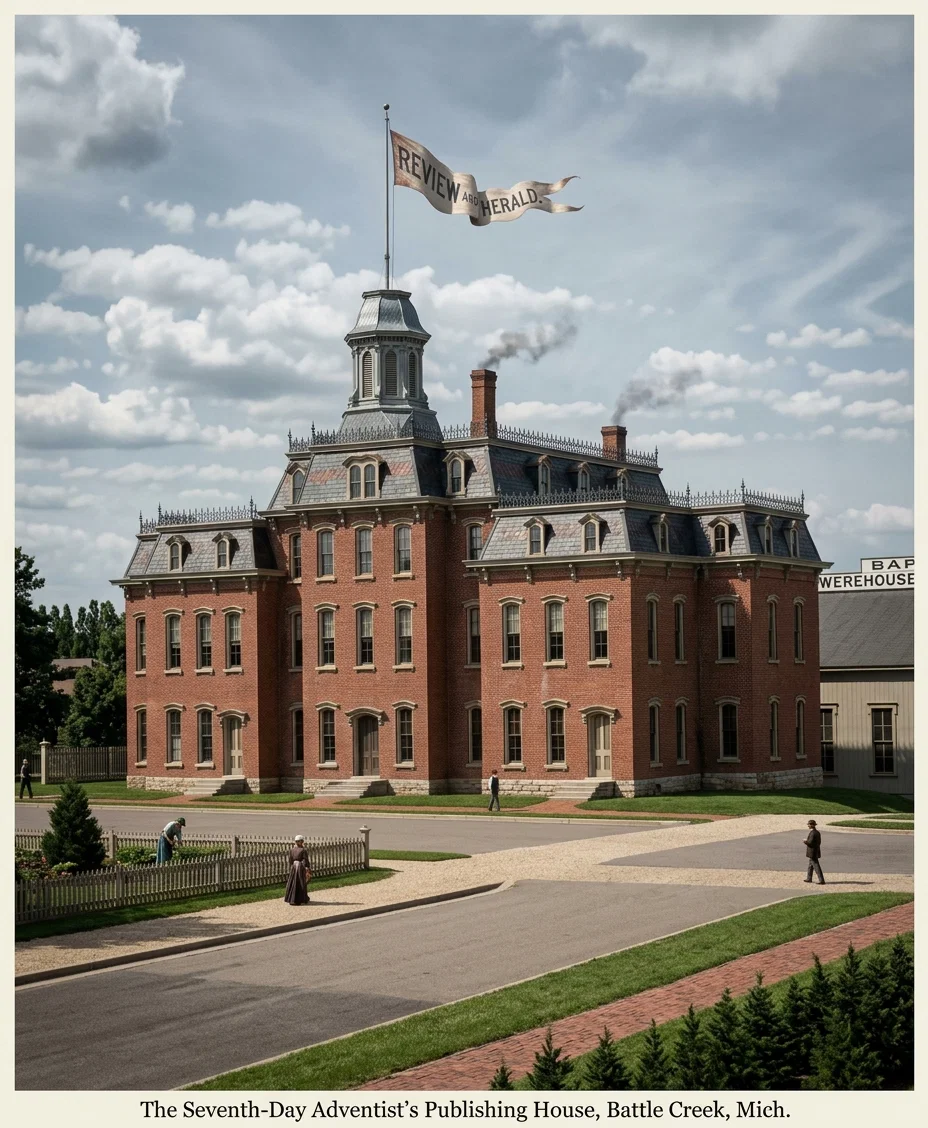
In November 1850, Eld. James White commenced the publication of the ADVENT REVIEW AND SABBATH HERALD, the first periodical issued by the denomination; and in 1861, a legally incorporated association, under the name of the Seventh-Day Adventist Publishing Association, was organized in Battle Creek, Mich.
Besides a large list of English works, forty-four are now issued from this office in the Danish language, twenty-three in Swedish, fifteen in French, and thirty-one in German.
The different periodicals issued at the present time by the denomination, the titles of which are given elsewhere, have an aggregate monthly circulation of from 150,000 to 200,-000 copies.
Books on the prophecies and other Bible subjects have been issued largely from the beginning, and have now reached an aggregate of about three hundred million of pages.
Nearly two hundred hands are regularly employed in the work, and the capital invested is over two hundred thousand dollars.
THEIR ORGANIZATION.
This is exceedingly simple. A body of believers associate together, taking the name of Seventh-day Adventists, and attaching their names to a covenant simply to keep the commandments of God and the faith of Jesus. The Bible is their only creed. A clerk is chosen to keep the records of the church, and an elder, elected by vote of the church, is ordained to look after its spiritual interests. If the church is large, its temporal affairs are assigned to one of more deacons, chosen by vote of the church for this purpose.
Evangelists are ordained ministers, who travel from place to place to preach the gospel, and are the only ones competent to ordain local elders and deacons.
NUMBERS.
They now number 660 churches, with an enrollment of 17,169 members, according to the returns made to the General Conference of Dec. 1, 1882. But owing to the scattered condition of this people, a large proportion of them are not so situated as to belong to any of the church organizations, single families being scattered all the way from Maine to California and Oregon, in all the Northern States, and in many of the Southern. The whole number is estimated at thirty thousand.
CONFERENCES.
The churches in a State combine to form a State Conference, of which there are twenty-seven, viz: Maine, New England (including in this division only New Hampshire, Massachusetts, Rhode Island, and Connecticut), Vermont, New York, Pennsylvania, Ohio, Michigan, Indiana, Illinois, Wisconsin, Minnesota, Iowa, Nebraska, Dakota, Missouri, Kentucky, Tennessee, Kansas, Texas, California, Upper Columbia, North Pacific, Colorado, Virginia; Province of Quebec, Denmark, and Sweden.
The next outward sweep from the State Conference is the General Conference. This is composed of delegates, ministers or laymen, from all the State Conferences. This Conference also annually elects its executive committee of three, to have charge of the doings of the denomination in all parts of the field. The president of the General Conference is the highest officer in the body. The object of the General Conference is to unify the work in all localities, equalize labor, and supply destitute fields with help. Twenty-one annual meetings have been held by this organization.
THE HEALTH AND TEMPERANCE REFORM.
At the present time the whole body of S. D. Adventists are abstainers from the use of alcoholic drinks of all kinds. Tobacco, in all its forms, is also discarded, none addicted to its use being received into the churches except upon the promise and expectation of its immediate abandonment.
A society known as the American Health and Temperance Association has been recently organized among this body of Adventists, which requires of its members to sign one of the following pledges:
TEETOTAL PLEDGE.—I do hereby solemnly affirm that with the help of God I will wholly abstain from the voluntary use, as a beverage, or in any equivalent manner, of alcohol, tea and coffee, and from the use of tobacco, opium, and all other narcotics and stimulants.
ANTI-RUM AND TOBACCO PLEDGE.—I do hereby solemnly affirm that with the help of God I will wholly abstain from the voluntary use of alcohol in any form, as a beverage, or in any equivalent manner, and from smoking, chewing, or snuffing tobacco, or using it in any other form, and from in any way encouraging the use of these poisons.
ANTI-WHISKY PLEDGE.—I do hereby solemnly affirm that with the help of God I will totally abstain from the voluntary use, as a beverage, or in any equivalent manner, of all liquors or substances containing alcohol.
The Association has subsidiary State societies and local clubs in nearly all parts of the United States. All S. D. Adventists, with very few exceptions, are signers to the teetotal pledge.
For the purpose of inculcating the principles of this reform and for the introduction of improved methods of medical treatment, especially for chronic invalids, the "Health Reform Institute" was founded Sept. 5, 1866. The institution was legally incorporated April 6, 1867.
A subscription of twenty-six thousand dollars was raised, which has since been increased by additional subscriptions, and the workings of the institution to over sixty thousand.
Increasing patronage demanding more facilities, a large building 120 by 130 feet, four stories high above the basement, provided with modern improvements, and opened for patients April 10, 1878. The old main building and seven cottages are also occupied by the institution, now known as the Medical and Surgical Sanitarium.
The International Tract and Missionary Society.
The object of this organization, which embraces twenty-eight State, or branch societies, is first, to systematically canvass the country with religious books, tracts and pamphlets, to obtain subscribers for our various periodicals, visit the sick, call upon, converse and pray with families and individuals; and second, in a more general way, to seek out openings for reading matter, and fill them, in all parts of the world.
Although of recent organization, between two and three hundred thousand dollars have been employed in carrying forward this work. Thousands of volumes, largely bound books, have been placed in public libraries, on board vessels, etc.
A distribution of about six million pages of reading matter, besides about five hundred thousand periodicals has been made annually for several years in the past. The present year their missionary operations have more than doubled. Five thousand bound books alone have been presented to libraries. A large number have been sold, also thousands of subscribers have been obtained for periodicals, in advance of other years. Mission and reading-rooms have been opened in New York, San Francisco, Liverpool, etc. from which publications are sent to every civilized nation.
The work is successfully carried on among the Danes, Norwegians, Germans, Swedes and French in this country; also in England, Switzerland, Denmark, Sweden, Norway, Germany, France, Italy, and the West Indies.