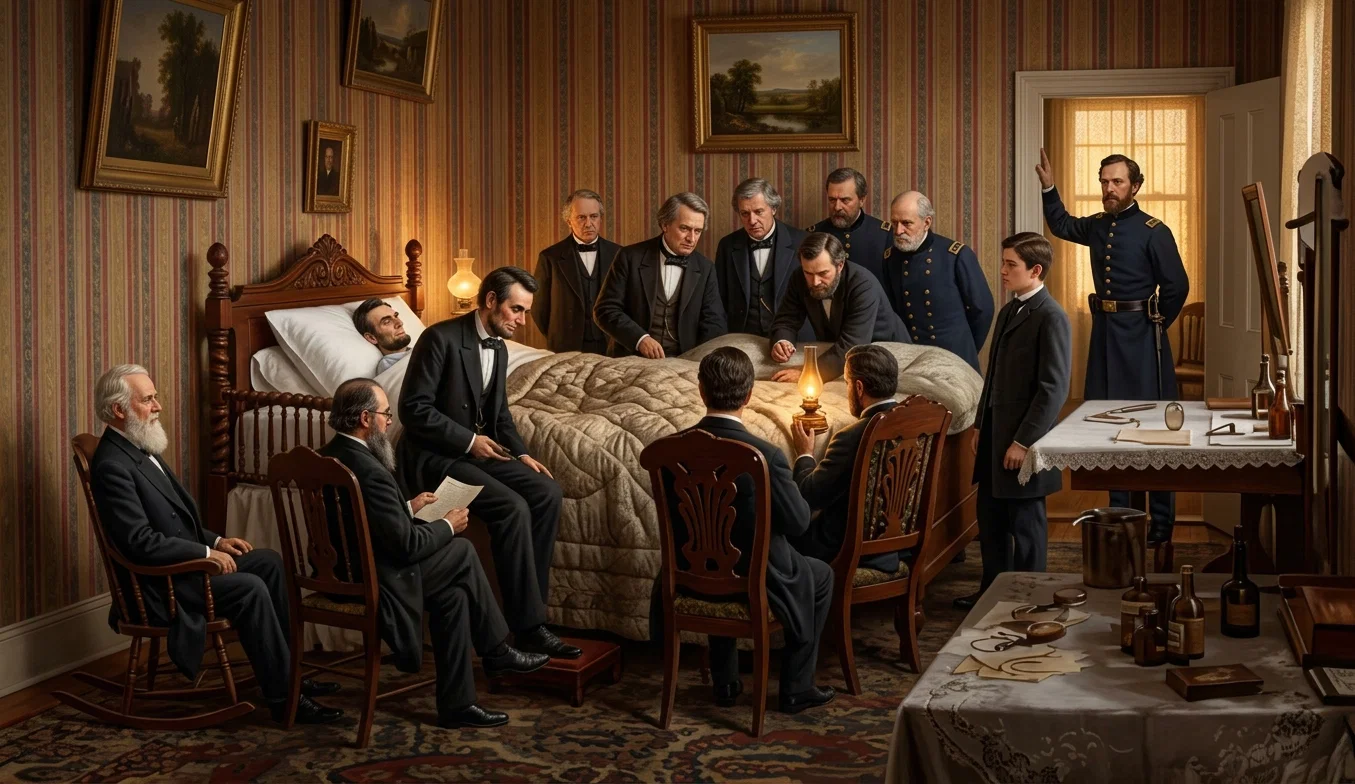
Much, very much, was said of Abraham Lincoln on the centenary of his birth, February 12. We believe that the anniversary of his death should cause all true lovers of country and liberty to pause a little time and consider the principles which made the man what he was, and which placed him in a position which resulted in his death, and to inquire what hold these principles are having upon the body politic now.
There may be others, but the following traits of character stood out prominently in the life of the Kentucky “rail-splitter,” the indifferent “clerk,” the “backwoods surveyor,” the “awkward country lawyer,”—for by all these terms has he been called,—and made him what he became, a mighty chief among men, and under God a saviour of his country.
1. SIMPLICITY.—There was nothing “put on” about Lincoln. The artificial was unknown to him. His simple but effective style of speech was garnered largely from the Bible, one of his best-read books. His primitive life in the forest and field, surrounded by all the open transparencies of nature, bred within him the simple, unaffected manner which put timid souls at ease and won hearts. And he was simple and natural to the end.
2. HONESTY AND INTEGRITY.—We are told that he was honesty personified. When in the practise of law, in the statement of the case before the jury, he would state as fairly his opponent’s side as he could his own. No judge, sitting upon the case, could do it more impartially, we are told. He did not do this that he might the more readily win his case; he acted as he did from his innate honesty. He would not take a case in which his client was acting dishonestly if he knew it; and if dishonesty developed during the trial, it always affected his advocacy.
In his early career in the practise of law he often showed at a disadvantage, for he was far from a “well-read” lawyer; but as the years went by, the people came to know him, they knew his honesty, his integrity, his absolute dependableness. They could trust him. He would brush aside all the little technicalities of the law, often used to defeat justice, and would base his case upon his sound, logical, analytical argument, and his honest statement became convincing. The sobriquet, “Honest Abe,” had a real basis in character. He demonstrated that “honesty is the best policy,” but only so when it is never used as a policy but the outcropping of an inborn principle.
3. JUSTICE.—He believed in justice. A sincerely honest man could not do otherwise. It was not for justice for the rich or great that he stood, but for the individual, how humble soever he might be. Things must be fair. The other man must have a fair chance. He would take no mean advantage of an adversary. Whole-souled justice and fairness himself, he believed that his opponent had the same right. He did not talk “square-deal,” but he gave it on all occasions.
4. TRUTHFULNESS.—One of his old acquaintances declared that he was truthfulness personified. He did not act a part. Some of the mighty speeches he made for liberty, his most intimate friends plead with him not to deliver, because it was “not expedient,” it would “hurt his chances,” it was not “good politics.” That mattered not to Lincoln. The truth must be spoken at whatever cost. Whitney declares that he was not only morally honest; he was intellectually honest, or true to his standard of right. Other great men can argue on both sides of a question if expediency demands; Lincoln could not thus falsify. His greatest trophies were, indeed, moral achievements. But the basis of all true moral achievement is the love of truth.
5. MAGNANIMITY.—Every man in active public life is bound to make enemies. This is inevitably true if he is honest, conscientious, truthful, just. It is even more likely if he is popular, and yet lacking in grace or culture. Most public men become enemies to their enemies. Some of them hold their enmity implacably to the end. It was not till the closing years of his life that Jackson could forgive his enemies. Mr. Lincoln seemed to have none on his part. He held no hardness against his most caustic critic, against his most inveterate enemy. Anecdote after anecdote is given in the various biographies of Lincoln illustrating this trait in his character. His was no little mind. It could busy itself with the smallest details where principle was involved, it could sweep away all the punctiliousness of centuries of precedent—court and social—if it stood in the way of direct justice or affirmative truth and honesty.
6. HIS LOVE OF LIBERTY.—He learned it from the trees and mountains and streams; from the purling brook and the deep-toned thunder; from the songs of the birds and the shining of the stars. Nature dealt with him openly, frankly; and the Bible pressed home all her principles of simplicity, truth, honesty, and freedom. It was love of liberty which impelled him to say: “If slavery is not wrong, nothing is wrong.” “He who would be no slave, must have no slave.” “They who deny freedom to others, deserve it not for themselves, and under a just God can not long retain it.” He saw that the country could not exist half-free and half-slave; it must be one or the other.
Had he lived, all his plans for reconstruction might have been thwarted by unscrupulous politicians. But his magnanimity, his love of mankind, his abounding generosity, would not have permitted the regime of carpet-bagging which followed the Civil War, and would not have aroused the bitterness, the enmity of the stricken South. When Abraham Lincoln died the morning of April 15, 1865, the South lost her best human friend.
7. COURAGE.—His was a courage born of righteousness and faith. He believed in all these principles we have named. They were essentials in his character. Justice, integrity, honesty, truthfulness, magnanimity, love of liberty, were attributes of Deity, God-given to man. He knew they were of God. He knew, or seemed to know, that God had called him to their manifestation and exemplification in politics and government, and his marvelous courage was the fruit of his faith. Mr. Whitney, in his “Life and Works of Lincoln,” says: “Mr. Lincoln’s preeminent greatness lay in the combination of the powers of analysis and synthesis. He could discover and unmask a fallacy more completely than any other living man; and he could define a moral, political, or legal issue more perspicaciously than any statesman in American history.” But in all the questions where these powers of the man were revealed moral principles were involved, and the moral principles in the man enabled him to see clearly the strength or fallacy of a proposition. The greatness of Lincoln rested in the moral man, in his absorption of divine truth, in his simple life, in his great love of humanity.
How Much Has Been Gained?
Look over the land. Note the prominent statesmen of our nation. Witness the political chicanery and graft and fraud and dishonesty and double-dealing in our city, state, and national life, in commercial, social, political, religious circles; in the capital-and-labor worlds. There is no slavery under the Constitution, but in fact it still exists in our great factories and mines and cities, our trusts and unions.
The religious world is seeking to bind the11bands of the tyrannies of the medieval ages upon modern humanity. Under the guise of necessity and benevolence it is demanded that all shall observe outwardly, at least, a religio-political sabbath by law. From Maine to California the struggle is on. Confederations which ignore the very foundation principles of Christianity are behind the efforts. The individual under the increasing influence of socialism in various forms is ignored and his rights forgotten, while the mass is becoming more and more in evidence. Men forget that the rights of all are the equal, inalienable rights of each one.
For the principles of liberty Abraham Lincoln died. For those principles God calls men to live to-day. Preeminently, perfectly, they have been found in but the one Man—Jesus of Nazareth. For them He died. We may be called to die as did He; and the espousal of these principles may mean death; but there is no other way to a true earthly manhood, to an inheritance eternal.