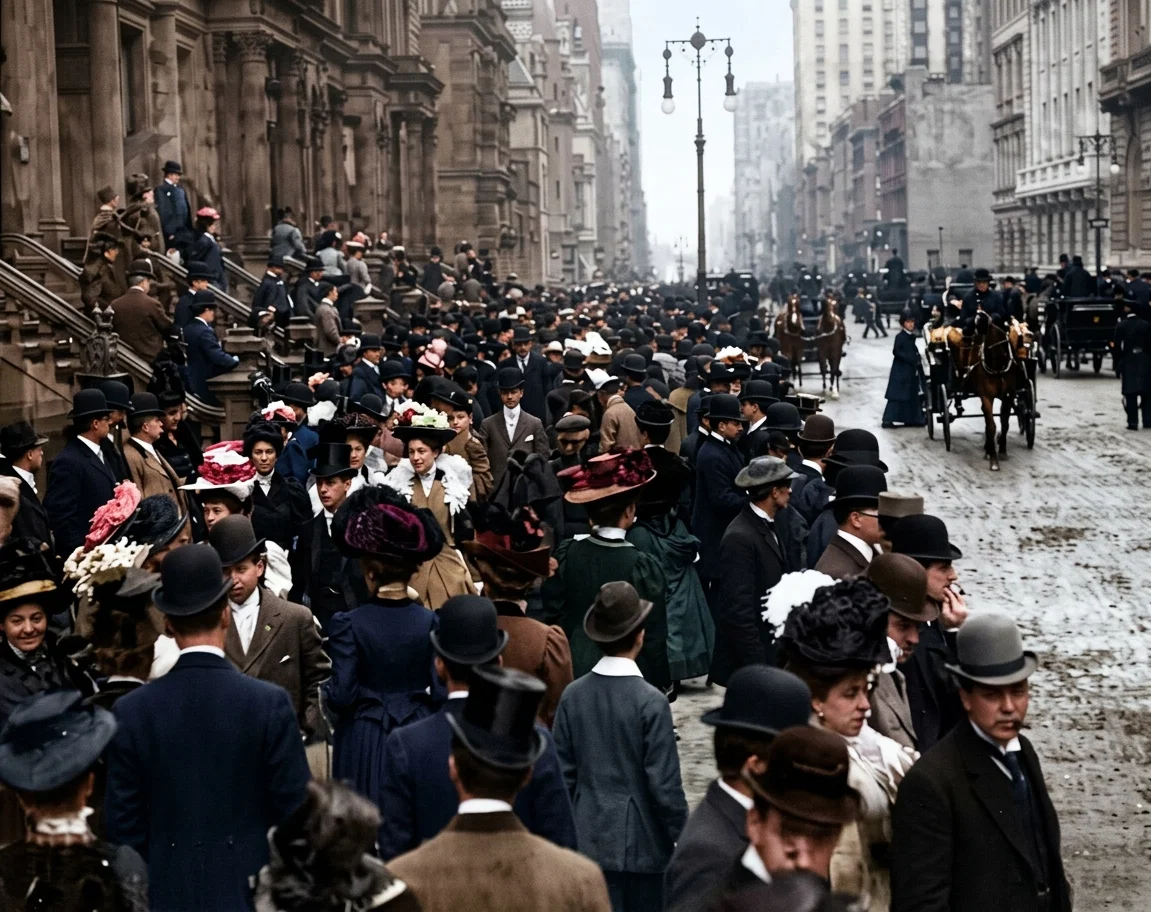
Copyright, Underwood & Underwood, New York. Easter afternoon on Fifth Avenue, New York, when the new spring styles are exhibited to crowds of admiring onlookers. The Resurrection and its meaning are forgotten.
LOOKING at it from a purely human standpoint, it would seem that if there is any place on earth where truly Christian ordinances ought to be kept in the right spirit, it is the Holy Land. But it is a sad fact that some of the most distressing scenes are enacted in connection with various religious festivals. This is especially true in two places, at two seasons of the year. The first of these seasons is that of Christmas, and the special place is Bethlehem, in what is called the Church of the Nativity. Of course one knows nothing about whether the church is in the right place or not; it may be and it may not be; the probabilities are that it is not. At any rate a church has been built there on the very place where Jesus is supposed to have lain when a child, and the particular spot marked by a star.
This church is held by three different denominations, the Greek Church, the Armenian Church, and the Roman Catholic. The rights of each, the place they are to occupy, the time, the duration, the manner of their services, even to the number of times they may burn incense, the portions of the walls, pillars, floors, etc., they may sweep, the hanging of their lamps, and all other details are prescribed by imperial decree from Constantinople, the Rev. H. J. Shentone tells us.
Nothing of this kind would be necessary were the devotees of these various churches Christians. It is because of the spirit of strife among them that a Mohammedan power must step in and keep the peace. Armed soldiers are continually on guard, and whenever any great festival or noted religious day calls for united worship, the conditions are nearly always deplorable, and many times disgraceful. Turkish soldiers, armed with rifles, stand guard night and day in the grotto of the manger, and a larger detachment of troops are present on Christmas and Easter to forcibly quell the disturbances between the rival sects.
Some portions of the buildings are cleaned only once a year, and a special order from Constantinople must be obtained. There is one window in the grotto that is never cleaned. Each sect has its designated localities, which once a year it may clean, but which no other may clean; while some bits of the wall are to be cleaned first by one sect and then by another. Whenever the cleaning days come, the governor of Jerusalem must be represented even in Bethlehem, and the mayor of the city must be there.
We are told that at one time there was a space, the right to clean which was in dispute, and when the signal to sweep was given, the priests of two parties rushed at the work, took each other by the throats; each party tried in every way it could to force the other from the place. Mohammedan soldiers had to separate them.
Years ago the Armenians succeeded in obtaining permission from the Turkish Government to hang a lamp chain in a certain portion of the church, and to the surprise of the governor of Jerusalem, whose duty it was to oversee the affair, the Greek ecclesiastics did not object. The chain was suspended and fastened in place, but when an Armenian priest wanted to place a lamp there the Greeks objected, and the Armenians have not been able to place the lamp there, for which the chain was hung, to this day. The chain still hangs, as Mr. Shentone remarks, “a memorial of Christian intrigue and violence.”
A few years ago, while one of the sects was cleaning the silver star that marks the spot where Jesus was supposed to have been born, in the crypt of the church, one of the nails that held the star in place was broken off; rival priests were at once on the scene. The soldier on guard gave notice of the momentous occurrence and the governor was summoned. The nail must be replaced. To the governor it was a simple thing to call in a blacksmith in the neighborhood to repair it, but when he appeared, he happened to be one of the sects, consequently was forbidden to do it lest a precedent might be established to the advantage of the sect to which he belonged. Finally the nail could not be replaced until a Gypsy, one who had no name or standing, was brought in to do it.
In the Holy City
So it is at Jerusalem. The same scenes are enacted there at the church of the Holy Sepulchre. Armed Turkish guards keep the peace between those who sing the songs of the birth, the crucifixion, and the resurrection of our Lord. It is an utter and wretched travesty of the Gospel.
On “Easter” day a procession may be seen on the Via Dolorosa or “The Sorrowful Way,” the way in which it was supposed that Christ went to the cross. Turkish soldiers must be on hand at such times, not to prevent violence on the part of outsiders, but to keep the peace between professed Christians.
O, if these churches could but learn the message which the Lord sent to His church on that resurrection morning: “HE IS NOT HERE; HE IS RISEN; HE GOETH BEFORE YOU INTO GALILEE; THERE SHALL YE SEE HIM,” they would be out in the great world living for Christ and winning others; yet not to the honoring of dead, empty places or forms, but to the worship of the living Christ and the bringing of His power to those who are sitting in darkness and death.