The Meaning and Outcome of the Great Battle-Ship Cruise
At a cost of more than ten million dollars the American fleet of sixteen battle-ships sailed around the world and came home without any noted accident or trouble.
It is hailed as a wonderful feat, and we presume that it was, altho they met no particularly rough weather, and they were welcomed by friends at every port where they stopped.
It has, however, stirred up the war spirit, the spirit of emulation, in all the great countries of the world. Americans, of course, feel that it is a great education to the sailors; but the fighters in other nations will feel that they must have as great a navy as America. The Frankfurter Zeitung declares: “This tour of the world has from its sheer success set the great nations into a sort of frenzy of emulation. Already we hear of a repetition of the experiment by a huge British squadron, which, of course, means that Germany must in time follow suit.” And the Berlin Post remarks that the next squadron that tours the globe will want to better the American record in the matter of time; while the Avanti of Rome declares that this maneuver “is proving the curse and scourge of mankind.”
The Berlin Kreuz Zeitung places all of the credit of the great achievement to Mr. Roosevelt; declares that “as Washington still lives as the first President and Lincoln as the martyr President, Roosevelt has immortalized himself as the battle-ship President.” To peace lovers it is not a very flattering title. And the Hamburger Nachrichten declares that Theodore Roosevelt “has benefited not his own nation alone, but all mankind,” seeing that “naval power is the true test of the greatness of a land.” What a sad commentary this is on the boasted civilization and advancement of Christianity. But this praise is echoed by a writer in the Leipzig Grenzboten, who anticipates a time when the Dreadnoughts of the fatherland will exceed 60, all less than 20 years old, all equipped with 13-inch guns only, and adds: “Mr. Roosevelt has brought that prospect nearer for ourselves, and to that extent we owe him a debt we can never repay.”
And the Süddeutsche Reichskorrespondenz adds that had it not been for the cruise of the sixteen units, “we might be satisfied with few ships.” Surely this is evidence enough, altho more might be given, to show the evil influence of this idolized voyage around the world.
Going in this direction the Paris Eclair estimates that in the year 1914 Great Britain “will rejoice in the possession of seventy-two battle-ships, each larger than the Dreadnought, Germany will have thirty-nine, France thirty, and the United States at least as many. Japan will then have twenty-one Dreadnoughts.” Thus they measure the extent of the influence exerted by the initiative of Mr. Roosevelt. “He has vindicated the 13-inch gun,” observes the Paris Figaro.
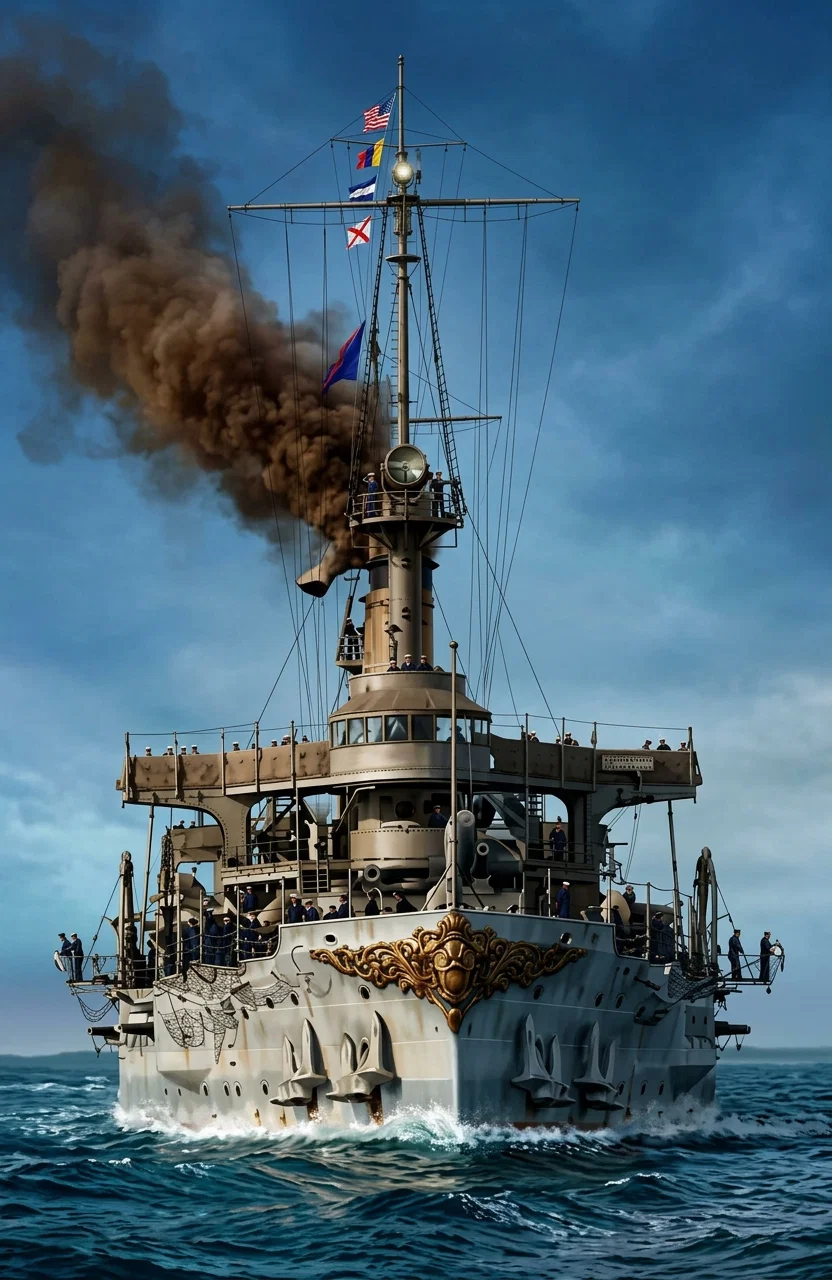
THE BATTLE-SHIP “CONNECTICUT”
This 16,000-ton monster will soon be not only a pygmy, but a back number, compared with the battle-ships now building.
The Unsupportable Burden
But on the other hand there are some newspapers which see the other side, and that is the awful financial burden. Remarks the Armee et Marine, of Paris, “How glibly the powers talk of sending a fleet around the world in the wake of the American squadron. But could they do it? Japan has not the seamanship; France has not the ships; Germany has not the money.” But there still remains some life-blood in the people, and the people can be bled. Just now the strife between England and Germany has become unbearable. Some of the strong men in the English ministry are for laying down the keels of six Dreadnoughts this year, while others are contending that it must be cut down to four. What kind of compromise will be worked out no one knows. There are those who contend that Germany is doing even more than this, but is keeping it to herself. An article in the Scientific American asks the question, “Which shall be the second sea power—America or Germany?” and goes on by statistics to show that while the United States is a little ahead of Germany at the present time, yet if the program is to be but two great battle-ships a year, Germany will soon be far in advance of America.
Are the Battle-Ships Vindicated?
There are those, who seem to know these things, who are really questioning whether the great battle-ship cruise is a success after all. We are reminded that the experiments along torpedo lines may demonstrate that the battle-ship is not so formidable as it may seem. The little torpedoes may find it exceedingly vulnerable, and may easily destroy the millions of dollars piled up in the huge steel monsters, as well as the thousands of men who man them.
And so the strife goes on, and the great burden grows heavier and heavier, and the backs of the people are bowed to the breaking. For it is not upon the great manufacturers or the wealthy people of the world that the burdens rest the heaviest. Many times they are among those that profit the most in adding to the burdens of their several countries. It is upon the shoulders and backs and prostrate forms of the great mass of the people that the burden rests and is resting heavier and heavier.
Take our own government for instance. The Spanish war year deficit was $89,000,000, only a trifle more than the last eight months’ deficit, which is $86,000,000. The deficit from the Spanish war was the largest in twenty years. The next largest was $69,800,000 for 1894, following the ’93 panic. The deficit of this entire year at the present rate will be greater than any since the Civil War.
Appropriation bills last Congress exceeded one billion dollars, and Chairman Tawney of the Committee on Appropriations gave warning that it was doubling the deficit. Last year it was $60,000,000. At the present rate, the present year will reach $130,000,000 by July 1, and we are told that Congress has again increased appropriations making the total $1,044,000,000; or an augmentation of $35,000,000. This is considered by some a “mere trifle,” and yet if the expenditure is to go on at this rate a great while, it will certainly not be a mere trifle for the great rich country of America; and we are told that one half of this expenditure is for war purposes. The burden is still heavier on the people of the Old World.
What is the cause of all this? It certainly is not found in the natural desire of man for war and death-making. It is the word of God which reveals the reason of it. That is found in Revelation 16: “Spirits of demons which go forth unto the kings of the whole world to gather them together unto the war of the great day of God the Almighty.” A mad desire for power and place is taking possession of men and nations. Blessed is he who is not drawn into the awful vortex.