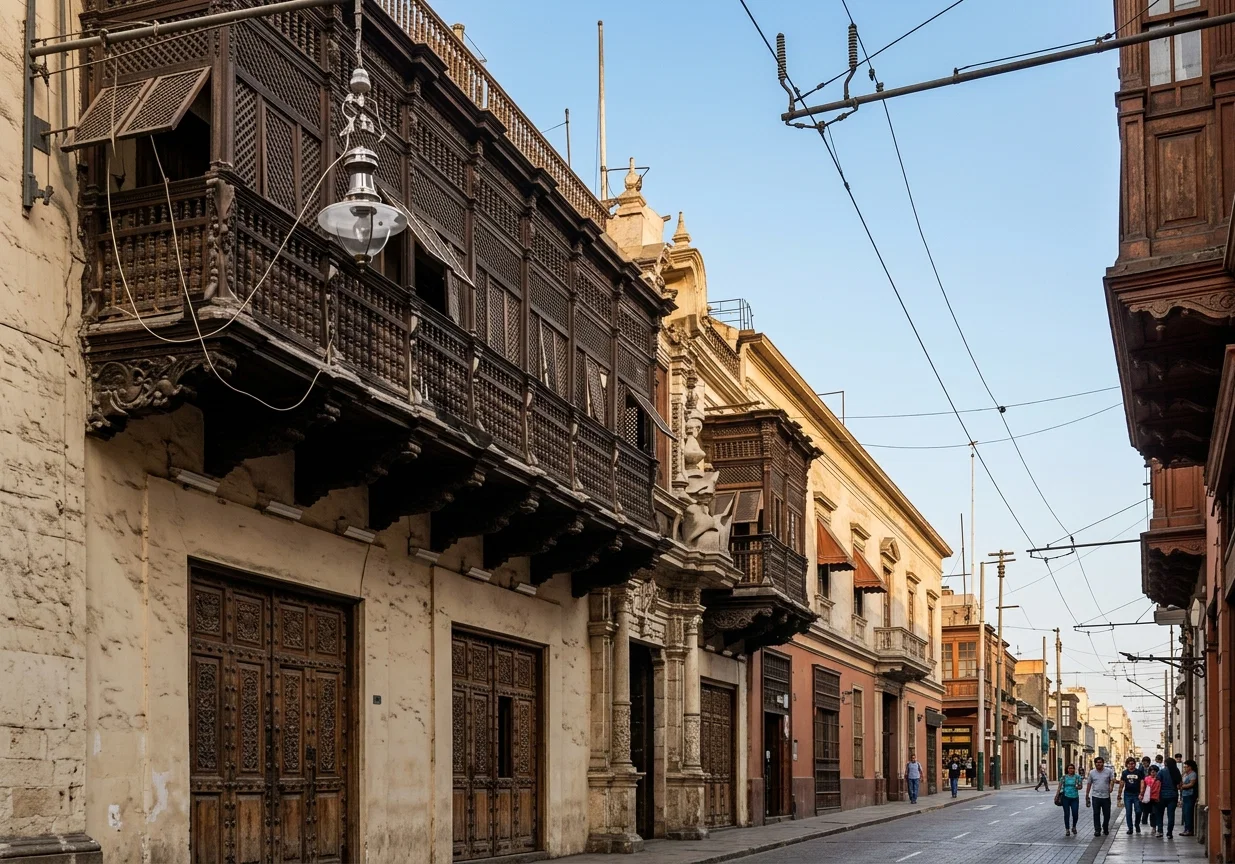
For the traveler there are many interesting things about Lima, Peru. The city was founded by the bold Spanish adventurer, Pizarro, who conquered for his country this wonderful land of the ancient Incas. Remains of the old wall, made largely of stones and earth, still stand as reminders of the tragic story of the past. The great stone bridge, with its arches of solid masonry, built about three hundred years ago, still carries its thousands of pedestrians daily. Many of the ancient houses still stand, apparently in good condition. Perhaps one of the most interesting is the old palace of the Spanish Viceroys. It is situated near the business center of the city and is much visited by tourists. Its massive doors, hung on old-fashioned hinges embedded in masonry, show evidence of the wear of centuries. In the patio protrudes from the wall a huge wooden beam, carved in fantastic shape. This is said to have supported the balances that weighed the gold sent to Spain. In the patios of many of these old buildings are large paintings of Scriptural or historical scenes. Some of these are quite valuable.
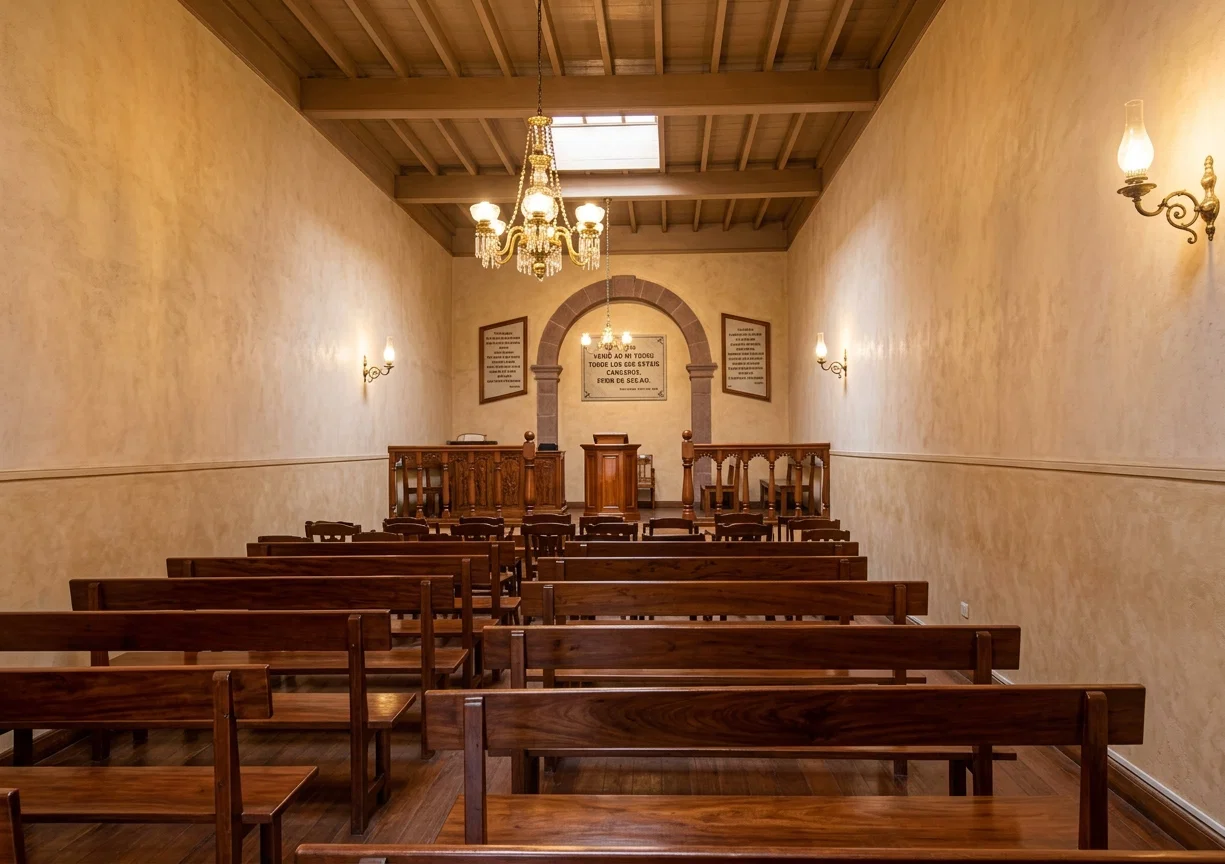
Protestant Mission Hall, Lima, Peru. From a work "Peru," by Miss Geraldine Guinness.
Lima, ancient and modern. The building on the left is an old palace of the Viceroys.
The city has a large number of plazas, or small parks, adorned with trees and flowers as well as statuary. Lima was once very rich in these works of art, but the Chilean conquerors in the war of 1877 to 1883 carried off the most and the best to adorn the streets and parks of Valparaiso. They also despoiled Lima of its fine zoological gardens, said to have been the best then existing in South America.
As one walks the streets of the city, he can not but note the number and size of its churches and convents. Altho the population does not exceed 150,000 and the city covers an area much less than an American city of the like population, still there are fifty-seven Catholic churches and convents. Many of these establishments cover whole squares in the best portions of the city. One of the oldest churches is that of San Pedro. It is still one of the most beautiful and most frequented churches in Lima. Its furnishings must be worth an immense sum. All is arranged to arrest the eye and awe the imagination. To the left as we enter the door, stands a gilded casket, with the front side of transparent glass. Within the casket lies a life-size image of the Saviour, showing in face and form all the signs of a terrible death agony. Above this, in a niche in the wall, stands another life-size image of Christ, crowned with thorns, His hands in chains, and blood streaming from His temples. These are surrounded by other images of “saints.”
As we go forward toward the great altar, we see various groups of images differing in their attitude and arrangement. Special prominence is given to the Virgin Mary; indeed in all the churches which I have visited, she occupies a place much superior to the Saviour.
This church is seldom completely empty. One can find, at almost any hour, kneeling forms bending before these lifeless statues, some praying, some weeping, some making the sign of the cross. Here an old man, there an aged woman, next a youth, or even a child, all seeking for pardon and peace, but going away unsatisfied. How the heart pities these poor suppliants! How we desire to make known to them the free grace of the compassionate Saviour of men!
The other day I visited, in company with a passing missionary, the great cathedral. This building faces on the principal plaza. It was founded by Pizarro himself in the year 1535, altho not fully completed until nearly a century later. The “sacristan” was kind enough to pilot us about the building and tell us something about its treasures.
Fully to describe all the valuable possessions of this edifice would fill a small book. I suppose that they are worth millions of dollars. One of the first things that we noticed was a holy-water fount made of solid copper. It is about four feet high and the bowl is about two and one-half feet in diameter. It was made at the founding of the cathedral in the sixteenth century. In front of the great altar there is a huge mass-book. It is two and one-half feet high and two feet wide and about six inches thick. The leaves are of lambskin. This also was prepared for the church in the sixteenth century and is still used in saying mass.
Surrounding the altar there are twelve pillars one foot in diameter and fourteen feet high. These are heavily plated with pure gold. In a recess by the side of the altar I found a painting fifteen feet square made in 1625 to commemorate the dedication of the cathedral. It is in a good state of preservation.
About midway along the northern wall of the building, in one of the numerous recesses, we saw the beautiful picture of the Virgin which Charles V., of Spain, gave to the cathedral. It is a painting, but the features seem to stand out as if it were in relief. The painting is made to stand on a pedestal of solid silver and is surmounted by a crown of purest gold. At the foot of this image stands a casket, enveloped with a heavy black veil. Our attendant brought a lighted candle, lifted the covering and there, exposed to our view, but protected by a pane of glass the entire length of the casket, lay the mummied remains of a human being. It was the body of the great discoverer and conqueror, Francisco Pizarro.