The Chicago Daily Tribune keeps what is probably the best record of news in the United States of any paper published. On the first of the year it issues its summary. Here are some of the figures which that paper has given for 1908:
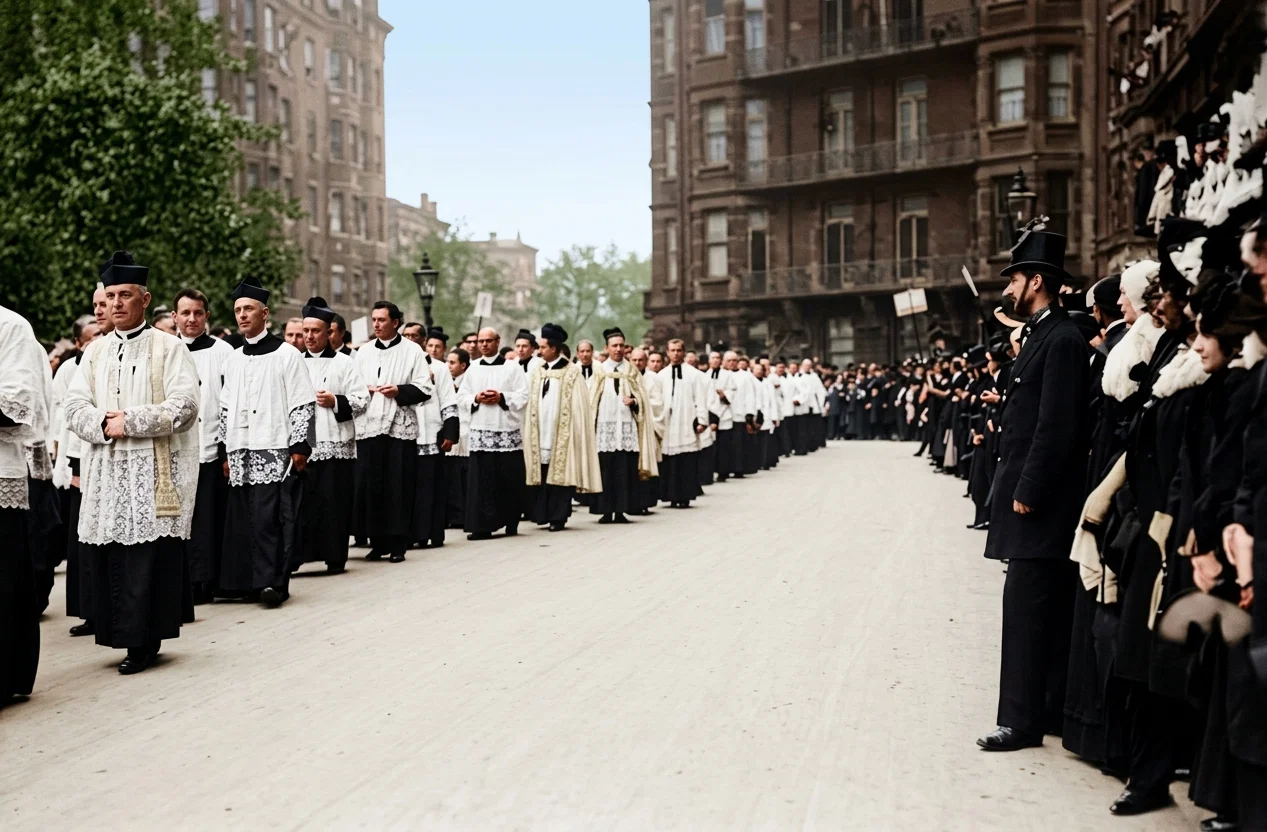
The great procession at the Catholic Missionary Congress, Chicago, Nov. 15 to 18, 1908. A company of the clergy.
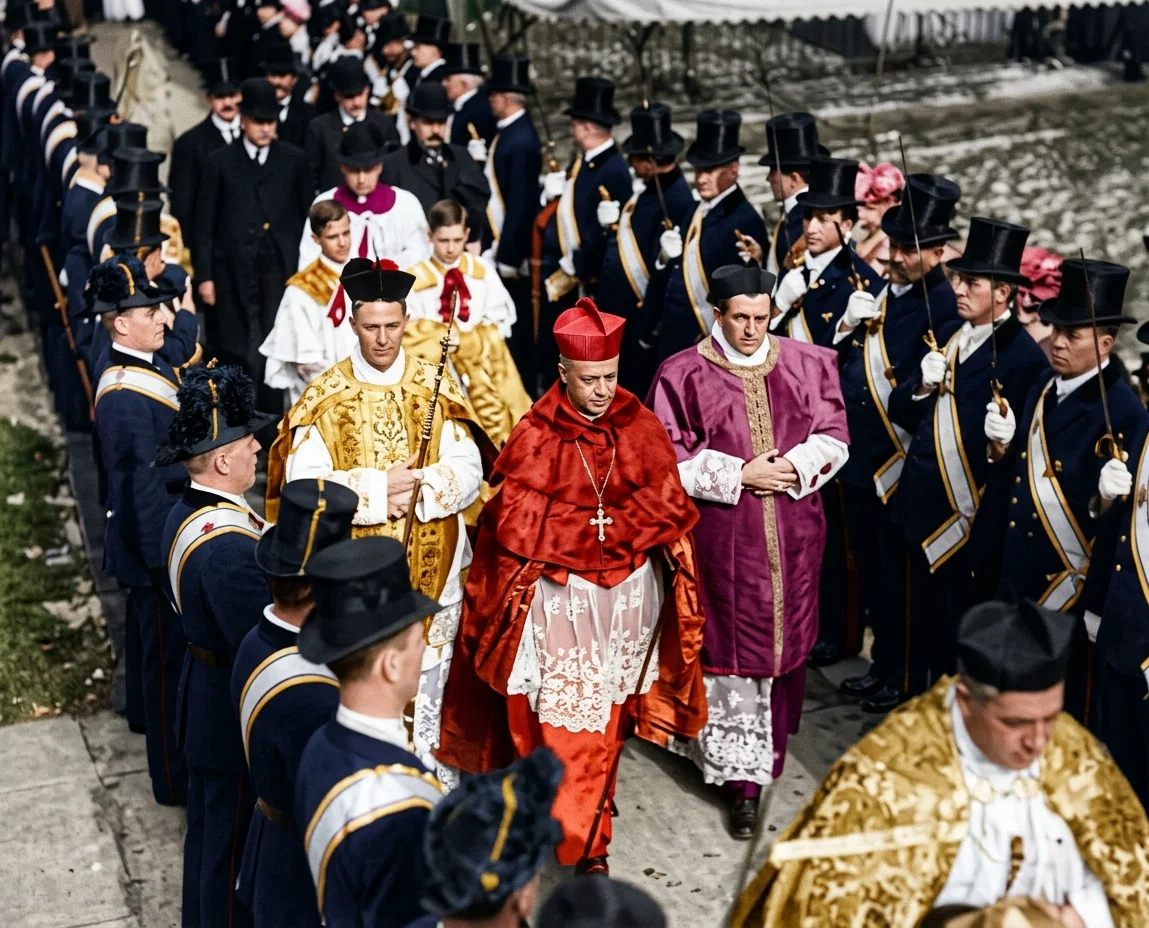
At the Catholic Missionary Congress. A procession of priests, guarded on each side by Knights of Columbus. Papal Delegate Falconio in front.
Of the accidents or disasters during the year, including some of the most extraordinary fatalities and disasters abroad, none of which are recorded, numbering less than 5, there were 236,568 lives lost. This places the loss of life in Italy at 125,000. It was probably 200,000. In that case the loss of life would be more than 300,000. Of the others, 5,000 of the 300,000 were lost in a flood at Hyderabad, India; 5,000 in a typhoon, October 17, in China; 1,000 in a typhoon, July 29, in China; 2,000 in a flood in Asia Minor, July 16; 2,000 in a flood, April 13, in China; and May 13, 10,000 in a flood in China. Twenty-five thousand have perished in China alone from floods and storms. In this country alone, 1,335 perished from fires; 1,679 from drowning; 766 from cyclones, storms, and lightning.
Embezzlements in this country in 1908 amounted to $13,555,536 which were discovered. This is greater than last year, and two thirds of this large amount must be charged to bank officials and employees. Ten bank presidents, 28 cashiers, 11 bank clerks, and 4 brokers have embezzled over $10,000,000; public officials nearly $350,000; forgers over $1,328,000; postmasters, $5,450, and a miscellaneous lot the rest.
The suicide record was an increase on the year before—10,852 reported in the public press, increasing from 5,340 in 1899. Since that time there has been a steady increase every year. Of the last year, 7,864 were males, 2,988 females. Among professional men, physicians as usual head the list; 16 lawyers, and 14 clergymen were guilty of self-murder. There has been a great increase in suicides during the year from business losses—634. Liquor is made responsible for 536, altho it probably figures in a great many of the others. To despondency is laid 5,318; domestic infelicity, 738; of those disappointed in love, 519.
The number of deaths of all kinds of personal violence in 1908, except suicides and lynchings, as recorded by telegraph and in the newspapers, was 8,952, an increase of 240 over 1907, in which year the number was 638 less than in 1906. But the gain in general has been slow and steady for a number of years. It is difficult to get at the causes of all of these; some may be accidental, and then there are on the other hand many murders that never come to light in the papers. Of these deaths more than half are attributed to quarrels. A very steady increase is also noted of murder by highwaymen—712, 101 more than in 1907. Liquor is responsible for 786. It probably is basically responsible for the majority of them.
The lynchings in 1907 were the smallest in 20 years; in 1908 they were 100, the largest number since 1903; 97 of these were in the South, 3 in the North; 93 were negroes, and 7 were whites. The causes given are 34 for murder, and 24 for criminal assault or attempted criminal assault. Several were lynched on mere suspicion.
The executions for capital crime number 36 in the North, and 56 in the South; 46 of those executed were whites, 44 blacks, and 2 Chinese; 87 of those were for murder, 5 for criminal assault. In 1907 there were 104; 1906, 123. The Tribune remarks: “The legal executions in this country steadily decreased, while the volume of crime increases.”
The railroad fatalities in 1908, including passengers only, were 3,145 killed and 10,296 seriously injured. The inter-state commission report will be much larger since that includes trainmen, yardmen, trespassers on tracks, employees of every description.
Holiday casualties during the year number 75 persons killed and 91 injured in season, and out of season 109 killed and 35 injured. This was a little less than last year. The sporting in holiday casualties numbers 368 killed and 3,820 injured. Thirty-nine were killed on the innumerable baseball fields. In the much fewer football fields 18 were killed and 313 injured. “The insane Fourth of July celebrations cost 103 killed and 2,812 injured.” “The idiots who rock the boat have drowned 8, and the criminally reckless who didn’t know it was loaded killed 41 and wounded 21.” There were 126 more killed in 1908 than in 1907.
The epidemics of the year in three countries, which are almost wholly from cholera, are as follows: 7,700 in Russia, 12,000 in the Philippines, and 30,000 in China. The great losses which have occurred in India are not given.
War Losses.— While there were no great wars in 1908, the loss of life in the minor outbreaks have amounted to 22,179.
Fire Losses.— The fire losses in the country during 1908 are appalling, estimated at $172,000,000 as compared with $150,000,000 in 1907. Adding the fire losses in Canada the total loss is estimated at $220,000,000. These figures are exclusive of forest fires which have involved a loss in ten states of $74,000,000 more, making a total of nearly $300,000,000.
There are some encouraging items. The manufacture and consumption of cigarettes and beer have greatly decreased; 2,000,000 less cigarettes were handled by the revenue department last year, with 50,000,000 barrels less of beer. Prohibition and work among the young doubtless have had their effect.
The number of gifts and bequests during the year by Americans amounted to the vast sum of $90,932,000, but this was a great falling off from the previous year, which amounted to nearly $150,000,000. In round numbers there was given to educational institutions, $36,000,000; to charities, $40,000,000; to religious organizations, $4,500,000; to museums and public improvements, nearly $9,500,000; and to libraries, $854,000. This was exceeded by 1905 and 1906 and 1907. It will be noticed that a very small part of it went for religious purposes. It would naturally seem that if religious influence were increasing a far greater amount would have been given to religion in view of the great needs of the mission fields and some of the religious institutions of the land. Many of these gifts make for intelligence, yet education does not necessarily mean betterment of morals.