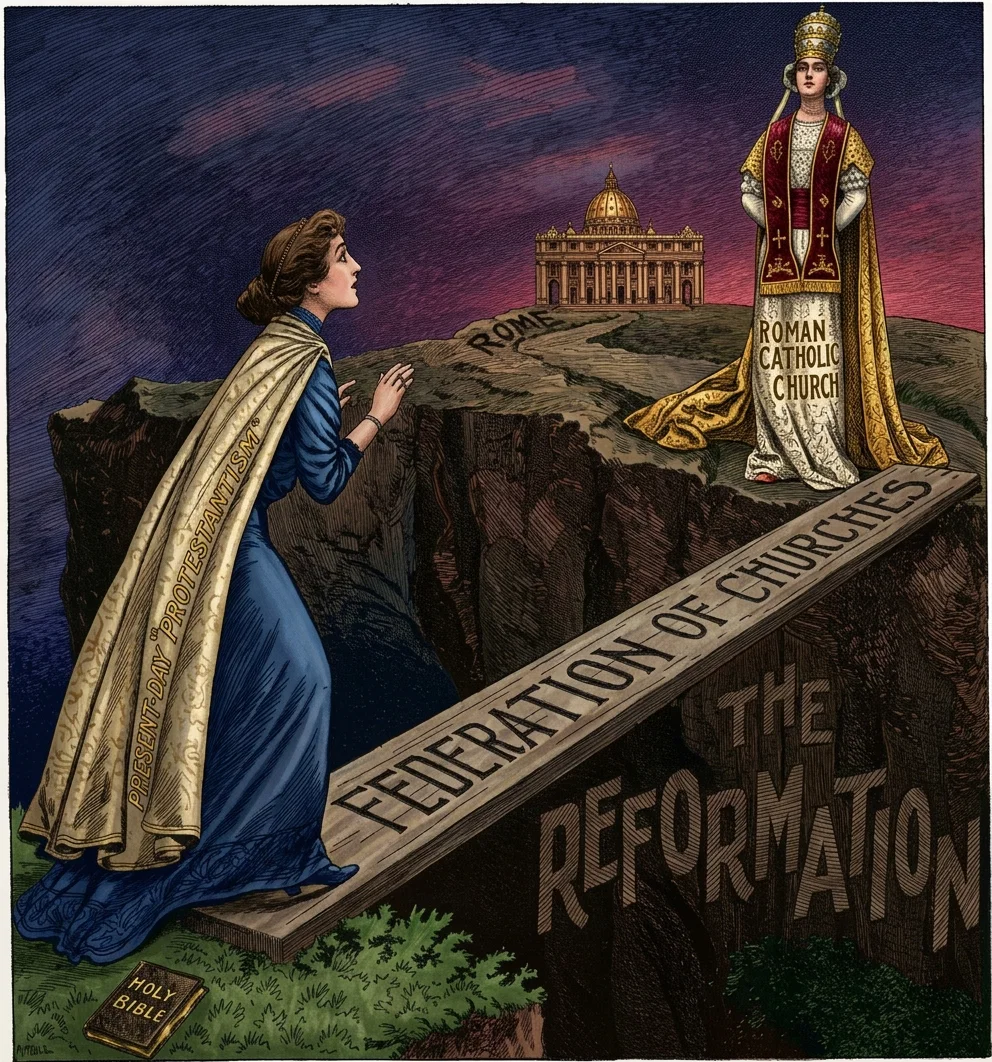
The Federal Council of the Churches of Christ, and the Sabbath
Will Protestantism Cross the Reformation Gulf to the Papacy by the Federation Plank?
ONE of the important things which came before the great Federal Council of Protestant Churches in Philadelphia, Dec. 2-8, 1908, was the matter of a Sunday law, “the first day of the week,” for “the Lord’s day, as a day of rest and worship.” A constituent body of the Federal Council is the Seventh-day Baptist denomination. In behalf of them, their own members, recognized and accepted as evangelical Christians, Dr. Wayland Hoyt offered the following resolution, and plead for its adoption:
“It is not our intention that anything shall be done to interfere with the convictions of those brethren represented with us in this council, who conscientiously observe the seventh instead of the first day of the week as a day for rest and worship.”
Fair and decent from the Sunday-law standpoint, wasn’t it? Surely, there could be no opposition to it.
But there was. Bishop Thomas Benjamin Neely, of the M. E. Church, opposed it. He said:
“Emphasize that phrase ‘The Lord’s day.’ Some people do not believe in the Lord’s day, but some other day, as the Sabbath. If we do not take a stand upon which day we believe we should observe as a day set apart for the worship of God, and of rest, this will give a wrong impression to the people. Is it the Lord’s day or some other day that we are standing for? If it is the Lord’s day, we should take the resolution by the committee and nothing more, and I trust that the resolution as proposed [by Dr. Hoyt], be not accepted. We believe in the Lord’s day and must stand for it.”
Dr. Wayland Hoyt said:
“Let us remember that the brethren of the Seventh-day Baptist denomination are members of this council as are any other bodies. If we are going to observe brotherhood and Christian love, we are not going to clash because of the religious and conscientious convictions of brethren associated with us in this council of churches. I do not myself sympathize with these brethren in their belief. I respect their convictions; I do respect them for the fact that they are willing to sacrifice; I respect them for their willingness to stand firm and true to what they believe. While I fully sympathize with the spirit of the resolution already submitted [for a Sunday law], it does seem to me that we ought never in this council of the churches adopt such statements as shall seem to conflict without due explanation, and I fully believe that our brethren are equally united in this.”
“This federation of churches shall be more and more acknowledged throughout the churches, and it is absolutely necessary that we be thoroughly fair with one another, that we be thoroughly brotherly with each other in all our relations.”
“I believe that God looks smilingly upon this desire to be absolutely fair and just and brotherly to all represented in this federation of churches. I earnestly hope that this resolution [above printed] will pass.”
Then the Rev. Arthur Mains of the Seventh-day Baptists spoke. He referred to the fact that his denomination was the smallest body in the council, thanked the council for their recognition of his people’s evangelical standing, and made an eloquent plea for religious liberty in that “city where the Continental Congress met, and where a Seventh-day Baptist presided,” who “would have been one of the signers of the Declaration of Independence,” but who was taken ill and died shortly before that great document was signed. He asked, “Shall it be that this council refuses to say that we shall not be interfered with in the exercise of our religious convictions?”
Others declared that they must not even admit that there is another day which is the Sabbath; that the Seventh-day Baptists were not the only ones involved, but the Jews and Seventh-day Adventists would use the resolution against them, and it would not do to recognize their own members. “We must take a stand as a body united in the belief that the Lord’s day is a day of rest and worship.” And so Dr. Hoyt’s resolution not to interfere with the faith and practise of Seventh-day Baptists was voted down by a large majority.
Will Seventh-day Baptists still remain a member of a federation which stands for religious legislation and emphatically expressed intolerant religious legislation?
The true Lord’s day, it may be remarked, is emphatically the day which the Lord gave, which has been revealed in the Lord’s Book, which was hallowed by the Lord Himself. That day is the seventh day.
The Federal Council of Churches may endeavor to legislate themselves into the belief that Sunday is the Lord’s day and Sabbath, yet God’s Book speaks the same unchangeable truth, “The seventh day is the Sabbath of Jehovah thy God,” and Christ by His Spirit calls it, “My holy day.” They are not fighting against men, but God.