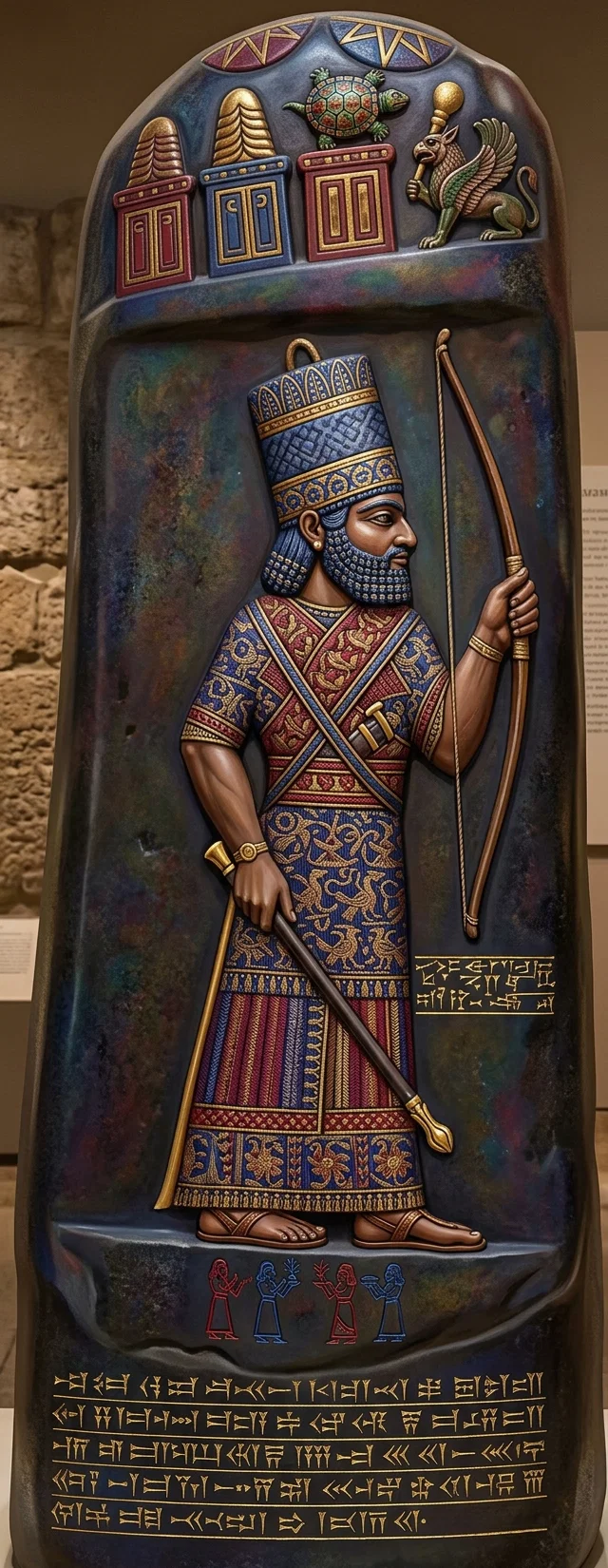
Babylonian Landmark: inscribed with the purchase-deed of a plot of ground, about B. C. 1100. (British Museum.)
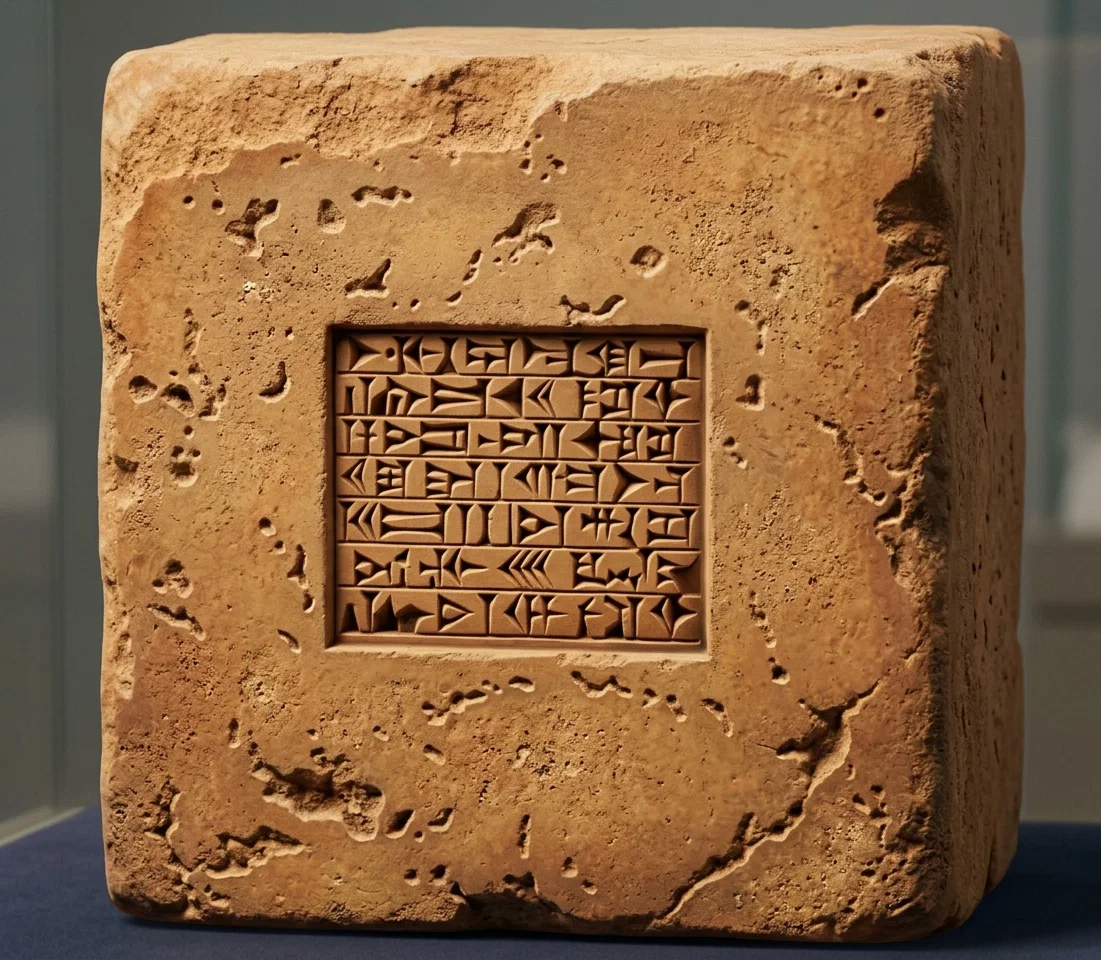
Babylonian Brick.
I. The Circumstances Preliminary.
OUT from Babylon had God called Abraham, because Abraham had already taken himself out of Babylon spiritually. Joshua, in his last address to the assembled heads of Israel, described the Babylon from which God had called Abraham, as follows: “Thus saith the Lord God of Israel: Your fathers dwelt on the other side of the flood [the river Euphrates] in old time, even Terah, the father of Abraham, and the father of Nachor, and they served other gods. And I took your father Abraham from the other side of the flood, and led him throughout all the land of Canaan, and multiplied his seed.” Joshua 24:2, 3. The living in the midst of idolatry, Abraham had already rejected the false gods of Babylon. God, therefore, called him and his seed to Palestine to the enjoyment of greater destinies. And today three world religions point back with pride to Abraham as their chief,—the Hebrew, the Mohammedan, and the Christian.
But the children of Israel in the land of Canaan relapsed back again into the idolatry from which God had called them. Therefore the Lord carried them back into Babylon physically to show them that they were there already spiritually. So far was their departure from the Lord that the Most High called, not them, but Nebuchadnezzar, King of Babylon, His servant. “Therefore thus saith the Lord of Hosts; Because ye have not heard My words, behold, I will send and take all the families of the north, saith the Lord, and Nebuchadnezzar the king of Babylon, My servant, and will bring them against this land, . . . and these nations shall serve the king of Babylon seventy years.” Jer. 25:8-11.
Through this servant, Nebuchadnezzar, tho a heathen king over a heathen nation, yet possessing great nobleness of character, God proposed to work for the advancement of His truth. A king of Babylon, however, could not, on account of his past training, stand close enough to God for direct communication. There was another. Daniel, a captive among the Jewish exiles, was, to the religion of Abraham, faithful among the faithless. Just as to John, the persecuted apostle of the New Testament, was given the greatest revelation to the Christian church, so the greatest revelation to the Jewish church was given to Daniel, the exiled prophet of the Old Testament. And as John, for his faithfulness, is known as “the beloved in the New, so in the Old Testament, the angel of God thrice addressed Daniel as “greatly beloved.” Exile, persecution, do not force us to impurity and departure from God; they simply withdraw us from the temporary joys of earth to behold the eternal glories of heaven.
A King’s Dream.
Compare, therefore, the bearing of Daniel in his trials, first in chapter 1, then in chapter 2. Chapter 1 may be called Daniel’s private test. He endured it successfully. Chapter 2 followed as his public test. “And in the second year of the reign of Nebuchadnezzar,” says chapter 2, verses 1 and 2, “Nebuchadnezzar dreamed dreams, wherewith his spirit was troubled, and his sleep brake from him. Then the king commanded to call the magicians, and the astrologers, and the sorcerers, and the Chaldeans, for to show the king his dreams. So they came and stood before the king.” The king had passed a sleepless night; for the same dream had reappeared to him a number of times. This is evident from the explanation of only one dream demanded, whereas the text speaks of “dreams.” The heart of the king was in the hand of the Lord and He was turning it in response to the prayers of His desolate people. Unable to understand the dream, the king was humiliated; he was irritated. He ordered his army of spiritual men to conquer this mystery—to tell the dream and its meaning; they smiled, they flattered, they argued, but gave no explanation, and the king grew more irritated. “If ye will not make known unto me the dream,” he cried, “there is but one decree for you: for ye have prepared lying and corrupt words to speak before me, till the time5be changed. . . . For this cause the king was angry and very furious, and commanded to destroy all the wise men of Babylon.” Dan. 2:9, 12.
Daniel and the Dream.
Contrast now the attitude of Daniel and the wise men. They had sought to gain time; but the more they labored, the more furious grew the king. Daniel had not been among them. Immediately, as soon as the officers searched him out to kill him, Daniel begged permission to go in before Nebuchadnezzar. It was granted. At once he stood before the astonished eyes of that ruler and requested—what? The very thing which had been refused the wise men. “Then Daniel went in, and desired of the king that he would give him time.” Verse 16. Ah! here is a secret. Why did Daniel secure the very thing which had been refused to the wise men?—Because in chapter 1 he had successfully endured his private test; now he was launching out. Strong in that past experience, he dared to throw himself on God and meet his public test.
It was a night for great things. Upon his bed the king is tossing through the long, sleepless hours. What a spectacle he has made of himself, and all through that dream! First of all, he has commanded to be destroyed his school,—that school, the pride and hope of his great life. The decree of death, by his own words, is hanging over that college of wise men. Within its walls he had collected the best and brightest of earth. From amidst the exiles and captives of all nations he had selected the noblest to adorn the venerable halls of Chaldean learning. Yet this hope was to be destroyed by his furious decree of only a few hours previous. And now, to crown it all, he had permitted his decrees, hitherto unchangeable, to be suspended at the request of a mere Jewish captive.
A Prayer-Meeting—Its Result.
In another part of the royal buildings, a different scene was passing. Daniel and his three companions were bowed in prayer. Before God, they were petitioning for their lives and for the hopes of their nation. If they should be destroyed, the devil had triumphed. Who would survive them, to keep alive in the hearts of their countrymen the promise of God to turn their captivity at the end of the seventy years? What, then, would become of the Jewish race and of the promised Messiah? They feared the wrath of the king; and much more they feared that mysterious dream, which they were unable to interpret. But on they prayed. They prostrated themselves before the Most High; they laid their hopeless lot before His all-seeing eye, and besought Him to remember. “Then,” says the record, “was the secret revealed unto Daniel in a night vision. Then Daniel blessed the God of heaven.” Prophecy triumphed over necromancy. The king had appealed to magic and had failed. Success followed his appeal to the spirit of prophecy.
The gray streaks of dawn were piercing the windows of the palace, when Nebuchadnezzar was summoned from his couch. “I have found a man,” cried his elated officer, “of the captives of Judah, that will make known unto the king the interpretation.” Seated upon his imperial throne, the king, surrounded by the majesty of state, awaited the coming of Daniel. The dim light of the morning, which permeated his Babylonian hall, revealed on the king’s face the traces of two sleepless nights. As they led the Hebrew captive before him, he awaited with impatience the promised reply. What would it be—an interpretation, or a disappointment? Calmly the faithful exile made known unto Nebuchadnezzar that the great revelation he was about to impart was not from him, but from God. “The secret,” he said, “which the king hath demanded, can not the wise men, the astrologers, the magicians, the soothsayers, show unto the king; but there is a God in heaven that revealeth secrets, and maketh known unto the king Nebuchadnezzar what shall be in the latter days.” Verse 28. His soft words fell with subduing effect upon the agitated spirit of the king. The confidence of Nebuchadnezzar was gained; in wonderment, he recognized before him the true servant of Jehovah, as Daniel recalled, point after point, the impressive dream.
The Dream of the King.
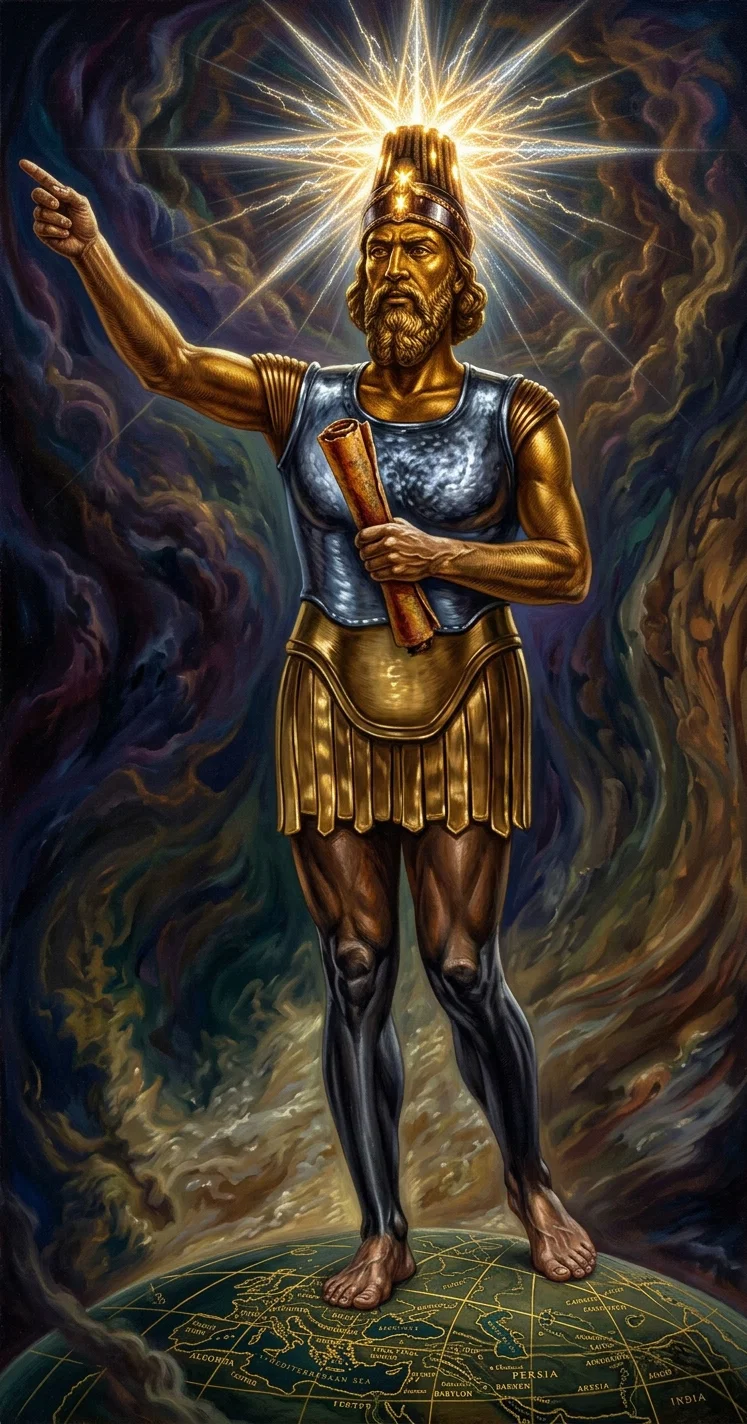
“Thou, O king,” he said, “sawest, and behold a great image. This great image, whose brightness was excellent, stood before thee; and the form thereof was terrible. This image’s head was of fine gold, his breast and his arms of silver, his belly and his thighs of brass, his legs of iron, his feet part of iron and part of clay. Thou sawest till that a stone was cut out without hands, which smote the image upon his feet that were of iron and clay, and brake them to pieces. Then was the iron, the clay, the brass, the silver, and the gold, broken to pieces together, and became like the chaff of the summer thrashing-floors; and the wind carried them away, that no place was found for them: and the stone that smote the image became a great mountain, and filled the whole earth. This is the dream, and we will tell the interpretation thereof before the king.”
[The next article will be upon the interpretation of the dream. The study will be complete in three numbers.]