BECAUSE of sin we are continually compelled to look upon the hideous where we might be viewing the glorious perfection of God’s beauteous handiwork. From time to time we catch faint glimpses of what we might see but for the fog-mantle of sin that now hangs heavy over the world.
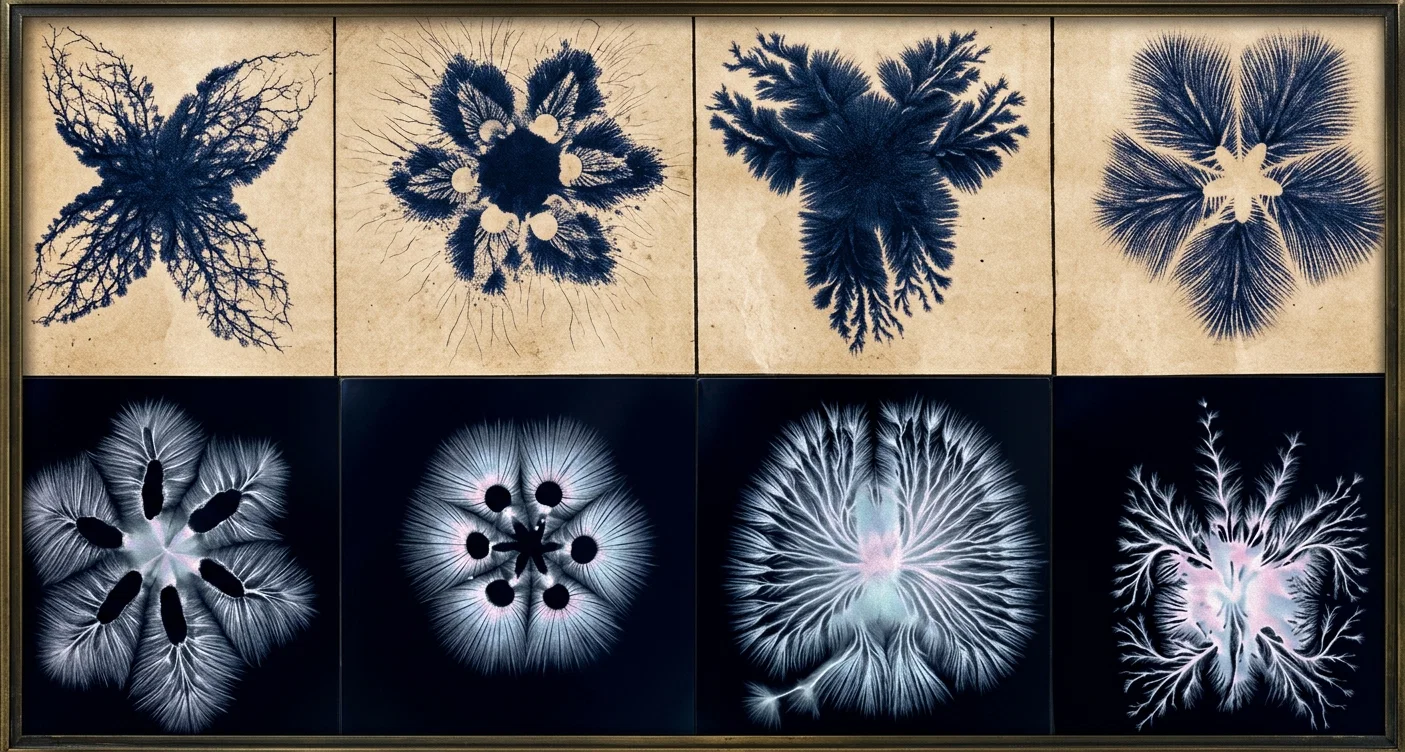
Courtesy of "Scientific American." Photographs of Electrical Discharges on Sensitized Plates.
THERE is one wonderful manifestation of God’s power to beautify, that even sin has not been able to purloin from the world, and that is the “covenant of promise” in the clouds. What marvelous display of color symphony, the whole gamut of color is thrown upon the sky-screen; but there is no discord of color, shade, or blending, no spot where the most critical or irreverent can find a flaw. Satan is not permitted to touch that covenant of the Creator, and so its beauty still stands unmarred. While still holding before us God’s promise to the race, that bow of promise also speaks to us of the loveliness, the perfection of beauty, which might be seen throughout the world if the race had never submitted to the contaminating touch of sin. What beauties in flower and field and forest, in mountain and hill and valley, in lake and rill and river, before the curse of sin fell to blight and mangle and destroy.
STILL, we are not wholly reft of beauty. We would see more than we do even now if our very eyes had not been pilfered of their visual power, and our senses dulled by the demoralizing and devitalizing influences of evil that have been working in us since the days of Adam. We recognize that we can not better, or even reproduce, the delicate beauty of tint in the commonest flowers. We see something of the perfection in them even with our sin-debilitated sight. The glories of the heavens are dimmed by the dust of our deserts and the fine ashes of our belching volcanoes; and yet there is enough left to us still to show us something of the marvelous handiwork of our Creator. Yet it is not in these great luminaries alone that we recognize the workings of the Omnipotent One. We see it also in the marvelous perfection of detail in the tiniest thing that flies or creeps, as well as in the mammoth and the man. Take down your microscope (which but for sin we would not need to use) and examine the minute winged mote that settles on your hand, as small as a speck of dust. Notice the beautiful coloring of those little fragile wings. Notice, too, what you can not see, that those wings must be operated by a perfectly-working set of muscles, which, in turn, are directed by a perfectly-working set of nerves under the control of a brain center; that those nerves and muscles and wings perform their work, if anything, more wonderfully, than do those of the great eagle; for quicker than the winking of an eye he is gone. In the works of man the minute is always lacking in detail. In the works of God what appears to us the most fragile, insignificant, evanescent, and transitory, has received the same attention to perfection as has that which looks to us mighty, permanent, and important.
NOTICE the wonderful designs in the picture printed on this page. Examine the delicate tracery of the lines and then the beauty of the completed piece. Each one of these designs was made in, perhaps, the thousandth part of a second by a discharge of electricity upon a sensitized plate. The result was, in a measure, controlled, or directed, by pieces of metal set in various symmetrical positions on the plate, which was sprinkled with metallic dust; but it was the pen of electricity that made a thing of beauty out of the crude design of the human brain and hand. The tracery of the delicate filigree of the electric discharge no human eye or microscope can follow to its termination. But this is only one of the tireless agencies of God working His perfect will. Is it any wonder, then, that the redeemed hosts, viewing the works of God with eyes loosed from the bonds of sin, shout in mighty chorus: “Great and marvelous are Thy works, Lord God Almighty; just and true are Thy ways, Thou King of saints.” The psalmist declares: “Neither are there any works like unto Thy works.”
THE Lord has a purpose in bringing His wonderful works to our attention. It is that we may not forget Him; and that, seeing Him2and remembering Him, we may be drawn to Him to love Him for what He is and for what He has done for us. He would teach us by the power manifested in His greater works that He is able to perform every promise made to man; and by the perfection of His most delicate and minute works that He is ever mindful of the needs and interests of every member of the human race. It is difficult for some to believe that the Creator of the heavens and the earth can stoop to the detail of recognizing the faith and hope, and caring for the needs of “such unworthy creatures as we are.” He is teaching us by these very works that He can and does. “Even the very hairs of your head are all numbered.” The God who has made us cares for and loves us; is pleased when we come to Him in faith to seek strength and grace and courage and blessing; pleased when we lay our troubles all bare before Him. Then, too, one of His most wonderful works was the plan and the gift for our salvation. “He hath made His wonderful works to be remembered.” Let us remember them, learn to think of Him when we remember them, and thus become more and more like Him from day to day.