HEBER, THE FIRST-BORN

4%

Pacific Press Publishing Company · Mountain View, California · Dec 14, 1904

FromSigns of the Times, Vol. 30, No. 49.

Read the full edition

HEBER, THE FIRST-BORN

A Story of Israel’s Deliverance
By HART HALL
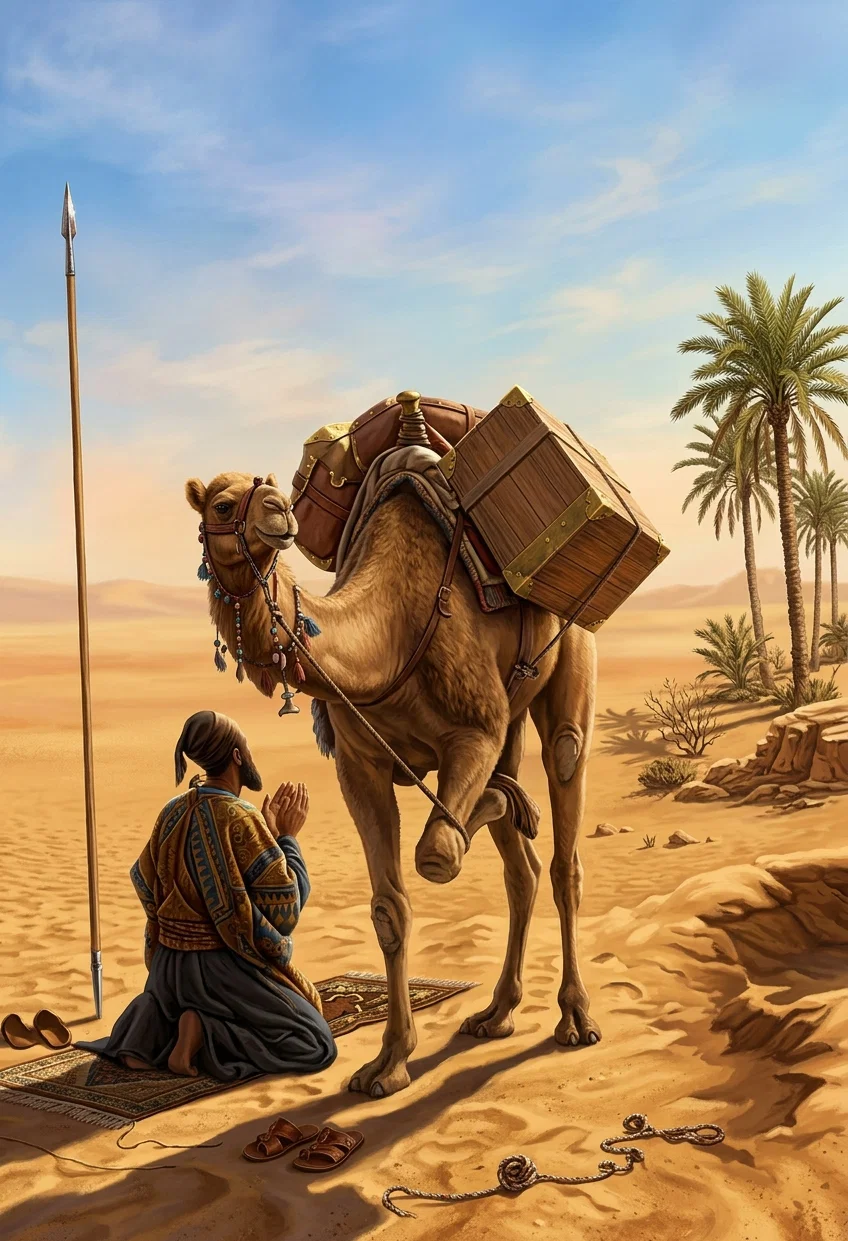
Egyptian Traveler Halted for Worship.

CHAPTER XI.

A SENTINEL pacing by the prison hearing slight but unusual sounds within, stepped to the door to listen just as the keeper swung it open. He was swept down as the captives, with Heber in the lead, burst out in their rush for freedom; but not before he had uttered a shrill cry of alarm, which was taken up and repeated again and again along the walls of the city. From every side came the soldiers running, but the escaping slaves, knowing that they were safe only in concerted action and in flight, tarried not for combat, but ran swiftly for the gates.
A group of sentinels from the walls gathered quickly to intercept them, but, when they saw the solid line of spears, held by strong and determined men, rushing down upon them, they scattered in wild disorder.
Heber, knowing the strong force of guards that would be at the gates, resolved on strategy; placing his hand to his mouth he gave the royal messengers’ cry for “open gates.” The ruse succeeded, for the guards, confused at the call and not knowing but the company running rapidly toward them with weapons glistening in the moonlight might be soldiers, swung the gates wide, not discovering their mistake until, after clanging them shut again, a detachment of the king’s troops dashed up.
But, once on the broad highway that stretched smooth and level to the borderland of Goshen, the fugitives, with a good start in advance of the soldiers, possessed every advantage, and the latter soon abandoned the pursuit.
On along the highway the fleeing ones sped, passing the stripped orchards and desolated fields and occasionally a broken-down obelisk, or idol that lay prone in disgrace, no longer worshiped.
But when they began to near the homes of the Israelites, the scenes changed; fields were green and verdure abundant; the grievous marks of the plagues were not to be seen here. God’s protecting hand had covered His people and their possessions.
Now within their own land, the lads separated, each going direct to his own home.
The Assyrians, grateful for freedom, would accept no place of refuge, but would flee on to their own country; and Anathpherah hastened to join his family, who had secretly gone on before and found a place of protection with the Hebrews, as many of the Egyptians had done, believing the God of the Israelites to be the true God and declaring allegiance for ever to Him.
The hearts of Heber’s parents had grown heavy with anxiety and grief as the evening passed and their first-born had not been restored to them. The Passover supper had been eaten, and with feet sandaled and burdens bound, they awaited departure.
The children had fallen asleep exhausted with the excitement and preparation, and now, in the deep, oppressive silence and suspense of waiting, they kept their vigil. It seemed so long since darkness had gathered, and finally, when their weight of anxiety for the absent one, who would be the victim of the destroying angel, seemed greater than they could bear, they bowed in importunate intercession to their Creator.
As they were thus engaged they heard the sound of running feet and then a knock at the door. Words would fail to describe their joy and relief as their son burst in upon them, and with deep gratitude to God they clasped him to their hearts. It was not long till his story was told, and though the midnight could not be long distant, he begged to lie down. “Sleep has not touched mine eyes these two nights past, thinking how to escape if the keepers should fail us; I am weary with running also. I am not afraid,” said he. “Let me sleep.”
His parents now continue the watch, their anxiety removed, but as midnight draws near they are stricken with an unknown dread. The mother sits beside her boy listening to his deep, heavy breathing that witnesses to his exhaustion. The moments drag wearily; they longed to know the exact hour, but the stars must not be consulted, for God had bidden them not to leave their dwellings, lest they die.
Suddenly, like the stab of a knife, comes the first cry, a horrible, agonizing, shuddering scream that dies away into a broken wail. Paleness stamps their faces as they rise trembling to their feet. The father grasps the oil taper, and its grim, ghastly light flickers on the face of their first-born as he lies sleeping a troubled sleep, half conscious of fearful things.
The parent sets the lamp on the table again and breathes once more deep and full, grateful withal.
The hour is passed, the blood is efficacious, the release has come. Again a cry is heard, then another, hoarse and agonizing. Then other screams intermingle, until there is no distinguishing, and with all else is heard the sound of hurrying feet as the Egyptians, frantic with anguish, hurry to the homes of the Hebrews and beg them to depart out of the land. With face blanched with horror, Pharaoh is called to look upon the dead face of his first-born. The grief and remorse of counselors and courtiers was terrible; unitedly their cry was for the Hebrews to depart, “for,” said they, “we all be dead men.”
“Children, awake,” cried the father, “Heber, arise; it is the hour now of which God spake; gather the burdens. Who knocks? The elder? Is it the time of which Aaron spake? Yea, the tread of feet is sounding! It is the release! Rejoice! It is the release, the release!”
(The End.)