HOSANNA IN THE HIGHEST

8%

Pacific Press Publishing Company · Mountain View, California · Oct 5, 1904

FromSigns of the Times, Vol. 30, No. 39.

Read the full edition

"HOSANNA IN THE HIGHEST."

“Behold, thy King cometh unto thee.”
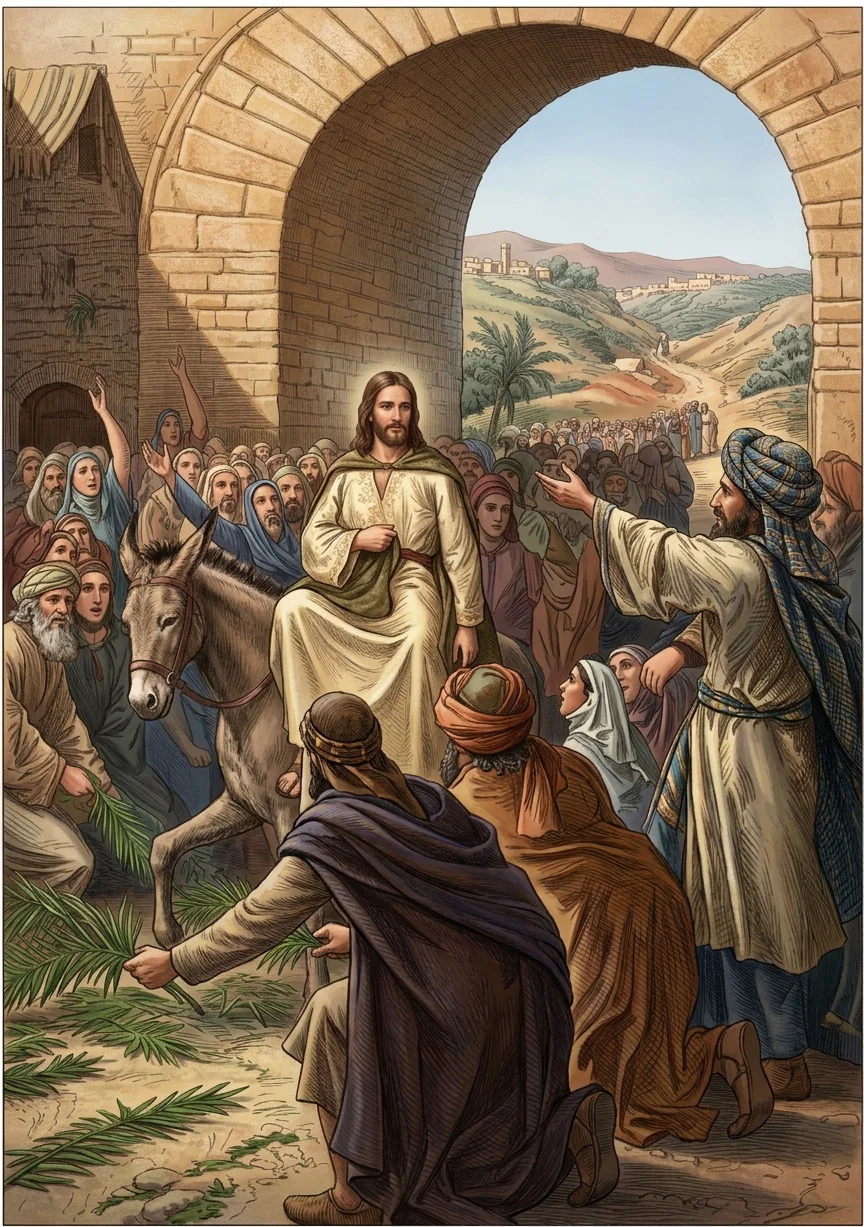
THE only record we have of Jesus’ riding, excepting in a boat, was on the day of His entry into Jerusalem in the role of a King. The reason that He rode on that day was that it might be fulfilled which was spoken by the prophet, saying, “Tell ye the daughter of Zion, Behold, thy King cometh unto thee, meek, and riding upon an ass, and upon a colt the foal of an ass.”
Two of the disciples had been sent to a certain place to procure the colt. They brought the colt, and put their garments on him, and Jesus rode upon it. “And the most part of the multitude spread their garments in the way; and others cut branches from the trees, and spread them in the way. And the multitudes that went before Him, and that followed, cried, saying, Hosanna to the Son of David; Blessed is He that cometh in the name of the Lord; Hosanna in the highest. And when He was come into Jerusalem, all the city was stirred, saying, Who is this? And the multitudes said, This is the Prophet, Jesus, from Nazareth of Galilee.” Thus reads the account as given by Matthew.
THAT was a great day in Jerusalem. It was a day when the “common people,” who had “heard Him gladly,” rejoiced to see Jesus occupying a position of triumph. It was one of the times when the impulse of the rank and file was wiser than the judgment of their “rulers.” Can we safely assume that such is not sometimes the case even in our day? There is evidence that it is sometimes even so, and that, as on that occasion, the rulers too seldom acknowledge the fact until too late. There were three conditions of mind in that throng, each of which it is well to contemplate. The “most part of the multitude” rejoiced exceedingly; the chief priests, the scribes, and the Pharisees were indignant, and Jesus was sad.
ALL of the Jews were expecting the Messiah, one who would deliver them from the Roman yoke and become a King to whom all others would be subservient. Many of the people, having heard the wise teaching of Jesus, and having seen the manifestations of His wonderful power and goodness, “hoped that it was He who should redeem Israel.” This, however, was the first indication on His part that He was really about to assume the kingship, and their joy knew no bounds. But, as was shown a few days later, their rejoicing was based entirely upon outward appearance, and not upon genuine faith. Had they known what was to transpire in so short a time, they would have derided Him even then. The Spirit of the Lord moved upon them just as it would have actuated the stones that lay in the street if thepeople had refused to respond to its promptings, and thus fulfil the prophecy.
THE rulers of the people—the chief priests and the scribes—were indignant because of their jealousy. They were envious of the honors that the people were bestowing upon Jesus, in spite of their adverse counsel. They were envious of the influence that Jesus, a poor man of Nazareth, was wielding over the people, while their own influence was waning in a corresponding degree. So manifest was this feeling on their part, that when they afterward brought Him before Pilate for condemnation, he saw that “for envy they had delivered Him.” Their anger was intensified when, after Jesus had ridden to the temple, He further manifested His power, and His disregard for their prestige, by clearing out of the temple the unholy merchandizing which they had sanctioned, and in which they were peculiarly interested.
THE procession had formed outside the city, first by His immediate disciples marching with Him, and then by others joining as they went toward the city. “And when He drew nigh, He saw the city and wept over it, saying, If thou hadst known in this day [margin, ‘this thy day’], even thou, the things that belong unto peace! but now they are hid from thine eyes.” Jesus was sad because He knew what was in the heart of man, and because He could discern the future. It could not be much joy to Him to receive the momentary applause of a multitude, the majority of whom would, at the behest of their rulers, be demanding His crucifixion within a week’s time.
But it was not what they would do to Him that caused His greatest grief; it was the consequences to themselves that evoked His bitterest tears. Hear His further lamentation for the already doomed city, doomed for the rejection of the One who alone could save: “For the days shall come upon thee, when thine enemies shall cast up a bank about thee, and compass thee round, and keep thee in on every side, and shall dash thee to the ground, and thy children within thee; and they shall not leave in thee one stone upon another; because thou knewest not the day of thy visitation.”
It was indeed a sad sight to see a people so highly favored fail to discern the day of their visitation, the day when the Crown of all their blessings had come to bestow upon them a “peace that passeth all understanding.” But were they the only ones who would be likely to make such a mistake?—Certainly not, else the story of their failure had not been written. “For whatsoever things were written aforetime were written for our learning.” Then it is our privilege, our province, to know the day of our visitation, the day of our opportunity. And wherein have all the failures of past ages been made? Was it not through unbelief of the Scriptures? It therefore behoves us of this day and generation to heed the lessons and warnings set forth in the sure Word, and to examine ourselves whether we be in the faith.
JESUS is coming again with a much more glorious display of triumph than that manifested when He entered Jerusalem, “meek, and riding upon an ass.” He will come in the clouds of heaven, in the glory of the Father, and all the holy angels with Him, and every eye shall see Him. There will be no mistake as to His identity then. All will know and recognize Him. Those who have been feeding upon His Word will know the day of their visitation; they will be looking for Him, and will love His appearing. They will triumphantly cry aloud, “Lo, this is our God; we have waited for Him, and He will save us.” And they will be “caught up together to meet the Lord in the air.” They also who have not heeded the lessons written for their learning will know Him, too; and they will “wail because of Him,” and “say to the mountains and rocks, Fall on us, and hide us from the face of Him that sitteth on the throne, and from the wrath of the Lamb.”
THERE is yet time to “make our peace, calling, and election sure;” but that time is now. “Now is the day of salvation.” The warnings and pleadings and tears of Him who gave His life for the vilest of sinners, are yet available; but the time that is sure is to-day. Let us be among those who, at the next triumphal procession of our Lord, will join in the grand triumphal song of the waiting ones, “We will be glad and rejoice in His salvation;” “Hosanna in the highest.”