We left New York the 29th of June on the steamer Oceanic. It is a large boat, and the journey across the water to England was very pleasant indeed. The ocean was as calm as a lake in pleasant and fair weather. There was only one sad occurrence to mar the pleasure of the voyage. After we had been nearly three days on the journey, a man fell overboard. It was just dinner time, and none of the sailors were on deck. Some of the passengers saw him fall into the water, and one of the second-class passengers saw him after he had fallen. He might have thrown a life-line to the unfortunate man, as there was a buoy within a few feet of him; but he did not think to throw it out, and simply called for others to help him. The ship’s crew did all they could to save the man; the ship was turned about in a few minutes, and a life-boat and crew were let down. About an hour was spent in trying to find the lost passenger, but it was too late; the man had gone down not to rise again, and the ship steamed on.
I spoke with the man who saw the drowning passenger in the water. He said that the man stretched out both his hands for help, and swam with all his might to save his life. He reproached himself bitterly, because he had not thought to throw out the buoy that might have saved a life. It seemed to him as tho he could see the man stretching out his hands, even after we had resumed our voyage. May we not learn a lesson from this incident? There are many people around us whom we might help, if we would just think to throw out the life-line. There are many sinking down into death, never to have the blessed experience of hope in God. A world is left unwarned of the great events that are to take place very soon.
We spent one day in Liverpool, made a few purchases there, and on the 7th of July took the steamer Victoria for South America. As we passed through the streets of Liverpool, and saw some of the many people there, we were led to pray that God might send more laborers into the field, that His work might be closed up quickly. England had been visited by an earthquake the Sunday before we arrived. Some of the people were shaken out of their chairs. It should be a reminder to them that a greater earthquake will soon shake them out of their places of careless repose.
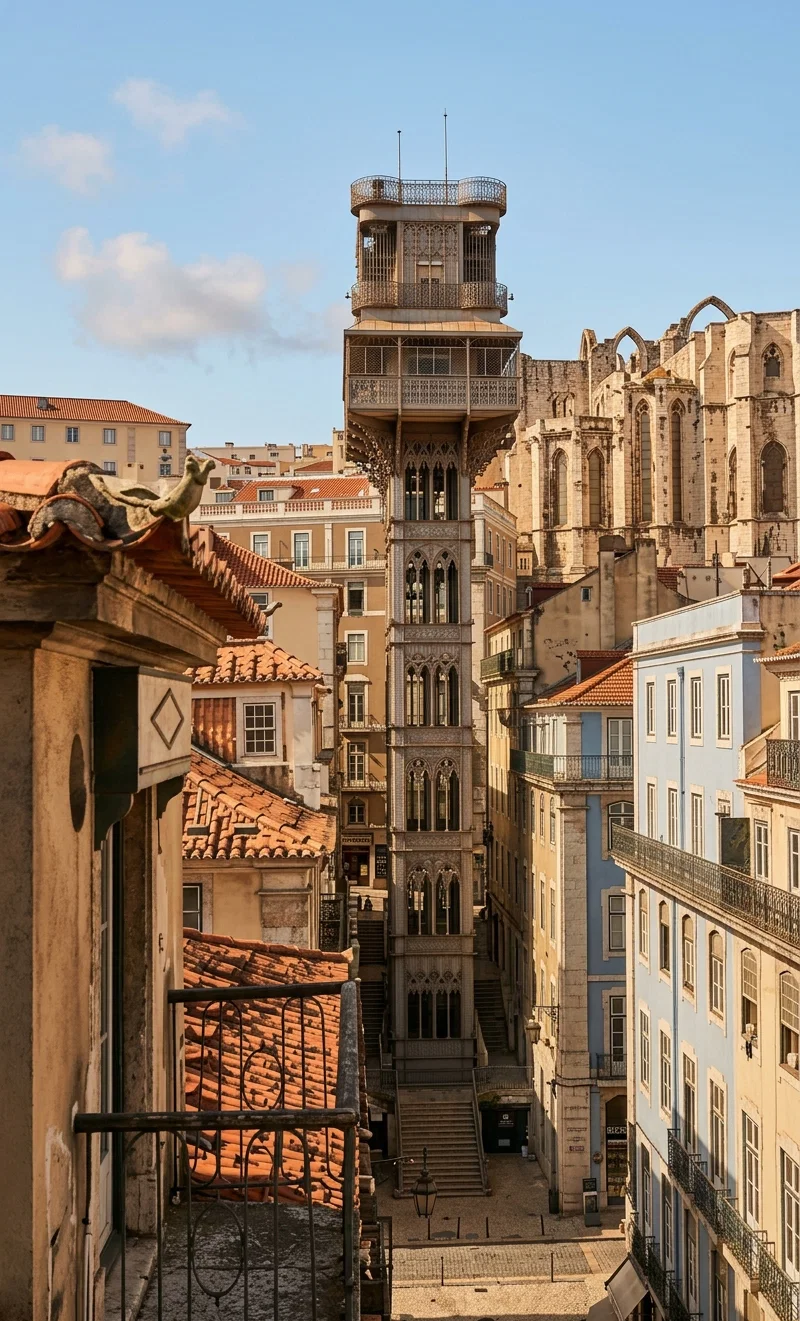
Elevator of Carmo, Lisbon, Portugal, from the top of which tourists view the city and the great cathedral ruined by the earthquake of 1755.
After leaving England we found the sea as calm as before; our journey to France was very pleasant, as none of us were seasick. We came to La Palisse on the Sabbath, and spent the day there. We walked into the country for a little exercise, after having been on the ship so long. The walk did us good. We also came into the city of Marseilles, which used to be the key to France. But when the Seine River, on which Paris is located, was opened to navigation, vessels were enabled to enter France by the new route. At La Palisse we saw three submarine torpedo boats lying in the harbor with their sterns covered over. Some think they have a special improvement of some kind in that part, and for this reason are kept covered. The greater part of the boats were submerged, but, as the water was very clear, we could see them below the water line. What awful weapons of destruction are being manufactured! We saw in the forts there four great disappearing guns. I am glad that something is being done to bring the truth to the millions of France; but how much more should be done than is being done!
On Sunday at 11 o’clock we sailed away, and soon came to Corunna, Spain. After taking on some passengers and freight, we steamed on to Corelez, where more passengers and freight were received. Spain occupied an important place in the world when America was discovered, but she has grown small since that time. However, the millions in that country should hear the last message of mercy.
We next came to Oporto, Portugal, where much wine was taken on board. It is claimed that from here the best wine in the world is shipped; but the best of it is “a mocker.” We did not go ashore at Oporto; missionaries are not so well supplied with money that they can make a business of sight-seeing. But when we came to Lisbon, we felt that a little time spent ashore might be of value to us and the cause. This is the place where the great earthquake of Nov. 7, 1755, which also shook about four million square miles of the earth’s surface, caused the greatest destruction of life and property. We had learned that there was still to be seen an old ruin caused by the earthquake. When we reached the shore, and inquired for the ruin, the people knew how to direct us to it. We thought that they might have quite forgotten it, inasmuch as about one hundred and fifty years had passed since the earthquake, but when we inquired for the ruin, we were immediately directed to it. We were surprised to find that the whole matter was fresh in the minds of the people.
When we came to the place, we found that a tower had been built on one side, and an elevator provided, so that visitors could ascend to the top, and take a look at the ruins from the tower. We also obtained a good view of the city and the harbor. Lisbon must be a very old city, for the history of its foundation is lost in antiquity. From the tower, we could only see the top of the old church ruin. The back wall and the side walls of the church are still standing.
There is a bridge constructed from the center of the tower to the front of the church. We walked over this bridge to examine the ruins farther. The church had been sunk six feet into the ground from the effects of the earthquake. The ground had sunk with it, and by the terrible jar the whole roof of the church had fallen down. Great, heavy stones were broken into many pieces. Some tombs of great men were also broken open. The head of the bust of Pope John XXII. was broken off. The head with the crown on was put in a case, where it is still in sight. The eyes and cheeks were colored, as also the crown, so as to look life-like. The grave of the founder of the church is still in this old church. One might suppose that because this church, ground and all, had sunk six feet, the ground must be somewhat soft; but this is not the case; for I examined it thoroughly, and found that the church was built on rock bottom. It must have been an awful crash that broke the ground and the rocks to such an extent as to sink a considerable part of the hill six feet.
Another interesting feature is that the street in front of the church rose nearly five feet, and remained in this condition. Farther back the ground raised still higher. The whole city was shaken to such an extent that the hills skipped like lambs, and moved like the waves of the sea. This earthquake marked the opening of the “sixth seal” of Rev. 6:12. In the country where the greatest effects were felt, and where a tower was built as a memorial, we have not a single worker to point out to the people the meaning of this great earthquake. Should not some one get a burden to labor for the salvation of that people? There will soon be an earthquake which will cause the cities of all nations to fall. The mountains and the hills are to sink away, and the islands shall not be found.
While men are stationed at the ruin to tell the people about the earthquake, and when it took place, we ought to be on the ground to tell them that at that time the sixth seal was opened, and that the darkening of the sun and moon followed on the 19th of May, 1780; that the stars fell on the 13th of November, 1833, and that the generation now upon the earth will see the Lord and Saviour come as King of kings and Lord of lords. The nations of the earth are now angry, and soon war and desolation will sweep over this earth like a mighty avalanche. Now is the time to get ready for these great events. Now is the time to sound an alarm, to get the people ready for a better country than the earth is in its present condition.
It is now the 17th of July, and we have passed the Canary Islands. To-morrow we shall reach the Cape Verd Islands, and there our ship will take on coal. Here was the scene of an earthquake about a year ago. Ships from every country, crossing the ocean south and north, generally stop here for coal. It is a great coaling station, and is controlled by the Portuguese Government. Our whole company are well; thus far none of us have been seasick to any extent. The voyage has been pleasant. We hope to be of service in proclaiming the message of the soon-coming Saviour in South America, in order that souls may be won for the Lord’s cause and kingdom.