VILLAGE LIFE IN INDIA

8%

Pacific Press Publishing Company · Oakland, California · Sep 7, 1904

FromSigns of the Times, Vol. 30, No. 36.

Read the full edition

VILLAGE LIFE IN INDIA.

[A. S. Albrecht, in Lutheran Observer.]
An Indian village is a little world in itself. Men live and die in the little village in which they were born, often without going beyond the village limits in their lives, or feeling the need of going. Their livelihood is there, their wants are few, and these wants can be supplied by their neighbors. Some villages are much larger than others, and some have a few educated men, while in others no one can read or write but the munsiff, or head man, and the karnam, or village accountant. The style of houses varies in different parts of the country, and also according to the size or wealth of the village, but in most respects all villages are alike. The houses are close together in two long rows, with small side streets branching off here and there.
If we enter the village from the east end, first we see a group of little huts, constructed chiefly of split bamboos, and not high enough for any one but a very small child to stand erect. These are the dwellings of the yanadi, or thief caste, who are employed as village watchman, perhaps on the principle that “it takes a thief to catch a thief.” At any rate, they never allow any one to steal what they are watching. Next come the houses of the Sudras, rich and poor, but the Sudras are by no means all one caste, as many suppose. The reddis and the kammas are the principal farmers, and when any religious procession takes place, each struggles for precedence. Here is the house of the village munsiff, who is a government servant, and whose duty it is to try all small cases of theft or disturbance, and report all others to the higher authorities.
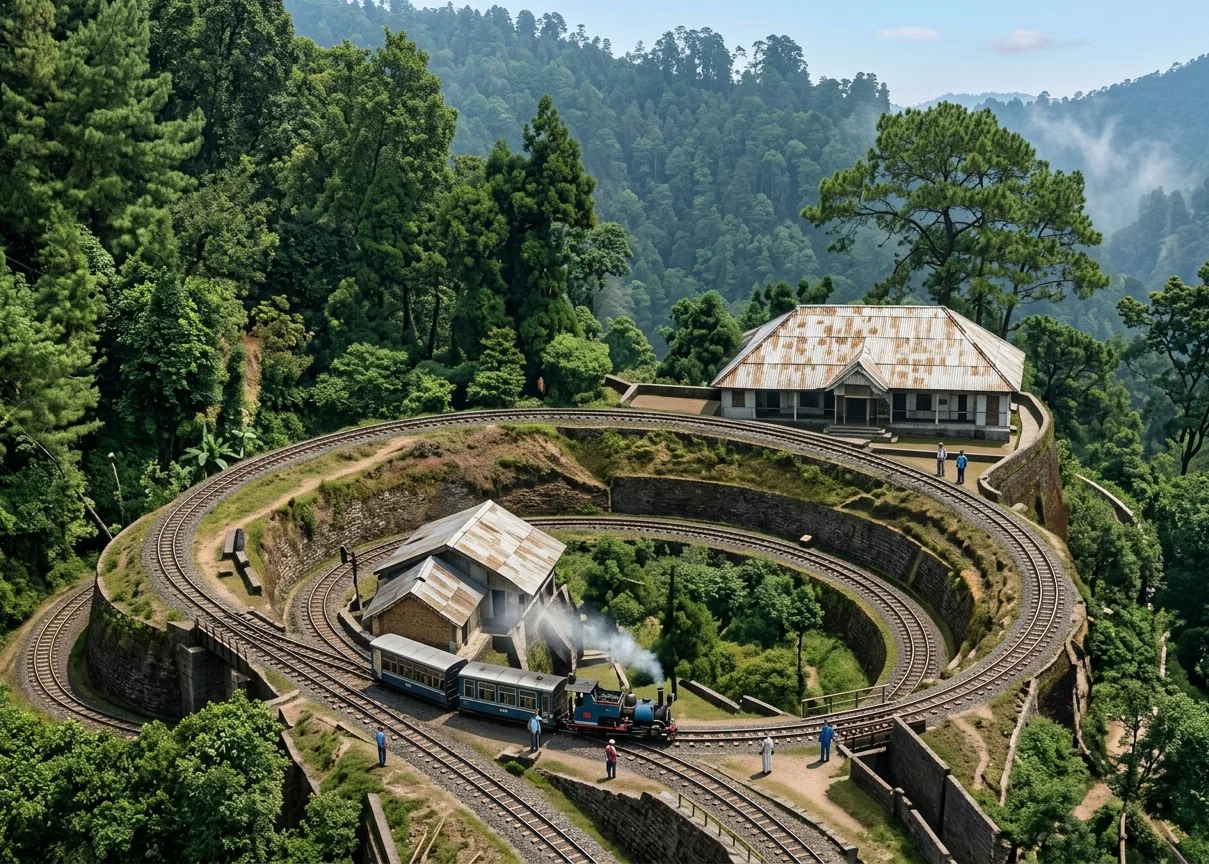
The Wonderful Double Loop on the Darjeeling Railway, India.
There, where the blue smoke is curling up, is the house of the potter whose wheel is always turning to supply the earthen pots used by the village for cooking, and for water. Those houses that are locked belong to the shepherds, who are away in the fields with their flocks and herds, and whose food must be carried to them by the women of the family.
Next come the rich merchants, who sell cloth, grain, curry stuffs, and the other things necessary for daily use. They are also the money-lenders, and take from 12 to 100 per cent. from their neighbors who want money for a wedding or a funeral feast, or to pay their taxes; and, sad to say, there are few who do not at some time fall into their clutches, and fewer still ever get out again.
Adjoining is the village post-office, kept in the house of the Brahman postmaster; next is the karnam’s and the schoolmaster’s, if there happens to be a native school, and the other Brahmans who occupy the adjacent houses are gentlemen of leisure, living from the income of their lands, and on the fees they get for performing weddings, foretelling auspicious days for marriages, journeys, etc.
Peep into the next house, and you will see the goldsmith at work, making a gold collar for some dark-skinned beauty, while his little son sits in front of him, blowing the bellows, and learning the trade. Here are some more boys also learning a trade. They are the barber’s sons, shaving their little brothers for practice, while the father stands near, giving directions, first to them, and then to another boy who is learning to beat the drum, for the barbers are also the drummers. Down that side street are the houses of the dhobies, or washermen, who wash for the whole village. A very rich lady, who has a fine cloth she is afraid the dhoby will spoil, will sometimes wash it herself, but otherwise, no one, rich and poor, not even a beggar, will wash his own clothes. That is the dhoby’s work.
Down that other street are the houses of the Mohammedans. In many places the Mohammedans are numerous and wealthy, but here they are few in number, and usually poor. Here is to be found the government toddy shop, which brings more poverty and misery to the people. In sandy places where the palmyra trees flourish, are also found the toddy tree climbers. There are also the Sudra weavers; the pichagunta people or gypsies, who go from house to house, telling stories, singing songs, and begging, and the mutthurachalu, who have long guns, licensed by government, and who often bear a bad reputation for their use of them.
At the extreme end of the village are the tank-diggers and road-makers, who say they used to be a very good caste, but it was spoiled from their eating field rats. Next to them often are to be seen little temporary huts occupied by the yellaka people, a wandering tribe of gypsy fortune-tellers, who weave baskets, and on their wanderings take from one place to another salt, cows, and donkeys.
All these, and others not mentioned,—for instance the carpenter and the hunter,—are caste people, and most of them belong to the Sudra caste. They are divided and subdivided, and many will not eat with each other, and none of the subdivisions will intermarry. Nearest to the tank-diggers, but separated from all of them, are the outcasts—the Malas and the Madigas. The Malas weave much of the cloth used by the villages, which must be washed in caste water before it can be worn. The Madigas are the leather workers, and the servants of the caste population. They make the shoes for the village, the leather collars, etc., for the bullocks and plows, and do the coolie work in the fields of the farmers.
They are not paid daily wages, nor for the goods they supply, but at the harvest time are given grain for the year. They also get the carcasses of all cattle that die from disease or old age, and are despised because they often eat the flesh, as well as take the skin for their work.