TIBET AND ITS BORDERLAND

10%

Pacific Press Publishing Company · Oakland, California · Aug 3, 1904

FromSigns of the Times, Vol. 30, No. 31.

Read the full edition

TIBET AND ITS BORDERLAND.

[Sarah Douglass McMahon, in The Independent.]
For hundreds of years Tibet, now about to be brought under British influence through the expedition of General Younghusband, has been an object of baffled curiosity to Europeans. It is an extraordinary fact that the earlier explorers were far more successful in their quest than recent travelers. The Englishman Manning in 1811 set foot in Lhassa, was admitted to the royal palace, and, presenting gifts, kowtowed thrice before the Dalai Lama, a smiling child of seven, who, as the incarnate god of the Buddhists laid hands on the clean-shaven head of the daring visitor and inquired wonderingly how he had overcome the difficulties of the journey. Manning won the favor of the Holy Boy and his courtiers by a diplomatic reply; he said he had had troubles indeed, but they were amply compensated for by the happiness of entering into the sublime presence of the Sacred One. The attendants gave him tea and a present of dried fruits. He was received and dismissed with every mark of civility. He says:—
The Lama's beautiful and interesting face and manner engrossed all my attention. He had the simple and unaffected manners of a well-educated, princely child. His face was, I thought, poetically and effectingly beautiful. He was of a gay and cheerful disposition, his beautiful mouth perpetually unbending into a graceful smile which illuminated his whole countenance. I was extremely affected by this interview; I could have wept through strangeness of sensation.
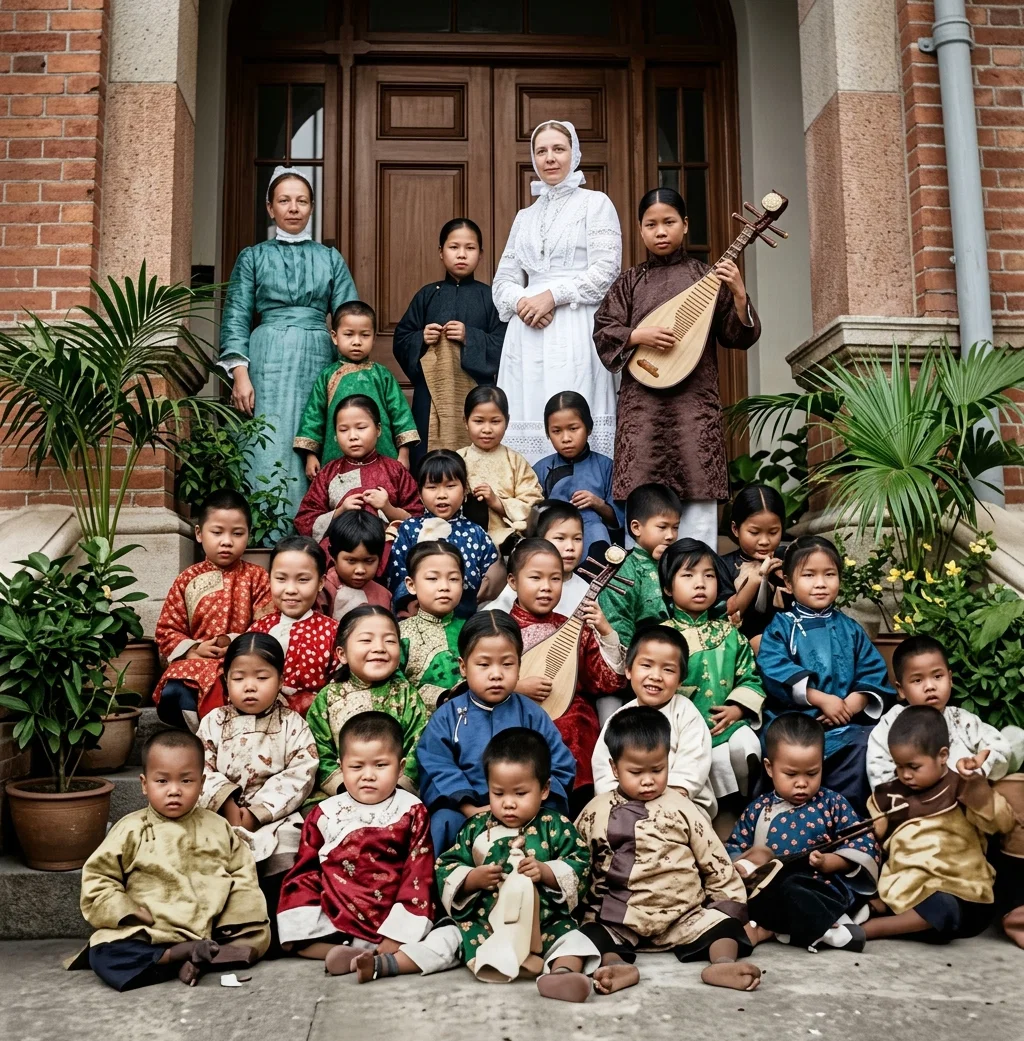
Pupils and instructors of a Christian school for Chinese blind girls in Hongkong.
Before Manning, near a score of Roman Catholic priests, and after him Fathers Huc and Gabet, in 1846, penetrated to the capital of Tibet, which it is now sacrilegious for a foreigner even to approach. The French Fathers spent two months in Lhassa before being expelled. No white man living can boast of having entered the sacred city and gazed upon the Grand Lama. Clever, bold, and resourceful as have been the later travelers, including the Russian Prejevalsky, the Englishmen Bower, Littledale, Landor, and Welby, the Frenchmen Bonvalot and Prince Henry of Orleans, the missionary Miss Annie Taylor, and the great American authority on Central Asia, William Woodville Rockhill, the Tibetans have succeeded in turning each and all back several days' journey from Lhassa. If they have not penetrated to Lhassa, these travelers have in their several hundred mile journeys added much to our knowledge of the country and its inhabitants.
Tibet is more than the Switzerland of Asia. It is literally, as geographers are fond of terming it, the Roof of the World. Conceive an enormous table-land 1,600 miles in length from east to west, and 500 miles in breadth from north to south, elevated from 10,000 to 20,000 feet above sea-level, an alternation of desert steppes, frowning peaks and fertile river valleys; so cold that the inhabitants live like denizens of the Arctic Circle; so rich in mineral resources and other wealth that China, Great Britain, and Russia dispute it as a prize; so inhospitable that wild animals, as well as beasts of the caravan, perish of starvation; traversed by Mongol nomads in its northern portions, inhabited throughout its fertile southern region by a priest-ridden, filthy, and superstitious race; owning a more or less shadowy allegiance to China, but hating English and Russian interlopers with equal bitterness, and you have a succinct idea of the Forbidden Land now opening to the avenues of civilization.
The Tibetans are degenerate, first because of their climate, and second on account of their religion. Ethnologists have often remarked that mountain races quickly differentiate themselves from dwellers of the plains in features, frame, habits, and customs. The high civilization of surrounding Europe has kept the Swiss from reverting to savagery. Not so with the Tibetans. Cold and poverty oblige them to be dirty. The frightful face of nature encourages superstition. The hard life has made them squat and muscular; it has dulled their moral sense as well, so that brigandage, drunkenness, and polyandry are common evils. In appearance these mountaineers are square-headed, with small eyes, high cheek bones, prominent noses, and large mouths. The men are clean-shaven, and the women daub their faces with a brown pigment and wear their hair in strands almost innumerable, which are taken down and cleaned but once a month, with results that may be better imagined than described. A common garment of the country is the whole skin of a sheep with the wool turned next to the skin. The women are often clad in a single garment of dark-blue serge, which is without fastenings, but is folded over in front and kept on with a girdle. Many of the Tibetans live in tents the year around, while the inhabitants of the more prosperous river valleys enjoy the squalid comfort of huts of brick, stone, or mud, as the absence of timber in this wild land makes wooden dwellings impossible. The Tibetans are born traders. They get tea and silk from China; broadcloth, rice, grain, and tobacco from India. They export silver and gold in quantity, likewise wool and salt (the staples of the country), yaks' tails, borax, musk, and ponies. All the trading is done by means of caravans, which come by slow stages several months' journey from Pekin, and in three to five weeks from the Indian border. Horses, sheep, and yaks (the latter an enormous mountain ox) are employed as beasts of burden. Caravans must be large in number, or well-armed to withstand the attacks of brigands, who often belong to a religious sect, and cover their depredations with the show of piety.
After all, religion, rather than commerce, is the key-note of the Tibetan character. The primitive rite of the mountaineers was devil-worship. Demons lurk in every pass, work their sorcery of disease and death on whole villages, entrap the unwary traveler into crevasses or raging mountain torrents, or destroy him with cold and hunger. Buddhism came in A.D. 638 and spread like a veneer over the ancient superstition. The Lamas or monkish holy men of the Buddhists simply took over the entire apparatus of magic and sorcery and converted it to their own uses. As the centuries passed, they consolidated their power and secured a terrible grip on the minds, persons, and fortunes of the people. The simple doctrine of the real Buddha or Sakya-munithe ascetic founder of the religion more than five hundred years before the birth of Christ, was changed into a belief in the incarnation of six Buddhas or Grand Lamas, each the head of an important monastery, and each supposed to be the incarnation of the Deity in the human form. From this it was but a step to the belief in the Dalai Lama of Lhassa as the supreme living Deity. The monasteries or abodes of the Buddhist monks are scattered all over Tibet. They are by far the most conspicuous structures—sometimes containing as many as three thousand devotees—as the monks are likewise the greatest landholders, and levy from the people both in state taxes and all manner of fees for the propitiation of devils. To the European the mode of worship seems compounded of mummery and magic. Ceaselessly-revolving prayer wheels, in which is written a holy text or sentence, confer on the believer great merit both in this life and the life to come. There are also prayer flags, rosaries, idols, scapulars, and chortens, or mounds of sacred stones. So similar are the rites and practices of Tibetan Buddhism to some of those of the Roman Catholic Church that Jesuit priests traveling in Tibet have guessed them to be borrowed from the church of Peter.
(Concluded next week.)