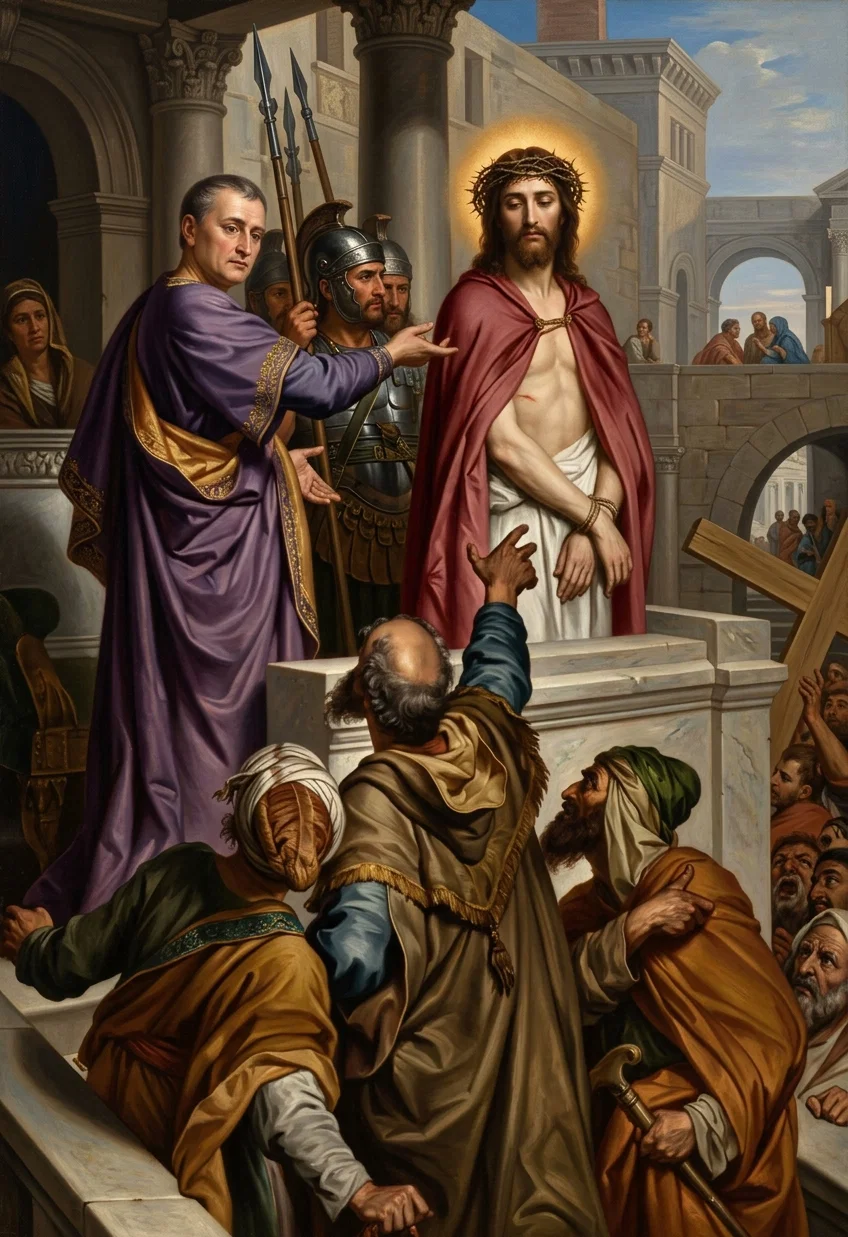
BEHOLD THE MAN!

8%

Pacific Press Publishing Company · Oakland, California · Aug 17, 1904

FromSigns of the Times, Vol. 30, No. 33.

Read the full edition

“BEHOLD THE MAN!”

AFTER an examination of Jesus on the charges brought against Him by the Jewish council, Pilate, the governor of Judea, publicly declared, “I find in Him no fault at all.” But he virtually conceded a condemnation, thinking to release Jesus through a pardon. It had been a custom of the governors to release some Jewish prisoner at the Passover. When the people were gathered from all parts of the province to celebrate their principal festal occasion, it was deemed good policy to please them by releasing one of their number who had been condemned by the Roman law. It also added to their pleasure to be allowed to choose the one who should be released. So, taking advantage of this custom, Pilate thought to make the condition such that the people would choose Jesus. He knew that the chief priests had delivered Him because of their envy, but he still had some confidence that the people could be moved in the interest of justice.
THERE was in prison a man named Barabbas, who had been convicted of insurrection and murder and robbery. Pilate thought that by giving the people a choice between such a desperado and the harmless Jesus, whom they had so highly honored but a few days before, they surely would choose the innocent One. But when he asked them which of the two they would choose, “the chief priests and elders persuaded the multitude that they should ask Barabbas, and destroy Jesus.” So they cried out, “Not this man, but Barabbas.” Pilate asked, “What shall I do then with Jesus which is called Christ?” and they answered, “Let Him be crucified.”
“WHEN Pilate saw that he could prevail nothing, but that rather a tumult was made, he took water, and washed his hands before the multitude, saying, I am innocent of the blood of this just person; see ye to it.” Then the people answered, and said, “His blood be on us, and on our children.” But Pilate was terribly mistaken; he could not wash away responsibility in that manner. Therefore he was guilty of the blood which alone could wash away his sin. No judge could be innocent in giving over for execution a prisoner whom he had thrice pronounced innocent; nor could the assumption of responsibility by others take away his responsibility, or cleanse his hands.
BUT before finally giving Jesus into the hands of His enemies, Pilate resorted to another ruse, which really accentuated his cowardice before the multitude. He voluntarily took Jesus, and had Him “scourged.” The Roman scourge was a whip with numerous lashes, and each lash was set with sharp bits of iron; so when the scourge was applied the skin and flesh were cruelly lacerated. And in addition to this torture, the governor permitted the whole band of soldiers to make the prisoner an object of sport for a while. “They clothed Him with purple, and platted a crown of thorns, and put it about His head, and began to salute Him, Hail, King of the Jews! And they smote Him on the head with a reed, and did spit upon Him, and bowing their knees worshiped Him.”
THE scourging and the further abuse and insult by the soldiers had been permitted by Pilate with the evident purpose of exciting pity and sympathy in the hearts of the people. So, in this bleeding, suffering condition, in this altogether pitiable plight, Pilate brought Him before the multitude, and said, “Behold the Man!” the Man in whose praise they had so recently sung “Hosanna to the Son of David; blessed is He that cometh in the name of the Lord!” the Man who had gone throughout their land proclaiming only good tidings, and doing only good works; the Man in whom there was no guile, stood before them—Himself a mute appeal for humane consideration and simple justice. But hearts that had rejected the Gospel could not long retain even a semblance of regard for Him whom the Gospel message would make known.
WHEN He was expected to take the throne of government, and give the people immediate promotion in a political way, they could throng the streets in efforts to honor Him; but in the hour of disgrace and apparent defeat, there was no more appreciation of all that He had done for them. “He is despised and rejected of men; a man of sorrows, and acquainted with grief; and we hid as it were our faces from Him; He was despised, and we esteemed Him not. Surely He hath borne our griefs and carried our sorrows; yet we did esteem Him stricken, smitten of God, and afflicted. But He was wounded for our transgressions, He was bruised for our iniquities; the chastisement of our peace was upon Him; and with His stripes we are healed.”
BUT the church of to-day can not sit in judgment upon the church of that day. The rejection of His plain teachings in the church to-day; the disregard of the Golden Rule, the ignoring of the commandments of God, and the substitution of human tradition to-day, are just as much a rejection of Christ as in the day of His formal condemnation. It is clearly a “falling away,” and those who maintain such a position in the more resplendent light of His Word, “crucify to themselves the Son of God afresh, and put Him to an open shame.” Heb. 6:6. “Therefore thou art inexcusable, O man; whosoever thou art that judgest; for wherein thou judgest another, thou condemnest thyself; for thou that judgest doest the same things.” Rom. 2:1.
WE of to-day will do well often to “behold the Man” as He stood in His dignified humility, weakened by fatigue and torture, the subject of public insult, “a reproach of men, and despised of the people,” the victim of envy and of false accusation, and, above all, His heart bleeding with sorrow and pity for those who were rejecting their only hope of salvation from sin. It is just as true of us as of those of old, that “all we like sheep have gone astray; we have turned every one to his own way; and the Lord hath laid on Him the iniquity of us all.” The Lord can say also of us to-day, “For the transgression of My people was He stricken.”
BUT, praise His holy name, He has given us another view—only to be seen, however, from the standpoint of repentance and faith. “Hear, ye that are far off, what I have done; and, ye that are near, acknowledge My might. He that walketh righteously, and speaketh uprightly; he that despiseth the gain of oppressions, that shaketh his hands from holding of bribes, that stoppeth his ears from hearing of blood, and shutteth his eyes from seeing evil; he shall dwell on high; his place of defense shall be the munitions of rocks; bread shall be given him; his waters shall be sure. Thine eyes shall see the King in His beauty; they shall behold the land that is very far off.” Isa. 33:13–17. “Beloved, now are we the sons of God, and it doth not yet appear what we shall be; but we know that, when He shall appear, we shall be like Him; for we shall see Him as He is.” 1 John 3:2. “Behold the Man,” and lay hold of eternal life.”
By first taking an appreciative view of Him in His humility, and accepting His great sacrifice for our sins, we may—by faith now, and by actual experience hereafter—be enabled to see Him in His glory, and to be made partaker of it. 1 Peter. This is the desire and prayer of the Master; shall it not be our earnest purpose in life?