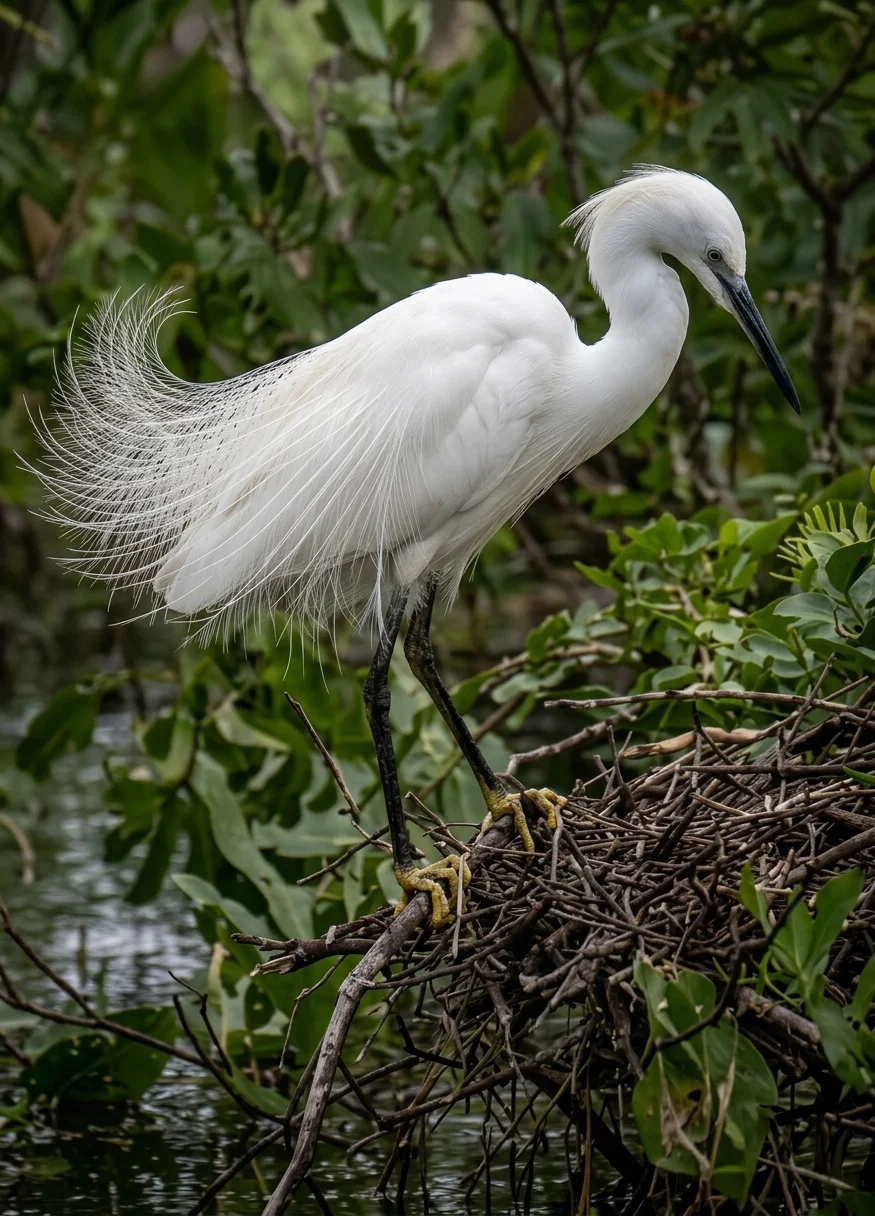
The Snowy Heron

5%

Pacific Press Publishing Company · Oakland, California · Aug 17, 1904

FromSigns of the Times, Vol. 30, No. 33.

Read the full edition

The Snowy Heron.

BY WILLIAM DUTCHER.
(Chairman National Committee of Audubon Societies.)
The recent history of the white herons is pathetic in the extreme, as it is a tale of persecution and rapid extermination. It was a sad day when fashion decreed that the nuptial plumes of these birds should be worn as millinery ornaments. Feathers and scalps, rapine and blood, are the accompaniments of savage life, but better things are expected of civilization.
It is hardly possible that any women of the present day are unacquainted with all the horrible details of the plume-hunting. The following pen picture of the horrors of the plume trade, drawn by Prof. T. Gilbert Pearson, Secretary of the North Carolina Audubon Society, shows the work in all of its bloody reality:—
In the tall bushes, growing in a secluded pond in a swamp, a small colony of herons laid their nesting home. I accompanied a squirrel hunter one day to the spot, and the scene which met our eyes was not a pleasant one. I had expected to see some of the beautiful herons about their nests, or standing on the trees near by, but not a living one could be found, while here and there in the mud lay the lifeless forms of eight of the birds. They had been shot down and the skin bearing the plumes stripped from their backs. Flies were busily at work, and they swarmed up with hideous buzzings as we approached each spot where a victim lay. This was not the worst; in four of the nests young orphan birds could be seen who were clamoring piteously for food which their dead parents could never again bring to them. A little one was discovered lying with its head and neck hanging out of the nest, happily now past suffering. On higher ground the embers of a fire gave evidence of the plume-hunters’ camp.
The next spring I visited this nesting site, but found only the old nests fast falling to decay.
When man comes, slaughters, and exterminates, nature does not restore.
This story of a single Florida colony is the story of what has happened in all of Florida, the Gulf coast of the United States, along the Mexican and Central American coast, both on the Atlantic and Pacific sides, and has extended into South America. From the enormous numbers of herons’ plumes that are annually sold in the London feather market there is no doubt that plume-hunters are at work wherever the white herons are found.
The much-sought-after plumes are worn by the herons only for a very limited period during the year, that is, in the breeding season. Unfortunately, during that time the herons gather in colonies; whether this is for protection or is merely social is not known. During the remainder of the year they are wild and wander over large districts, when it is impossible for plume-hunters to kill them in quantities that would afford pecuniary returns. However, during the breeding season the habits of these unfortunate birds change entirely, and with the growth of the parental instinct they lose all sense of fear or wildness, and the hunter has little trouble in securing his victims. The death of the parent bird entails the destruction of the helpless nestlings by the painful and lingering method of starvation.
Mr. Chapman says, in his “Birds of Eastern North America:” “The destruction of these birds is an unpleasant subject. It is a blot on Florida’s history.” The blood stain is not on Florida alone, but may be found in every part of the world. A few years more of reckless slaughter during the breeding season and the white herons will be classed among the extinct birds, the number of which is far too rapidly increasing.
Dealers often state that “aigrettes” are manufactured, but this is not so; man has never yet been able to imitate successfully these beautiful plumes; all that are offered for sale have been torn from the backs of the smaller white herons. Even the stiff plumes, or “stubs,” are not manufactured, but are the plumes of the larger species of white herons.
Herons’ plumes are often sold as “ospreys;” this is simply another trade name used to disguise the fact that they are herons’ plumes; the “osprey” of science is the fish hawk, which produces no plumes of any kind.
Both “aigrettes” and “stubs” are dyed various colors, especially black; however, no matter what is the tint of the plume, its original color when on the back of the heron was white; the artificial color is merely in response to the dictates of fashion.
It is conceded that the sale of “aigrettes” from American birds is prohibited, but it is claimed that there are no laws that prevent the sale of imported goods. Granting that this may be the case, how is the buyer to tell whether the goods are from American or Old World herons? The most expert ornithologists can not separate the plumes after they are taken from the birds.
The wearing of “aigrettes,” or plumes from the white herons, whether native or foreign, has now become a question of ethics which every woman must decide for herself. It matters not a whit where the plume comes from, the fact remains the same that the woman who wears one is party to a cruel wrong, and the plume itself becomes a badge of inhumanity and is no longer a thing of beauty.
“Mark how the mother lulls to slumber Her new-born babe with tend’rous love And guards her treasure from above!”
The word mother is the most sacred of all names, and motherhood is the closest of all human ties. O, mother! when you nestle your little one to your loving breast and look into the eyes that reflect the mother-love shining from your own, do you not sometimes think with an involuntary shudder of the sorrow and grief it would be were the child to be taken from you? Or, still worse, if your tender care were to be removed from the helpless infant? While this thought is still with you, extend it to the bird-mother, for she surely has for her offspring the same tender love that you have for yours; she has the same affection, the same willingness to face danger to protect what is to all mothers dearer than life itself. O, human mother! will you again wear for personal adornment a plume taken from the dead body of a bird-mother, the plume that is the emblem of her married life as the golden circlet is of your own, the plume that was taken from her bleeding body because her motherhood was so strong that she was willing to give up life itself rather than abandon her helpless infants! Whenever you are tempted in the future to wear a herons’ plume, think for a moment of your own motherhood, and spare the bird-mother and her little ones.