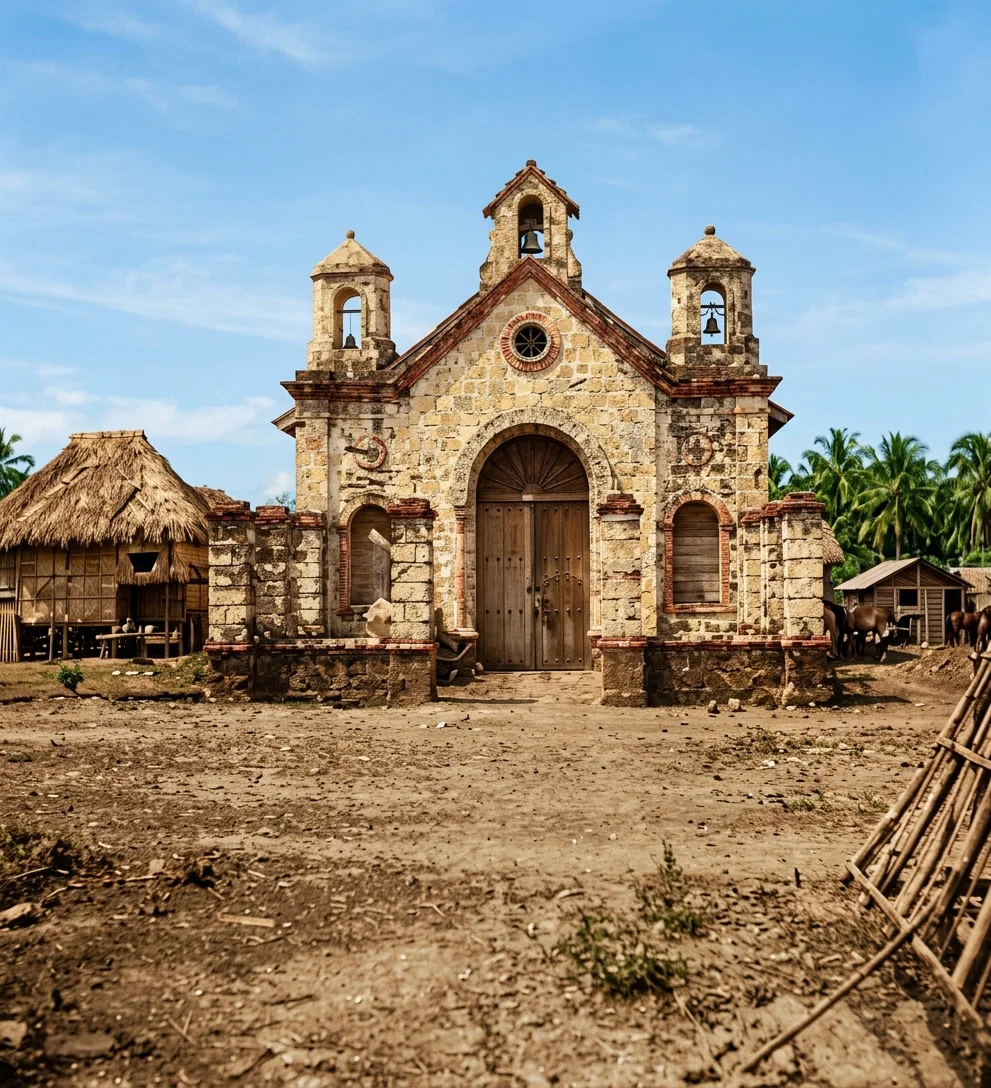
Old Church at Camp Dewey, P. I., at one time the headquarters of Aguinaldo.
THE AGLIPAY SCHISM IN THE PHILIPPINES.
[Under the above heading the Literary Digest of May 21, gives the following condensed account of this noted revolt from Catholicism in the Philippines. It is a part preparation of the field for the pure Gospel. The article from the Digest follows:—]
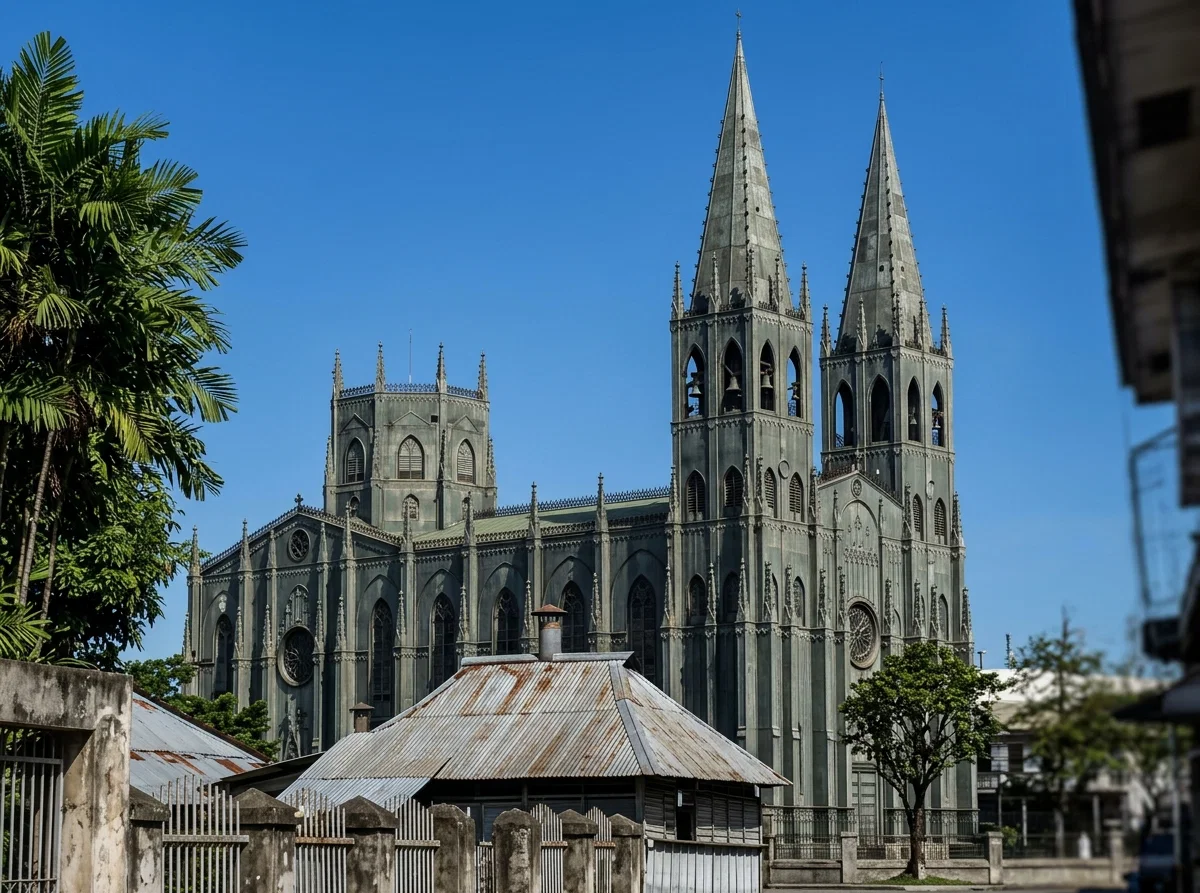
San Sebastian Church, Manila, P. I.
Mr. James A. Le Roy writes a concise account of the trend and development of the Aglipay schism in the Philippines which resulted in the formation, some eighteen months ago, of the “Independent Philippine Church.” It is significant to note, he comments, to what an extent Protestant ideas have crept into the organization, the ritual, and even the doctrine of this new church. The writer supports his statement with data from the church’s official publications. Before proceeding to this comparison, however, he gives (in the Independent, New York, April 28) a résumé of the facts leading up to the present situation, which we quote in part:—
The schism was first proclaimed on August 3, 1902, in a meeting arranged by the Workmen’s Union, the organization through which Isabelo de los Reyes had begun his semi-socialistic propaganda, which was rather more than suspected of being primarily an anti-government agitation, regardless of proclaimed principles. The feasibility for his ends of an anti-friar agitation, which should assert as a national cause the rights of the native clergy, may readily be seen. Reyes had associated with him certain of the more independent native priests, chief among them the excommunicated Father Aglipay. Reyes, however, was more radical than his chief associates, who, after the former had flung his defiance of the Catholic Church to the winds, took counsel of prudence, and did not at first care to go to the extreme of proclaiming their rebellion against the authority of the pope. Aglipay sheltered himself with his old advisers, the Jesuits, who, of course, counseled submission; and Reyes was left to conduct what schism there was for nearly two months as an adjunct to his agitation among the proletariat (which about that time landed him in jail). Aglipay’s brethren among the native clergy of North Ilocos have always been the most independent-minded of their kind, and it was here that the schism finally was formally launched early in October as a definite anti-Rome movement among the native clergy, one of their number being consecrated bishop. The formal inauguration of the new church took place in Manila, on Oct. 22, 1902.
The new church first formulated its position, Mr. Le Roy tells us, in a series of “Fundamental Epistles.” The first of these dealt with the question of the ordination of bishops; the second with the “friar question,” and with Archbishop Alcocer’s anathema against the schism. So far, we read, no announcement had been made as to doctrine, except that the dogma of the Roman Catholic Church would be retained. In Epistle III., however, Mr. Le Roy finds something more implied than a mere renunciation of obedience to the pope. We quote his comment and citations:—
Along with orthodox Catholic disquisitions as to the nature of divinity, went such a statement as: “Once having valorously thrust off the burdensome religious servitude of four centuries of mystery and medievalism, let us also have the virility to think with our own minds . . . with the natural reason which we have received directly from the generous hands of the Creator.”
The worship of the saints and of the Virgin is not to be relegated, but they shall not have a place before the members of the Trinity itself. Outlining the sublimity of a conception of God based upon modern science, and its revelation as to the universe, the Epistle says: “Calmly compare now, dear brothers, the sublimity of these profoundly great and venerable ideas about the true God, with the overwhelmingly gross paltriness of the absurd marvels that are attributed to the miracle-working saints, like the wandering one, who, showing his repugnant ulcers, is said to cure the pest; the holy friar who brings back lost things, and provides sweethearts, . . . and other superstitions which, at the cost of the gravity of our holy religion, the Romanists have invented.”
And a little further along Protestantism spoke quite plainly thus: “Instead of certain books of religious exercises wherein abound so many impostures, and attempts at erotic declamations to the female saints, written by lazy, neurasthenic friars fasting from flesh, give to the faithful the immortal and only Book of God which is the Bible, wherein they will learn to adore Him as they ought, and to follow rules of life adjusted to the desires of our Creator, and to the laws of nature contrary to which we can never go.”
In Epistle IV. the idea of lay participation in the management of the church and its propaganda was outlined; and in Epistle V. the pope was attacked in answer to his bull on the Philippines, issued in December, 1902.
By February, 1903, Mr. Le Roy continues, the bishops of the new church already numbered more than a dozen, and the Supreme Council had been organized. The latter put forth the “Doctrine and Constitutional Rules.” Of these we read:—
The first part contains the doctrine. Chapter I. declares the object of the Independent Philippine Church to be as outlined in Epistle III., stress being laid upon the restoration of God’s “most Holy Word” in the worship of Him, and upon the necessity for freeing consciences from all “anti-scientific scruples against the laws of nature.” Furthermore, the aim is announced to “reconquer the rights and prerogatives of the Filipino priesthood.” Chapter II. contains an orthodox profession of faith in one God, and in His manifestation through the Trinity.
Religion, rightly conceived, is declared to be too serious to countenance image worship, and the necessity for perfecting the individual intelligence so as to comprehend the Divinity is reiterated. These declarations of the chapter in question are noteworthy: “The immortal and only Book of God is the Bible, and in it we ought to learn to worship Him as is fitting; to glorify Him, as we see in the Psalms; to pray to Him as the divine Master Himself teaches. And in the Bible we find also salutary rules of life, both private and social, rules that will bring us well-being as well in this life as in the next.”
“In all that is not contrary to the pure Word of God, to nature, to the sciences, and to right reason, we follow the same belief as the Romanists.”
Worship and rites, declares the next chapter, shall be the same as those of the Roman Church “except where it has falsified the Biblical teachings with simoniacal and deceitful ends in view.” In the temples the Protestant practise of having all seated should be followed, instead of having the women squatted on dirty floors, often covered with saliva. On the altars the “saints and Virgin are to be put at one side, and the symbols of the Trinity in the center.” The priests shall give especial attention to the reading of the Bible in the services, for which purpose the Book of Job is particularly commended. Prayers are to be “short and simple,” and not made up of the useless repetition of Ave Marias, “which excites the13imagination, stifles fervor, and induces sleepiness.”
The special festivals in honor of saints are not condemned, but more particular pains should be taken to celebrate the days of the Saviour, and ten Ave Marias should not be said to one “Our Father.” Prayers, moreover, should be said in the local dialect, and mass should also be celebrated in the dialect, its features being explained to the congregation as it proceeds.
The rules of life, as laid down in Chapter IV., are to be followed primarily the commandments as they were interpreted by Jesus. Charity to our fellows is the first duty, and these rules of life are for all the days of the week, as well as for Sunday. Another duty of man is to perfect his intelligence. We should praise and defend “philanthropy, justice, honor, arms, labor, and the sciences.” The dignity of work is proclaimed, as it is in the “inexhaustible law of well-being.”
The second part of the document consists of the rules for the government of the church. The Bishop Maximus (Obispo Maximo) is to consult with the Supreme Council on all important matters, the council being composed of bishops, and certain selected presbyters nominated by the Bishop Maximus. . . . The interesting feature of this part of the document is its proclamation of communism as the ideal of the new church. The “abolition of property, the communism of possessions” was proclaimed by Jesus, yet had only made progress in notable degree during the past century; hence the new church, while holding this as its ideal, must yet not attempt to put it into practise at one blow.
This feature, Mr. Le Roy believes, was introduced into the document by Isabelo de los Reyes, who had lived among the socialists of Spain and Italy and the ideas upon which he has been seeking to arouse the Filipino proletariat. Reyes is the editor of the daily organ of the new church, La Iglesia Filipina Independiente, Revista Católica (The Independent Philippine Church, a Catholic Review). He disclaims complete acquiescence in the “Doctrine and Constitutional Rules,” says Mr. Le Roy, and “declares himself to be in favor of the marriage of the priests, and of the abolition of the confessional, and have no belief in hell.”