In a previous article I called attention to the fact that the Italian people are losing confidence in Catholicism, and that many of them are drifting into skepticism. This transition is quite natural, for when a person has been brought up in a religion that he comes to see has been deceiving him for many years, he loses confidence in all religion. Especially to the mind of a Catholic, religion and Catholicism are synonymous terms. And therefore the problem in Italy is almost as serious in dealing with skepticism as in refuting Catholicism. And it is a skepticism that very often takes a peculiar form, because, while many will rail against Catholicism and show their utter disregard for it, yet, after all, they will in a sense defend it as compared with other religions, as their business and social relations depend so much upon the influences that are held within the grasp of the Roman Church.
Here, in Rome, for example, are brought together many thousands of Catholic priests, monks, nuns, and students for the priesthood, who, in procuring the necessities of life, naturally must buy great quantities of goods of various kinds. They try to so regulate these purchases that they will hold the greatest possible number of shopkeepers under obligation to them, by giving to them their patronage. A man may be an infidel, having no faith in religion at all, yet when his living comes from a certain source he will not speak evil of the religion that helps him in his business. Therefore to help this situation it will take a religion in which a man has confidence to believe that there is a reality, and such a religion will not only convert him from his skepticism but from his Catholicism also. In order for a person to sacrifice friends and business, he must catch a glimpse of something eternal.
Now have we not in the Third Angel's Message that reality and that enduring substance before which these earthly considerations become as empty dross? I believe that we have in this message just that which the world, including Italy, needs to save them from skepticism, Catholicism, and the thousands of other "isms," new and old, that are raging in these last days.
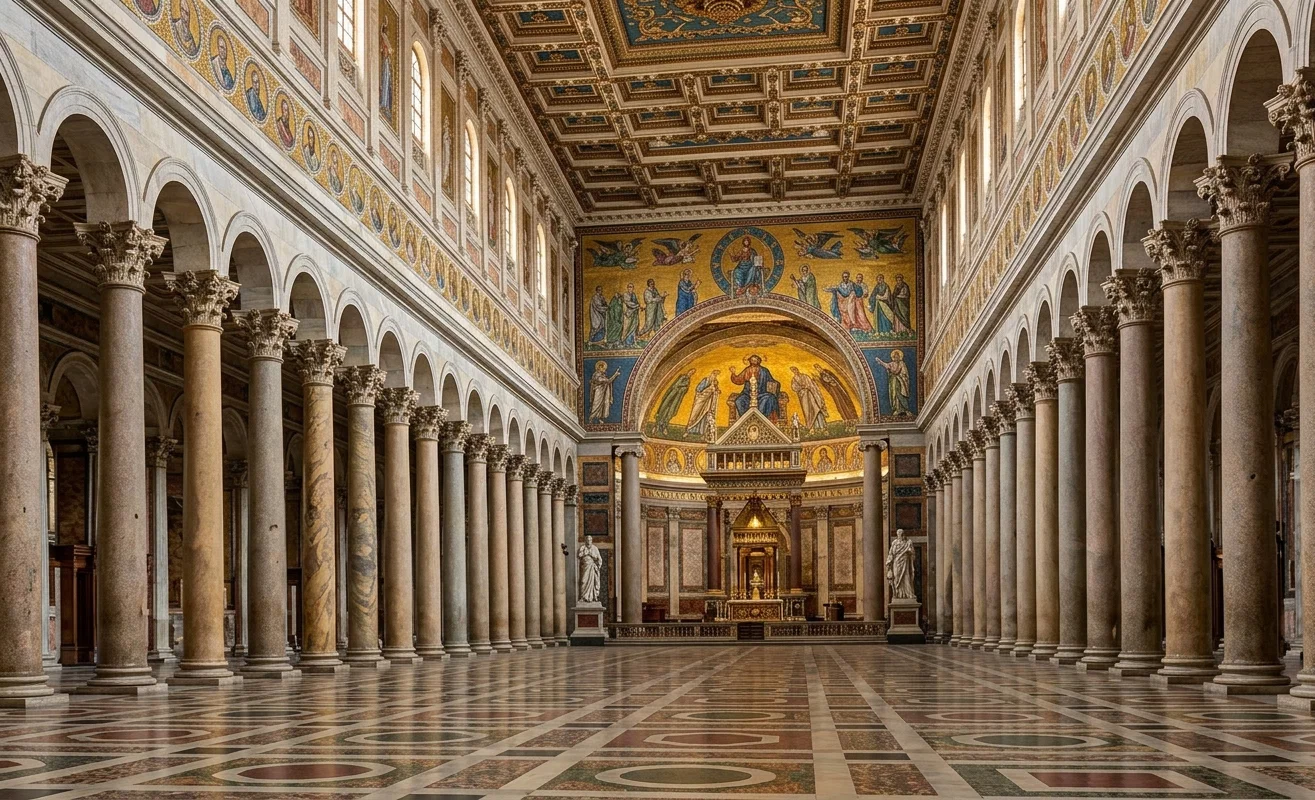
Interior View of St. Paul's Church, Rome.
To illustrate this last statement, let me call attention to a circumstance that occurred here a short time ago. One afternoon, at our regular Sabbath meeting, a Baptist minister was present who has worked here for several years. I was giving a series of readings on the points of the message, and, on that particular Sabbath, was explaining the prophecy of the twenty-three hundred days. When I had finished, the minister said, enthusiastically, that such preaching is just what is needed in Rome, for it shows up so plainly the inspiration of the Bible. And he went on to say further that he was giving some talks to young men at the Young Men's Christian Association, but he experienced so much difficulty with the young men because they were so full of skepticism. He felt sure, however, that such lectures as the one he had heard would do great good. He said that I ought not to delay, but should procure an interpreter and start meetings immediately, and he believed that it would not be long before we could do a successful work. He emphasized his words by hunting about and procuring an interpreter for me, but as yet we have not been in a position to open meetings in a hall.
I only speak of this instance to show how some others are struck by this message, and see immediately its adaptability to the present day conditions. If others are impressed in this manner, surely we that know this message should have greater confidence in what the truth is able to do.
The Protestant work in Rome is comparatively new, as no Protestant churches were allowed within its walls previous to Sept. 20, 1870, at which date the Papacy lost control of the temporal power in Rome. Previous to this date no Protestants were allowed to meet in Rome, only one or two small embassies, and under the flags of their countries. All other work along religious lines was strictly forbidden. And many times since 1870 the pope has lamented the fact that the Protestants are allowed to evangelize in Rome, and longed for the opportunity to drive them out. Therefore, it is only a little over thirty years that the Protestant work has been carried on here, and, altho mightily opposed, it has made some progress. The Methodists have here a very fine church building, where they have two meeting halls, one for the English-speaking and one for the Italian congregation. The hall for the Italians is quite commodious, and generally very well filled at their services. This Italian church has a membership of about three hundred. Besides this church building, the Methodists have a fine school building, and are doing a splendid work along educational lines. Then there are the Wesleyan Methodists, who have also a good church building, and a membership of something over 250. The pastor of this church is an Englishman, and he can preach very acceptably in the Italian language.
The Baptists, taking them all together, have three good church buildings here and operate several mission halls. They number about five hundred. Three of their evangelists have been Catholic priests, and one has been a monk.
The Waldenses have also an excellent church edifice, which is splendidly located, and have also a mission in another part of the city. They number in membership something over three hundred, and one of their pastors told me that their yearly accessions amount to about twenty-five.
There are also a couple of independent churches with which I am not so familiar. Besides these churches that are working entirely among the Italian people, there are five churches that hold their services exclusively in English. These congregations all occupy good church buildings, and during the season have large congregations. Considering the opposition that is continually given by the Church of Rome, and the short time in which Rome has been open to the Gospel, the work here has been quite successful.
The opposition that the Roman church brings against the work of evangelization is not small. I have been told that wherever a Protestant meeting is started in Rome, the Catholic Church will start an opposing effort right across the street, and will conduct their services as near like those of the Protestant meetings as possible. If the Protestants have preaching service, they will have the same; and if they have mothers' or childrens' meetings, the Catholics will hold similar services. So we can see that they contest every inch of the ground. The priests and other Catholic workers know the solicitude that the pope has over these “Protestant encroachments,” and they realize that the one that fights them the most successfully will not be forgotten when the rewards are given out.
By operating in such close proximity to the Protestant meetings, they are able also to detect who are frequenting them, and then bring to bear upon the attendants at those Protestant services all their influence. They will refuse to help them when they become sick or in want. Or if they are shopkeepers they will threaten them with a withdrawal of their patronage. Very often these threats are successful, for the Catholic Church practically controls all the hospitals in Rome, and they are the distributors of the charities.
The Lord has been preparing the Adventist people in a special way to deal with this situation, in that we can largely nullify these threats by using the training that God has given us along the lines of medical missionary and Christian help work. Our visiting nurses might do a splendid work in taking the places of the nuns who at present put the people under such great obligation to them by the nursing and help that they give them when sick. With the aid of a dispensary along rational lines we could help13many poor sufferers, and in this way assist in breaking the power of Rome that holds them in bondage in both soul and body.
Taking it altogether, with our great message of the prophecies to open the eyes of the skeptics, our scriptural overturning of the claims of purgatory, our special gospel of healing for the body, our training along the lines of Christian help work, and our glorious Sabbath truth with which to strike at the very core of Catholicism, we have a vanguard to present to the enemy such as has never been mustered against the Church of Rome since its inception. All these great doctrines have been hidden since the time of the apostles, and have not been fully brought to light until these last days. Therefore, Rome has not met them until now, and shall they not accomplish their appointed work?—They certainly shall, for we have a great message.