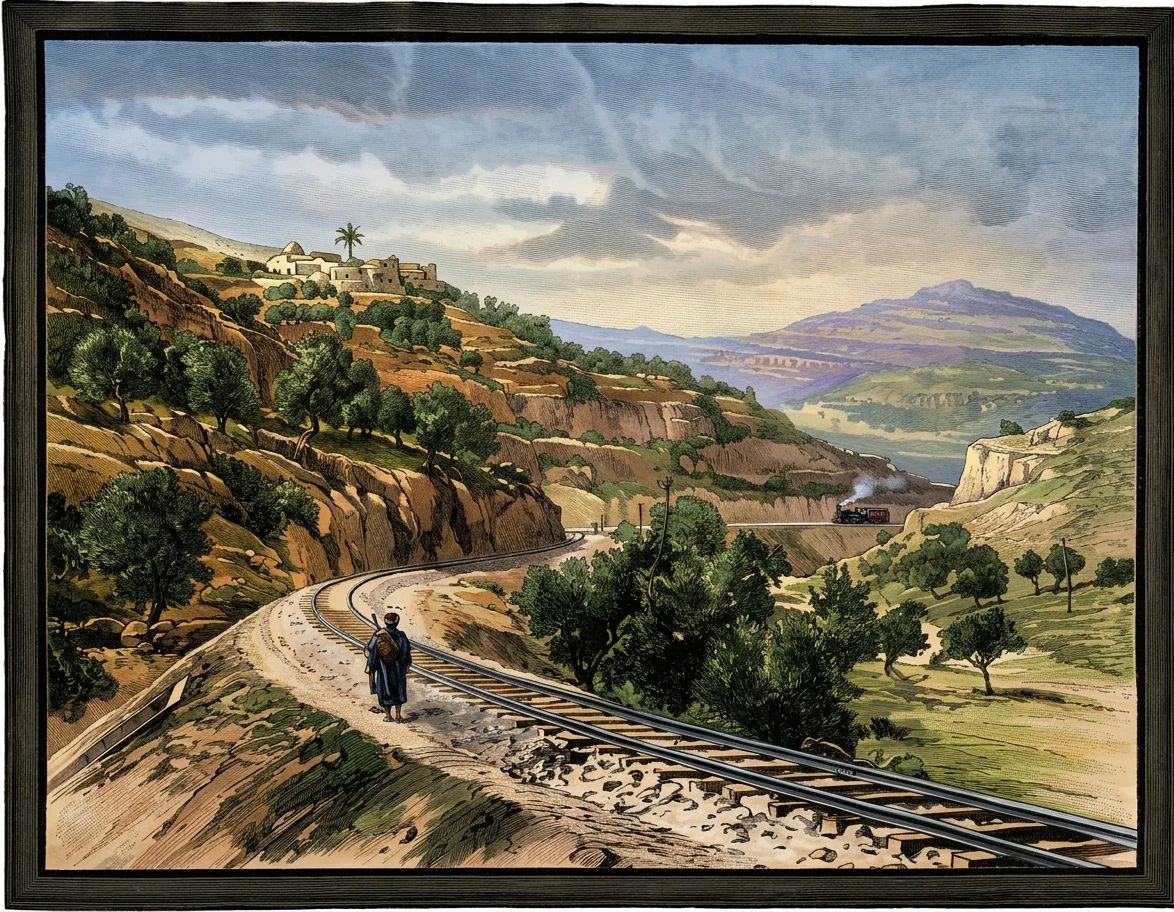
IN Bible times and up to within a few years, people who traveled between Jerusalem and Joppa had to walk, or ride on some kind of animal. But it is not so now, for they can go “up to Jerusalem” or “down to Joppa” on the steam-cars. Joppa is now called Jaffa. It is on the shore of the Mediterranean Sea, and is about thirty miles from Jerusalem by the old road. The railroad line, however, is fifty-four miles long, because, in laying the track, it was necessary to wind around the hills in order to make the ascent to Jerusalem. There are 176 bridges on the road. Leaving Jaffa, the first station is Lydda, about twelve miles distant. Our illustration shows a section of the railroad track and a small train coming down from Jerusalem.
Modern Mode of Travel from Jerusalem to Joppa.
THE mention of Joppa and Lydda in connection with Jerusalem calls to mind some experiences in the ministry of the apostle Peter which the Lord thought it worth while to have recorded for our learning. “And it came to pass, as Peter went throughout all parts, he came down also to the saints that dwelt at Lydda. And there he found a certain man named Æneas, who had kept his bed eight years; for he was palsied. And Peter said unto him, Æneas, Jesus Christ healeth thee; arise, and make thy bed. And straightway he arose. And all that dwelt at Lydda and in Sharon saw him, and they turned to the Lord.”
“NOW THERE was at Joppa a certain disciple named Tabitha, which by interpretation is called Dorcas [margin, Gazelle]; this woman was full of good works and almsdeeds which she did. And it came to pass in those days, that she fell sick, and died; and when they had washed her, they laid her in an upper chamber. And as Lydda was nigh unto Joppa, the disciples, hearing that Peter was there, sent two men unto him, entreating him, Delay not to come on unto us. And Peter arose and went with them.”
“AND when he was come, they brought him into the upper chamber; and all the widows stood by him weeping, and showing the coats and garments which Dorcas made, while she was with them. But Peter put them all forth, and kneeled down, and prayed; and turning to the body, he said, Tabitha, arise. And she opened her eyes; and when she saw Peter, she sat up. And he gave her his hand, and raised her up; and calling the saints and widows, he presented her alive. And it became known throughout all Joppa; and many believed on the Lord.”
THIS is a brief narrative, and if one such occurrence should be heard of in these newsy days, there would be columns of reports about it. This humble apostle, in the simple garb of every-day life, bearing no outward sign of power or authority, just walked into the sick man’s room and spoke the name in which lies all power in heaven and in earth. He took no credit to himself, just kept self in the background, simply saying, “Jesus Christ healeth thee.” Then the paralytic of eight years’ affliction was immediately made whole. O what power there is in The Name, when it is given its rightful place “above every name!”
THEN this humble man of faith, this itinerant representative of the meek and lowly One—not the autocrat of the Vatican, attended by a military body-guard; not the self-styled “Elijah,”2 (722)sounding a trumpet before him—is told of the death of a humble sister in Joppa, a missionary worker for the Master. It was twelve miles away, as the railroad now goes, and there was no railroad train or stage-coach. But what is that to the man accustomed to itinerant work on foot? The humble lay brethren had come for him, the call was of the Spirit of God.
ARRIVING at the house where the deceased sister lay, he is met by the testimonials of her Christian help work. The “widows” were bewailing the loss of a temporal benefactor. This was apparently the extent of their appreciation. So it seems to have been necessary for Dorcas to lay down her life in order to more effectually tender their hearts, and that the manifestation of the goodness of God in a more striking manner might show to them the real Source of all their blessings. Then, alone with the dead, the apostle presents the case to the Master whom he had learned both by faith and by experience to trust. Great was the victory when he “presented her alive” to the “saints and widows”—not merely that Dorcas was restored to them, but because “many believed on the Lord.”
BUT this is not all of Peter’s experience in Joppa. He “abode there many days,” and it was during this time that he experienced that wonderful vision which taught him and all the apostles a lesson that they had failed to learn before, altho the Lord, when present with them, had often repeated it to them. It was there, on the housetop of Simon the tanner, that in a vision he saw “as it were a great sheet, let down by four corners upon the earth; wherein were all manner of fourfooted beasts and creeping things of the earth and birds of the heaven. And there came a voice to him, Rise, Peter; kill and eat. But Peter said, Not so, Lord; for I have never eaten anything that is common or unclean. And a voice came unto him again the second time, What God hath cleansed, make not thou common.”
WHAT was the meaning of this vision? Was it that Peter should eat of every living creature on the earth? No; the lessons of the Spirit are spiritual. There is no doubt that Peter learned the lesson that God designed he should learn, and we can get that from Peter himself. At the house of Cornelius, two days afterward, when speaking to the company who had assembled to hear him, he said: “Ye yourselves know how it is an unlawful thing for a man that is a Jew to join himself or come unto one of another nation; and yet unto me hath God showed that I should not call any man common or unclean.” Soon afterward Peter attended a council of the apostles and brethren of Judea at Jerusalem. They had heard of his preaching to the Gentiles at Cæsarea, and called him to account for it. So Peter related all about the vision, and his visit and experience at the house of Cornelius, and how the Spirit had witnessed to his ministry there. And when the brethren heard it, they “glorified God, saying, Then to the Gentiles also hath God granted repentance unto life.” And this is the lesson of the vision at Joppa.
YES, there are railroad facilities and other “modern improvements” at Joppa and Lydda and Jerusalem, but have these added anything to the power of the Gospel? Is there such manifestation of the Spirit at any of these places as there was when Peter and his fellow-workers walked from village to village and from city to city, sowing the precious seed as they went? Truly, in the providence of God the world is being covered with the facilities for a quick Gospel work, but are they being utilized as they might be for that purpose? In the judgment there will be an accounting as to why the Gospel made greater progress in the days when its messengers traveled afoot than it does with all the “modern improvements” at hand. Is it not strange that the adversary gets the principal use of the great inventions of men, for which God gave the wisdom? Surely the enemy could not achieve such usurpation without the co-operation of those who use the various means of travel and communication. G.