IS THE GERMAN EMPEROR COURTING THE FAVOR OF THE ROMAN PONTIFF?
By Chas. T. Everson
WITHIN less than a week the two great Protestant monarchs of Europe have visited the pope. The visit of Edward VII., king of the British nation, we referred to quite fully in our last article, and desire at present to notice some features in connection with the visit of William II., Emperor of Germany, to the Holy See.
We recall from the article dealing with the visit of the English sovereign that King Edward went in quite a modest way to see the pope. But the visit of the German sovereign was in marked contrast to the visit of Edward VII. The Emperor of Germany, for the third time, has now presented himself at the papal court. On his former visits he has always employed the carriage of the German Embassy at Rome in going to and in returning from the Vatican. On the occasion of his last visit, however, he went to the pontifical court with such pomp and ostentation that it has completely eclipsed his former visits.
In fact, when the German monarch left Berlin to come to Rome to become the guest of Victor Emmanuel III., King of Italy, he took with him the imperial carriage, his own livery, body-guard, and a large retinue. His own horse he took to ride on the occasion of the great military display given in his honor by the King of Italy, but the imperial carriage and livery he employed solely on the occasion of his visit to the pope.
On Sunday morning of May 3 the German sovereign attended divine worship in the private chapel at the German Embassy. It was a service conducted according to the usual German Protestant rites, with a sermon delivered by Pastor Peters, the preacher of the Embassy. From the Embassy the royal party went to the German Legation to the Vatican, where the emperor gave an elaborate luncheon to a small company of invited guests, prior to his visit to the pope. On this occasion Cardinal Rampolla sat at the emperor's right and Cardinal Agliardi was at his left, and directly in front of his majesty and between the two German princes, sat the German minister to the Vatican. At the right of the crown prince was Cardinal Gotti. We notice that, altho the guests were few, consisting mainly of the emperor's suite, yet among them were three of the most powerful cardinals of the Catholic Church.
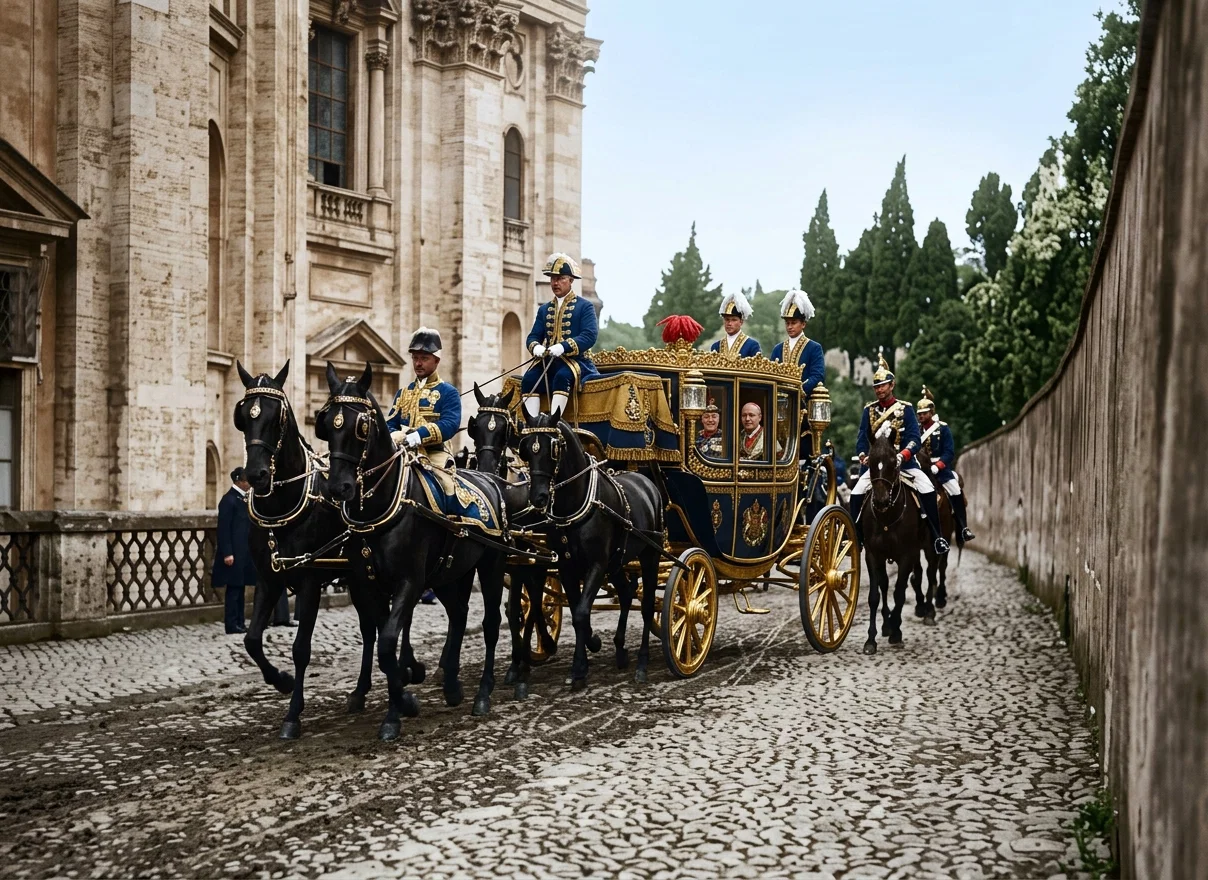
At the conclusion of the festivities the first person to leave the Legation was Cardinal Rampolla, who went directly to the Vatican and repaired to the private apartments of the pope. Here he held a brief interview with the Roman pontiff. Shortly after the cardinal's departure, the royal party left the Legation for the Vatican. It was preceded by a company of carabineers, and the men in charge of the German imperial stables, who were dressed in magnificent attire. Four black horses, upon two of which were mounted lackeys, drew the imperial carriage, which was luxuriously upholstered in white. Following the carriage came the emperor's own body-guard, brought with him from Germany, especially for this occasion. They were dressed in very showy uniform, with silver helmets upon which were mounted eagles of the same metal, and brilliant breastplates covered their waistcoats of white.
In the carriage with the emperor was the crown prince, while following came fourteen carriages containing Prince Eitel, General Wandersee, and the retinue of his majesty.
German Emperor Going to the Vatican.
At the Vatican also the most extravagant preparations were made for the reception of the sovereign of Germany. In fact, honors were accorded this Protestant monarch that are denied even to Catholic kings. As he entered the Vatican the magnificent Swiss and Palatine guards and the dignitaries attired in gorgeous apparel appeared to their best advantage, and the general atmosphere of the surroundings was one calculated to impress the emperor and the princes with the greatness of the pontifical court. As on the occasion of the visit of King Edward, the throne room was turned into an ante-chamber and the interview was held in a small adjoining room. Leaving the princes with the German minister, alone the emperor entered the audience-chamber, in the middle of which he met the pope, stooped with age and leaning on his cane. His majesty bowed twice while he took the outstretched hand of the aged pontiff, who wore the rich, traditional, white robe, but no ermine cape, while around his neck was a necklace of gold, to which was attached a cross of the same material. The pope immediately opened the conversation, inquiring about the condition of Victoria Augusta, the German queen, speaking sympathetically concerning her recent accident. The queen is a very strong Protestant, and, consequently the pope wanted to make her feel that he was very friendly toward her, for it is said that one reason besides her recent accident, that deterred her from coming to Rome, was her aversion to going to the Vatican. The pope also expressed himself as much pleased with the progress of Catholicism in Germany. The interview of the emperor and the pope lasted twenty-five minutes, and at its conclusion the emperor introduced the princes to the pontiff, who asked the young men how they were impressed with Rome, “the center of Catholicism and antiquity.” The crown-prince responded that he was glad of the opportunity of coming to Rome, and thereby satisfying a long-felt desire. The pope then presented the emperor and the princes with three magnificent and costly mosaics, while the emperor in turn gave to the pontiff two beautiful photographs of the cathedral at Metz.
The royal party then repaired to the third floor, where are the apartments of Cardinal Rampolla. The German sovereign and the princes entered the throne room where anciently the cardinals received the visit of the pope, and there held a brief interview with Cardinal Rampolla, the papal Secretary of State. That the emperor has displayed such friendliness for Cardinal Rampolla is quite significant, as he is the individual that deals directly with the sovereigns in presenting the claims of the Catholic Church, when any difficulty arises.
The entire visit at the Vatican occupied an hour and ten minutes. And that it was regarded by the pope with a high degree of satisfaction is evinced by the fact that he went to the window to see the grand procession as it was leaving the Vatican. And, furthermore, wherever the German sovereign went thereafter in Rome, from the windows of the cloisters and convents and from the street corners, the nuns, monks, and priests, waved their handkerchiefs and saluted his majesty with great applause, and the Catholics in general expressed their admiration of the emperor's new attitude toward the Vatican in no uncertain terms.
On the day following this visit to the pope the emperor spent one whole day visiting Montecassino, the famous convent, founded by St. Benedict. He donated to the library twenty volumes of ancient manuscript and contributed $2,200 toward beautifying and repairing the crypt of the monastery.
It is not an unusual occurrence for monarchs to visit and confer favors upon Montecassino, for, from the time of Totela, the Gothic conqueror of Rome, in the sixth century, many powerful monarchs have presented themselves at the St. Benedictine shrine. But at a time when France is driving out from its country the Benedictine and other orders of the Catholic Church, it seems quite significant that the German monarch should be embellishing the tomb of the founder of this powerful order.
That his majesty is seeking the influence of the Vatican is certainly believed at the pontifical court; and many go so far as to affirm that he is taking advantage of the present Catholic disturbances in France to ingratiate himself into the good-will of the Roman pontiff. And that he is, in a large measure, succeeding in obtaining the birthright of “the first daughter of the church” is quite evident. For, on the day following the emperor's visit, the pope emphatically declared that now, under no consideration, would he receive the President of the French Republic if he should come to Rome. The emperor wishes to bring to bear upon the strong Catholic wing of the Reichstag the influence of the Vatican in his favor, for then he can readily dispatch some measures that have been giving him no end of trouble. But in Germany the entire Protestant press has come out in no uncertain terms in denouncing the emperor for the ostentatious way in which he has accentuated this visit to the pope. They are not so much opposed to the fact that he went, except for the ostentatious manner in which he paid this visit which is susceptible of an interpretation that is not at all pleasing to the Protestants of Germany.
The Italian people also regard the emperor's recent visit with no small degree of dissatisfaction; for the German monarch, while a guest at the palace of their king, went to visit the pope, the avowed enemy of the Italian monarch with a pomp and ostentation reserved solely for this papal visit.
The relation that exists between the Vatican and the Italian Government can be well understood from the following circumstance. When Humbert succeeded to the throne of Italy he made a visit to the king of Austria that has never been returned, because the Austrian monarch is a staunch Catholic. He will not visit Rome, for then he would have to stop at the palace of the King of Italy; and this he does not wish to do, because of the enmity between the king and the pope. Therefore when the German sovereign went from the palace to the Vatican with such ceremony it would seem that he was more anxious about gaining favor at the Vatican than to please his hospitable host at the Quirinal palace.
And as we view these events in the light of divine prophecy, we can see that the beast shall again, for a short time, make his power to be felt. The countries where his great achievements have been wrought in the past are weak and drifting away from firm alliance, and, therefore, his efforts in these days, among the great Protestant nations like Germany, the United States, and England. That he is succeeding in these directions is plain to all who are alive to the things that are occurring around us. It ought to tell us in unmistakable terms that the coming of the Lord hasteneth greatly and what we do we must do quickly.