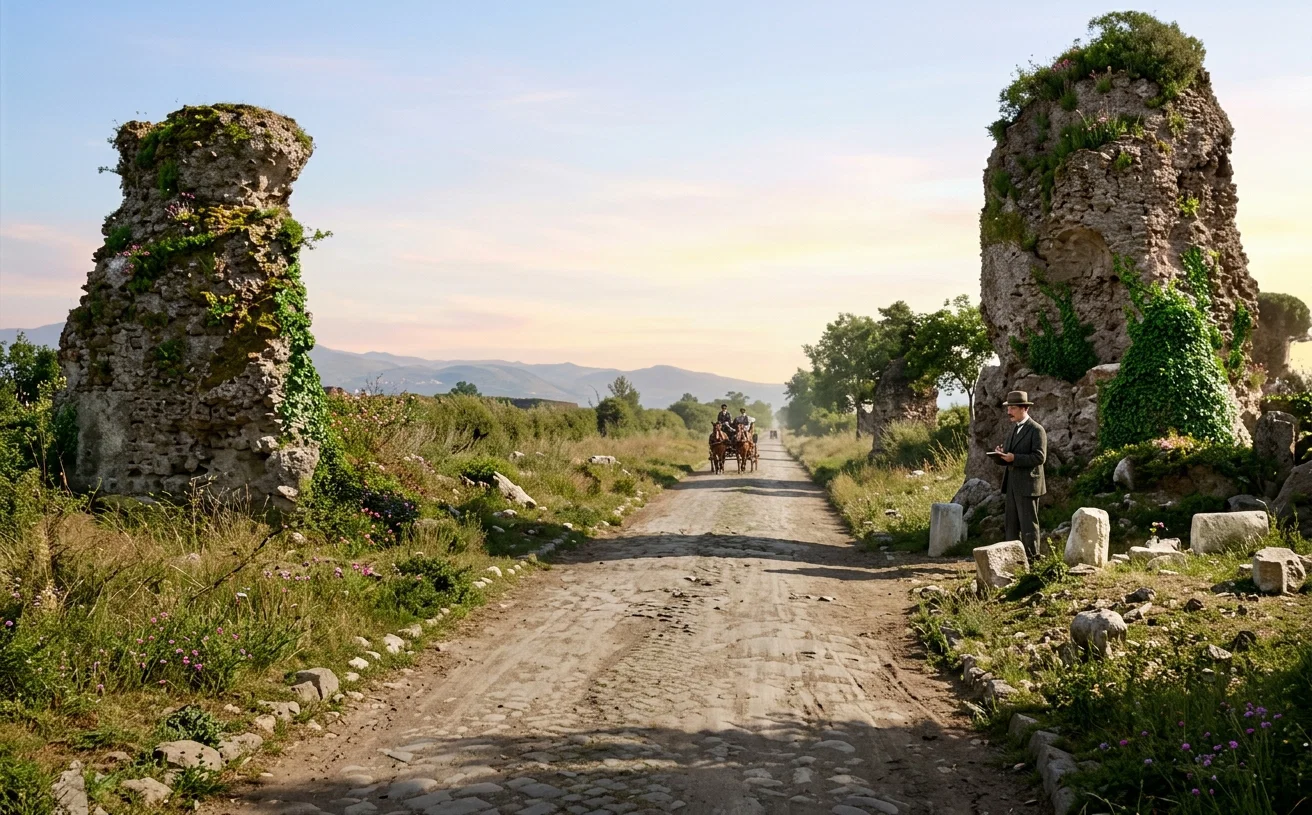
There is little in this picture of itself to interest. The broad, ancient highway stretches to the southeast. The old piles of moss and tree covered ruins stand by its side, and the westering sun casts shadows across the old road. One solitary tourist, or curiosity seeker, and a distant carriage relieve the monotony of the somber loneliness of the scene. All about speaks of desolation. Yet this is a picture of to-day.
LET us go back nearly nineteen hundred and fifty years. The highway was still old at that time and well traveled by military and civilian, by plebeian and men of noble blood. A little to the southwest rolls the blue Mediterranean; for this broad road is the highway, built probably by Appius Claudius, connecting Rome and Naples. A stout ship, buffeted by wave, wind, and current, lands its passengers near to our scene at Puteoli. Principal among these are several prisoners bound to Cæsar's court, well guarded by Roman soldiers. Heavy with chains, they pursue their journey toward the great city of the world. Of all the prisoners one stands out conspicuous and alone, charged as a criminal, yet guilty of no crime; associated with sinners, yet hating sin. His weary, eventful, solitary journey, with only two companions in heart, is nearly over. The city to which he is bound with his companions—he a prisoner, his comrades free—is forty-three miles distant, and the long journey nearly done. But the journey had told somewhat on the indomitable spirit of the prisoner-in-chief, and even he, who had said of earth's severest trials, “None of these things move me,” had almost lost heart.
It is not the great trials of life generally that discourage the soul of the Christian. This man had met, since the beginning of the shaping of events which led to this journey, mad mobs hungering for his life; he had borne testimony before kings and courts; he had escaped conspiracies of banded assassins who plotted to destroy; he had suffered shipwreck; been bitten by a poisonous viper; his life had trembled in the balance of the decision of a fearful military tribunal; but in all these trials his sublime faith and courage had risen superior to all ills, and cheered the hearts of discouraged companions. But the long, wearying journey, and the heavy chains, had at last told on the brave soul, and courage had waned. It was a weakness of the flesh, not of the spirit.
WHEN the ship lands at Puteoli the aged prisoner finds brethren, with whom he is permitted to tarry over Sabbath. He then takes up his weary tramp to his destination. Over the very road of our picture he travels. News of his coming had been hurried on before to those of like precious faith, and they start down the Appian Way to meet him. Forty-three miles from Rome, at the Appi Forum (the Market of Appius), ruins of which are shown in our picture, came the brethren to meet the aged prisoner. The busy market was filled with the hum and jar and bustle of sailors and fishermen, but they found the faithful heart, and made themselves known. And when Paul, the “ambassador in chains” (for he it was), saw them, “he thanked God, and took courage.” He was glad that some heart remembered him in his trials, that faithful souls were willing to come so far to meet him and greet him, tho a prisoner in chains; that they were willing to identify themselves with him in his open shame and reproach, knowing that he was blameless. He “thanked God and took courage.”
SO GOD constantly sends encouragement to every soul in life's weary way. He knows the unseen struggle, the unremunerated toil, the invisible pain of body and heart, the secret conflicts with the enemy, ending sometimes in defeat, the reproach for His name's sake—He knows it all, and the little tokens of light and goodness and cheer along the way are the smiles of God to cheer the heart of the pilgrim. These blessings may not come in persons, but they will come, and that from the Father's hand and heart. Keep open eyes to see, open ears to hear, open hearts to receive His blessings, and tho the world's mart may be as crowded as the old Roman market, we may there find the messengers of cheer and help, and thank God, and take courage. “Be of good courage, all ye that hope in the Lord.”