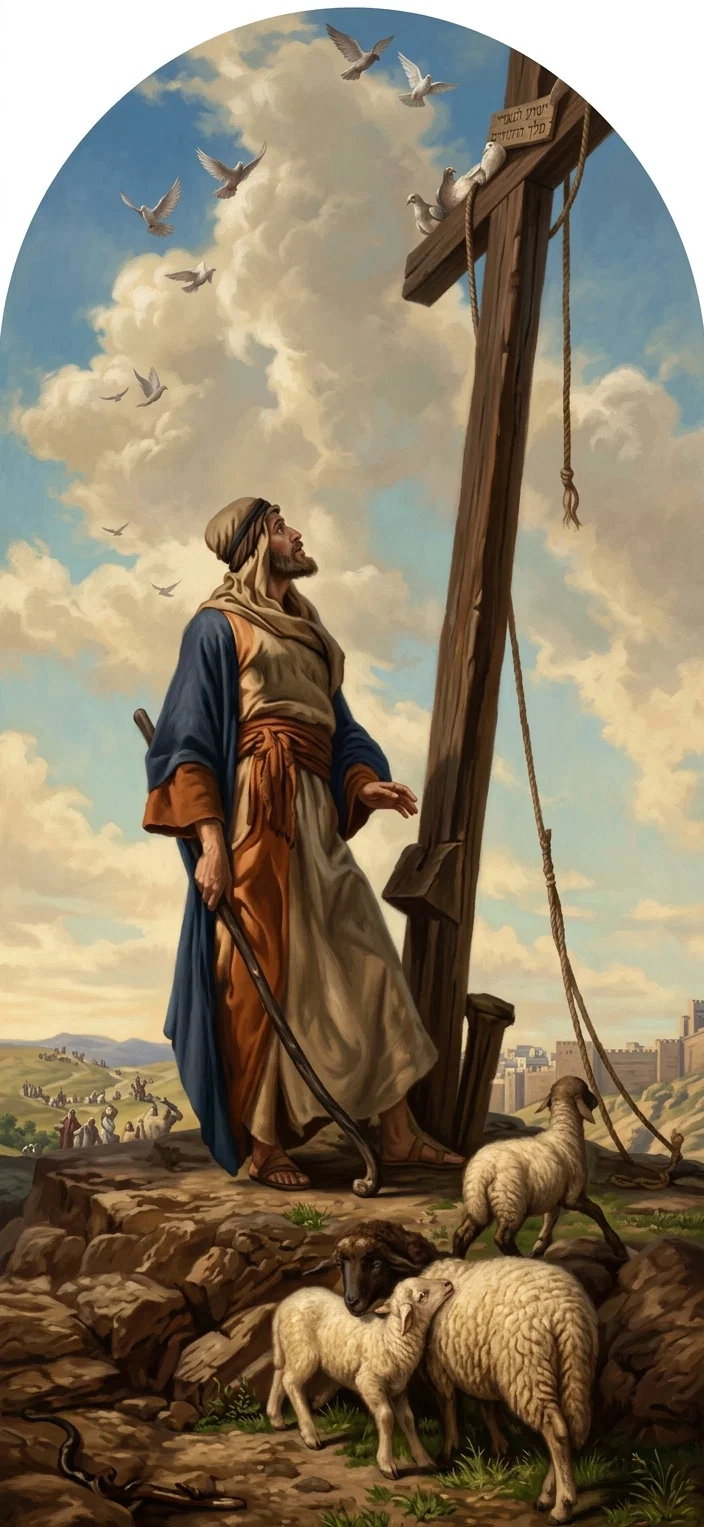
THE picture on this page is, doubtless, only the conception of the artist, but it might have been a fact. At any rate it teaches a useful lesson.
Its time is A. D. 31, in the spring of the year. Jesus of Nazareth and two malefactors had just been crucified on a hillside near Jerusalem, Jesus as the King of the Jews. His execution was by the Romans at the demand of His own people, the Jews. A few hours later the body had been removed for sepulture, and the cross left standing ugly and bare, outlined against the Judean sky. The people had dispersed, the curiosity of the crowd satisfied, and again the shepherd with his flock comes upon the scene. The sheep feed thoughtlessly by, while the shepherd wonders, perhaps, why such a man should die, and the meaning of His death. He still reads the inscription,—
“THIS IS JESUS OF NAZARETH, THE KING OF THE JEWS.”
Nails are in the wood, a loose rope hangs from the cross-beam, and the doves fly idly about and rest upon the cross as tho it were placed there for that very purpose.
TO-DAY every part of the instruments of the cruel death would be carried away as souvenirs by the curious, as sacred relics by the superstitious. To-day men look with fear and reverence upon what are said to be pieces of the true cross, nails used in the crucifixion, which in the aggregate would make a dozen crosses and a keg of nails. Men seek the supposed spot of our Lord’s crucifixion and burial, erect costly memorial churches over them, make long pilgrimages to the spot, as tho there were life and power in these material things.
READER, let this truth sink deep into your heart: There is no merit in a dead past. Whether it be Noah’s ark, the robe of Elijah, the staff of John the Baptist, the seamless vesture of Jesus, the cross upon which He suffered, the cruel nails which fastened Him to the tree, the sepulcher in which He was laid, the napkin wound about His head—not any one, nor all, possess any merit whatsoever. Could we find the very sepulcher above its stone-cut vault, faith would hear ringing the cry of the messenger of the Lord spoken nineteen centuries ago, “He is not here; He is risen.” We might look upon the wood of the veritable cross on which He died, but it could be as truly said, “He is not here.”
Shepherds of Jerusalem.
THE JEWS of old looked upon their magnificent temple pile, upon all its appointments and services, and said, “The temple of the Lord, the temple of the Lord, the temple of the Lord, are these,” but Jesus declared that those who had faith in the material things alone, had made that temple “a den of thieves.” The holiest instruments of God are made so because of His indwelling presence, but when He departs, that holy thing becomes common. How forcibly God revealed this when, at the death of Christ, a strong, invisible hand rent the heavy veil which separated the sanctuary from forbidden eyes, thus declaring that they had rejected Christ, and the glory had departed. The thing we cherish as the holiest is profane unless Christ be in it.
THE cross of Christ in itself is nothing. It stands for eternal sacrifice on the part of God; it stands for death to sin. “Cursed is every one that hangeth on a tree.” But the Victim of Calvary was not there because of His sins, because of the curse that came to Him on account of His conduct. He was there because of our sins. “He hath made Him to be sin for us, who knew no sin; that we might be made the righteousness of God in Him.” “He was wounded for our transgressions, He was bruised for our iniquities; the chastisement of our peace was upon Him; and with His stripes we are healed. All we like sheep have gone astray; we have turned every one to his own way; and Jehovah hath made to light on Him the iniquity of us all.” That cross stands for His amazing love, and for death to sin.
DO WE love it? Do we wish like Paul to glory in it?—Then “reckon ye also yourselves to be dead unto sin;” “our old man,” “crucified with Him, that the body of sin might be done away, that so we should no longer be in bondage to sin.” It is the privilege of every soul to glory in the cross of Christ as the slayer of our sins. But, then, it is not in the material cross, but in the sacrifice of Jesus Christ. Reckon that sacrifice yours, and yourself, like Him, dead to sin forevermore.