LET the cynical critic of modern missions or the esthetic apologist of orientalism go to Marsovan, Turkey, and study the effects of forty years’ teaching of Western ideals of Christianity and civilization. Marsovan, 350 miles east of Constantinople and seventy miles south of the Black Sea, has been little touched by the surface influences of Europe, and forms a fair field for such study and comparison.
From the highest point of the mountain road, where one first gets a view of the plain of Marsovan, the city seems like a garden of the Lord. The rich plain, twelve miles by thirty, is enclosed in its wall of mountains. Midway on the northern side, and nearly surrounded with gardens and vineyards, lies the city. Pass through the green environment into the city and you have the narrow, crooked, rough, and filthy streets and the small shops of any Asiatic city. There are good houses and a few pleasant gardens, but they are carefully hid from view behind high walls of mud bricks. The houses are crowded together as tho there were no broad fields and no mountains to which to lift up the eyes. Sanitary conditions are disregarded. The people must go out of the city for their good air, as do their cattle for the grass.
On the highest ground on the north, overlooking the city and with the unbroken view of the mountains on every side, stands the mission compound. Within the enclosure are the buildings of the college, the hospital, the girls’ school, the boys’ and girls’ orphanages, and the missionary homes. You pass through the gates and you seem in another world. This circle of happy homes, of eager youth, of keen mental and spiritual life is object-lesson enough for any open mind. And even the dullest and darkest minds feel in some dim way that this is a better life. It is no wonder that Turkish women, who have been fortunate enough to have the care of the cheery, bright, hospital wards, dread the going back to their own homes.
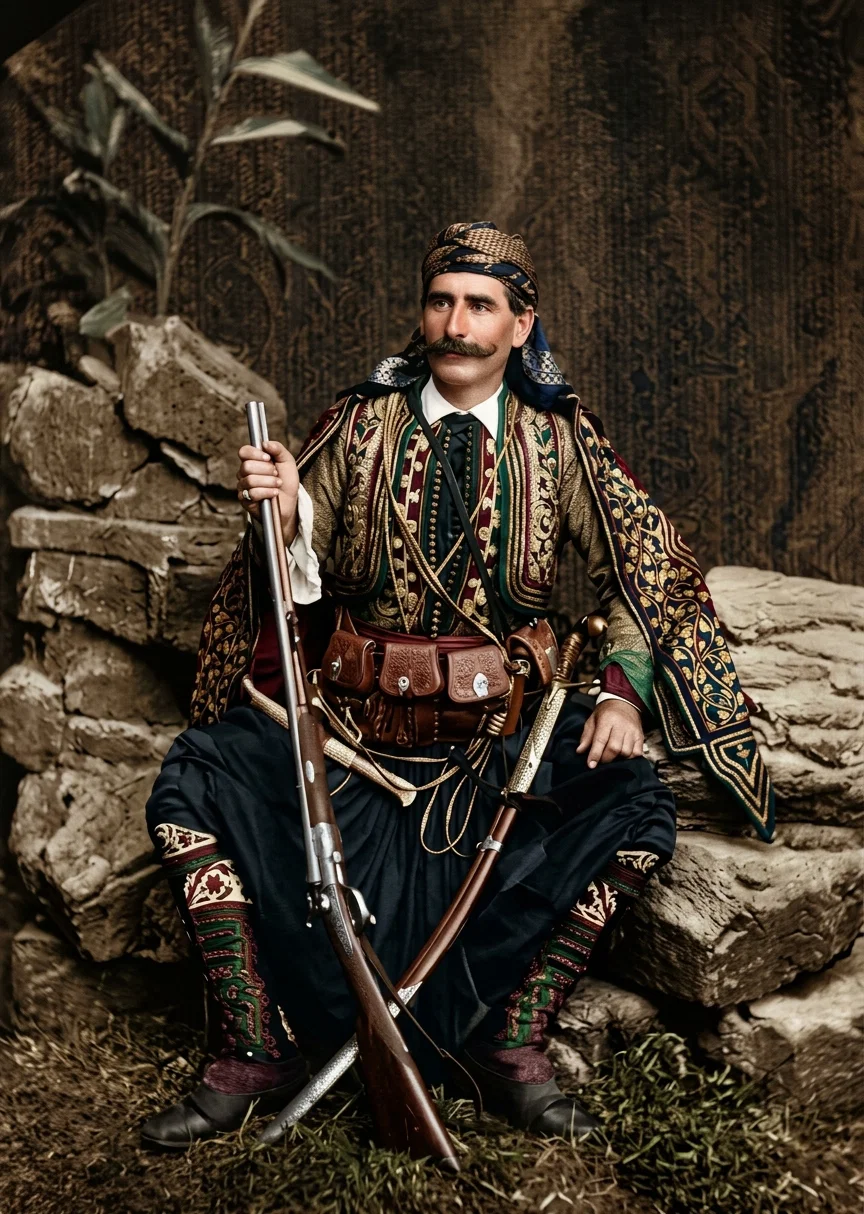
A Typical Turkish Official—A Human Arsenal.
The college is doing good work. The foundations for thorough industrial training have been laid. Forty per cent of the students do some work for self-support. The trades of shoemaker, tailor, carpenter, and cabinet-maker are well taught. All the furniture for the college and much for the mission homes and the general market is here made. It is a pity that the Turkish Government has even temporarily stopped the erection of larger shops. The young men not only become skilled workmen, but all the students gain what is just as important for the regeneration of the East, a sense of the dignity of manual work.
The college is true to its missionary purpose. It does not aim at proselyting, it is Catholic in its sympathies; but the Bible is the chief text-book, the religious life of the college is constant and pervasive, impressing the privilege of service; and an examination of the lists of the fifteen classes graduated will tell the story of the success in this direction, in the large proportion devoted to teaching and preaching.
The girls’ school has wisely refrained from trying to grow into an American college. The conditions in Asia Minor are not what they are in Constantinople. The life of the villages is rude and simple. The girls must be the teachers and helpers of their people, but never out of sympathy with them. Marriage is early, and can not yet be postponed as in the western world, and three years more in school to complete a college course would render the service of teacher or mission worker practically impossible, and so retard the real progress of the people. It is interesting to find but one servant in this family of ninety boarders, the pupils sharing in all parts of the housekeeping and so gaining the most practical knowledge of domestic economy. Good homes are sure to come from such a school. They have come in scores and scores of places. Forty years ago but one woman in Marsovan could read; to-day the primary education is common, and the higher education represented by the girls’ school is held essential for any woman who would have a position in the community.
While the work for Armenian orphans grew out of the massacres, it will, no doubt, go on as an important part of mission service. The groups of bright, happy boys and girls, well cared for, well taught, sent forth as skilled workmen or useful helpers in home, and school, and church, are the good out of evil that the love of God is ever working in human lives.
The hospital is, no doubt, the most striking and persuasive part of the mission service. It seems the only way of gaining the good-will of the Turkish population. People who are callous to spiritual influence are quick to feel the healing touch. The hospital means are simple, but adequate for the most improved scientific care. I doubt whether more difficult and successful surgery is done in any hospital of America. A single year will show 300 cases in the hospital and 5,000 treated by the dispensary.
Through these many agencies the mission has won its way into the heart of the Christian peoples. The good name of the college has gone far and near. The assistant governor of the province has placed his boy in the family of the president. There is the best feeling between the Protestants and the Orthodox and Gregorian churches in many places. The chief priest of Marsovan has taken lectures in theology at the college, and urged the sending of evangelists to the villages. When remonstrated with by some zealous partisans of the Orthodox church for his fellowship with Protestants, he answered, “As a priest of the church I am bound to seek the truth. Where can the most light be found save at the American college?”
The seal of the college is the sun rising behind Ak Dagh, the noble mountain to the east, and the motto, “The morning cometh.” The morning has come, but not without its clouds and storms. No other institution has been so seriously threatened by the misguided ambition of some of its pupils, and the deep-seated mistrust of the Turkish Government. The fourteen young men still in prison are a heavy load for these brave hearts to carry. Shall not the Christian men and women of America unite in the prayer that freedom may be granted by the government for the work of these Christian institutions, and that peaceful and orderly progress may be the happy lot of the peoples of Asia Minor?