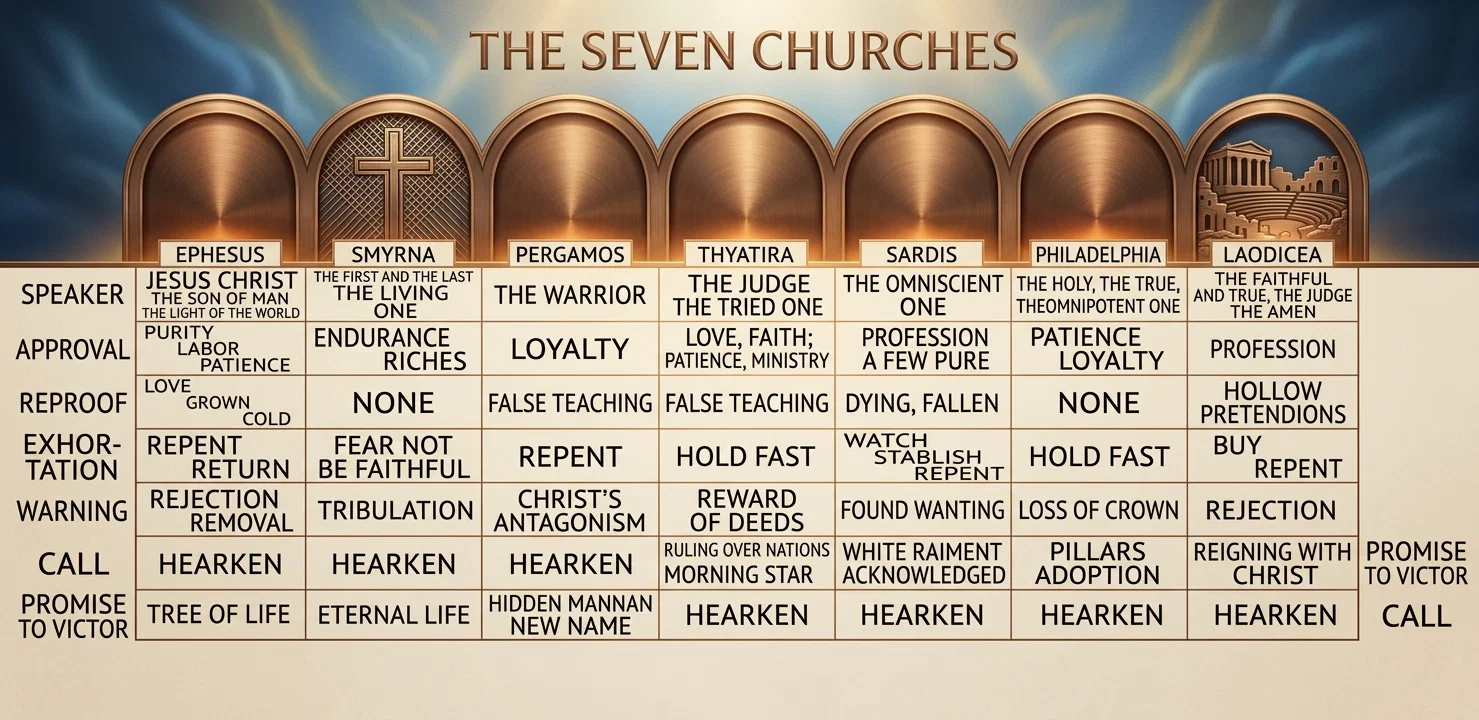
THERE were seven literal churches in literal Asia, doubtless known by the names John uses in Revelation 1 and 2.
2. But it is not in harmony with the plan, the object, the scope of the book of the Revelation of Jesus Christ to confine to them the seven sevenfold letters, with all their fulness of prediction, instruction, and promise.
1. Because there were other churches in Asia as important as some of these mentioned, as, for instance, Troas and Colosse.
2. The fact that just seven are noted evidences that fulness and completion is indicated, in harmony with other lines of prophecy and symbols in the book. A seven-sealed book spans all the records of time; a seven-headed dragon covers all the great historic dynasties; seven golden lampstands represent the entire church, seven spirits of God, the one all-pervading Spirit, seven horns, the fulness and glory of the Lamb’s unconquerable sway.
3. The seven churches warned bore in their history, character, or name some one or more features which fitted them to be types of the different stages and characteristics of the entire church of God from apostolic days till the coming of our Lord Jesus Christ. Thus Balaam is used as a type of religious teachers; Jezebel, of the apostate church; Egypt, of infidelity; Babylon of old, of mystical Babylon; and John himself stands as the representative of God’s servants even to the close of earthly probation.
That the scope of the prophecy and the similarity and difference of the letters may be clearer, we present a diagram of the seven churches. Let the student note the following features:—
1. The diagram covers the Christian dispensation from John’s day to the second coming of Christ.
2. It is impossible to mark the definite beginning and ending of each division or church. They blended into each other, telescoped each other, so to speak, and the characteristics of each and all continue in some measure to the end. In general, it may be said that Ephesus included the closing part of the apostolic age; Smyrna, the time of the pagan persecutions; Pergamos, from the days of Constantine to the sixth century; Thyatira, the greater part of the long period of the Dark Ages; Sardis (beginning with Reformation times), Philadelphia (with Advent-message days, about 1840), Laodicea (especially after 1844), all represent last-day conditions, manifest even unto the very end.
3. The general plan, the sevenfold division, of our Lord’s letters to the church in each condition is the same throughout, with the exception of a few striking features. We have, (1) the speaker or writer, our Lord Himself under different titles; (2) approval if there was aught to approve; (3) the reproof, if the Master saw aught to reprove; (4) the earnest exhortation; (5) the faithful warning and admonition; (6) the call to hear, coming sixth in the first three, and seventh in the last four; so that before and after the promises comes God’s blessed invitation; (7) the promise to the overcomer, coming seventh in the first three and sixth in the last four.
4. It will be noticed that these conditions naturally fall into three irregular pairs, with a seventh which stands alone; Ephesus and Philadelphia, Smyrna and Thyatira, Pergamos and Sardis, and Laodicea.
5. Ephesus (“desirable”) represents a pure condition of the church, in which there was much to approve. Yet even here the love had grown cold under the influence of error, worldliness, and apostasy. But this condition is duplicated in fuller measure in Philadelphia (“brotherly love”), against which the Infinite has no reproof. Surely brotherly love is a desirable condition, and dwelling in it the church will have to be when she welcomes the return of the Lord.
6. Smyrna, persecuted under Pagan Rome, is duplicated on a larger scale in Thyatira, persecuted under Pagan Rome. Christ has no reproof for Smyrna; the sufferings are sufficient. Persecution purifies the church. The church driven into the strongholds of earth for protection in the Middle Ages, loving God, believing in Christ Jesus, enduring, ministering to all, even their persecutors, is fittingly represented by Thyatira, which had also imbibed false teaching, and in the darkness of the wilderness lost much of the light of truth in the night of error. Yet the Master tenderly loves the church in Thyatira.
7. Pergamos, lifted up with worldliness and pride and the favor of the State, is duplicated in the post-reformation churches, under Sardis. Sardis is the darker picture. Notwithstanding the place given to false teaching in Pergamos, the church was in a measure loyal. But in Sardis, connected with the world, bound in creed and form, there are but few, comparatively, who know more of Christianity than mere profession. There is the name to live, but the church is dead. How fitting the description to many in the churches in the present! Union with the world has crowded Jesus Christ from the heart. Yet God regards the comparatively few and pure; and these He will call out of Babylon before its destruction.
8. Laodicea represents the last phase of apostasy in the church. It is the waxing cold of a part of the remnant church, because of abounding iniquity. Matt. 24:12; 2 Tim. 3:1–5. It represents a large holding of theory and fact, but without the living truth. God has not one good thing to say of those in Laodicea. Their case is wretched indeed.
Here is the Lesson.
We, Christian reader, are in one of these three conditions. Are we in a church united with the world, seeking a closer union with the State, with a name to live, yet dead? “Protestants” we may be called, but with no power to protest against the principles of the Papacy in Church or State, in our own fold, or in the State. Is this our condition?
Or are we in Laodicea, counting ourselves possessed of spiritual riches because we have a working theory of the Gospel, at ease, having need of nothing, indifferent, wishing to be let alone? Is this our condition?
Or are we living in that condition where our heart condemns us not, where we have confidence toward God? Are we patiently enduring? Are we loyal to God? Have we entered the door which the Holy One has opened before us, and which no man can shut? Have we by faith followed Him into the Most Holy place, where He ministers before the ark of God containing the eternal, holy law, unchanged and unchangeable in a single jot or tittle? Are we bringing the sins which that law reveals to Jesus, putting them away forever, walking in His footsteps, obedient to all His law? If we are not, we are yet in Sardis or in Laodicea.
God calls to us, indifferent and lukewarm tho we may be, to be zealous and repent. For tho the Infinite One may have no good thing to say of us, He has wonderful things of blessedness to say to us, and which we may by faith make ours, so that they shall be of us.
The church which will greet with gladness Jesus Christ when He comes, is the heir of all the ages. Every warning of the past is hers. All the instruction to all the ages shines upon her pathway. Every promise to the overcomer is hers, one great sevenfold promise of the fulness of His bestowal of grace and glory. Access to the Tree of Life, life eternal, the hidden manna, the new name, power over the nations, the white raiment, public acknowledgment of faithfulness by the King of the universe, adoption as sons, pillars in God’s temple, reigning with Christ,—all are awaiting those who are now in Laodicea, but who heed the call of the faithful and true Witness.
Great is the task set before those who now live, great are their temptations, weak are wills and faint and uncertain are purposes, but His grace is sufficient. It is easier to live for God amid the fiercest persecutions than to arouse from the lethargy of Laodicea. Yet it is possible5The drunken with self-conceit and self-complacency may recover from his death stupor, admit the Lord Jesus into his heart, and reign with Him forever. The Spirit calls, and the soul in its lukewarmness listens listlessly, but moves not. Christ, in His love chastens that He may arouse us. O soul, do not rebel. “Be zealous and repent,” and you may be among those in Philadelphia, kept by the power of God unto eternal life and immortality at His coming.