THE DAY-LINE

6%

Pacific Press Publishing Company · Oakland, California · Dec 17, 1902

FromSigns of the Times, Vol. 28, No. 51.

Read the full edition

THE DAY-LINE.

This great international bugbear to Sabbath-keeping is a very near neighbor to us in Fiji. It may be of interest to many who have heard so much about the day-line to know how it appears at close range. After a number of years spent in Fiji we can say that the day-line is a very harmless thing, and it seems neither to affect Sabbath-keeping nor Sunday-keeping. Denominations both Protestant and Catholic live right by it and have no trouble from it. Natives are easily frightened, but we never knew one to get alarmed over the day-line.
We are satisfied that very few honest souls are worried over the day-line, or thereby deterred from keeping the Sabbath of the Fourth Commandment. In the first place, the Author of the Sabbath knew all about the day-line when He commanded man to observe the seventh day. Had the day-line been a real obstacle to Sabbath-keeping, God could not have been so unreasonable as to have commanded a Sabbath to be kept. He “hath made of one blood all nations of men for to dwell on all the face of the earth, and hath determined the times before appointed, and the bounds of their habitation.” It was no afterthought with the Creator that there must be a day-line. He knew the earth was round when He made it. Man was a long time finding out this fact. Some poor souls were judged worthy of death because they had courage to assert such a fact. Many centuries ago, however, this truth had been written in the Bible. Isa. 40:22. Now that man has found out that the world isround, he insults his Creator by implying that the Sabbath can not be kept because the world is round, has a day-line on it, or because it has a north and a south pole. In the judgment, how ashamed and confounded will be the man who has such a lame excuse to offer for his disobedience to God’s holy law!
It is often the case that he who offers the day-line objection, is a great stickler for Sunday observance. Having disposed of the Bible Sabbath to his own satisfaction, his brain, confused by the effort, seems powerless to grasp the fact that the world is as round on Sunday as upon any other day. The day-line has as much to do with Sunday-keeping as with Sabbath-keeping.

Where is the Day-Line?

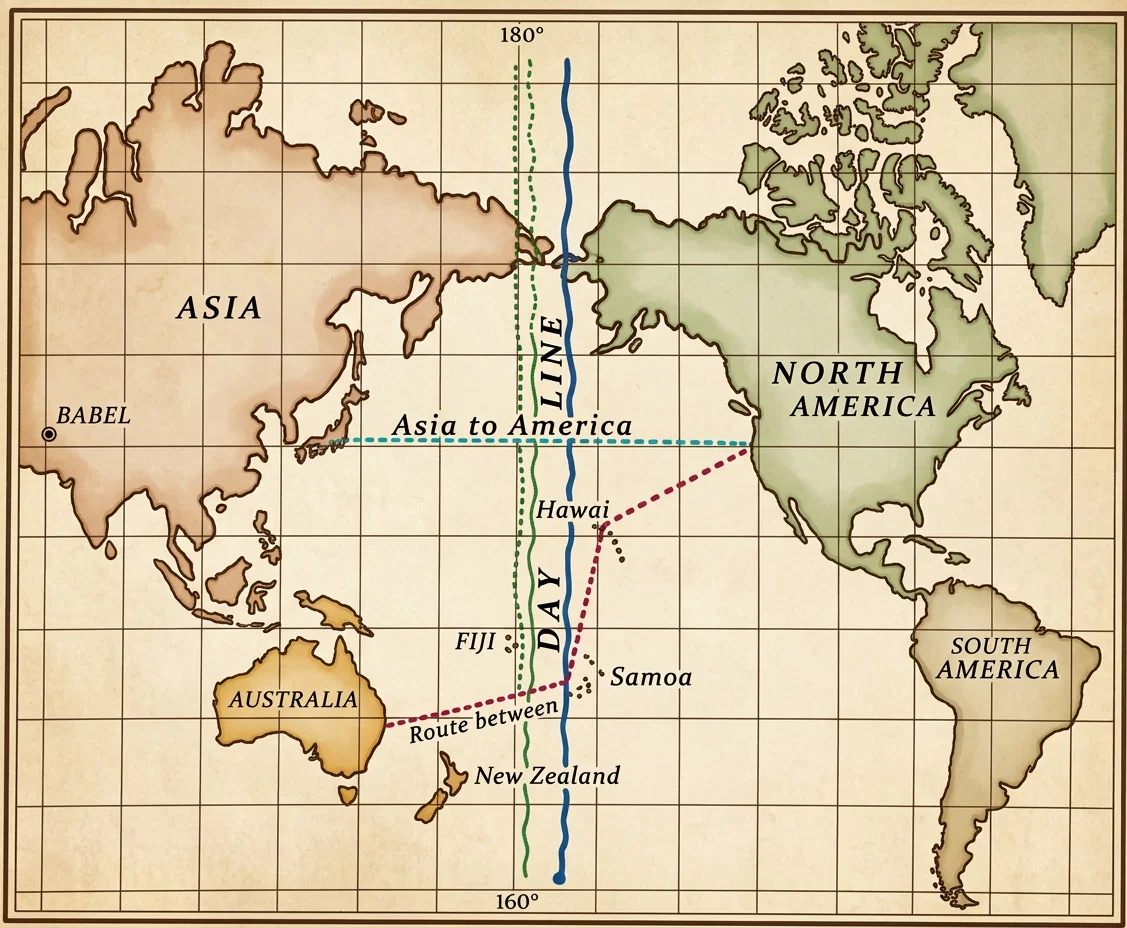
There must be some places where travelers going from the western confines of the continents of America to Asia or Australia, or vice versa, must adjust their reckoning of time. The settlement of the earth by the descendants of Noah indicates the natural location for such a day-line to be in the Pacific Ocean. Some talk of an Edenic day-line, meaning a day-line located where Eden is supposed to have been. This is thought by some to have been in the valley of the Euphrates. A better name for such a day-line would be the Babylonian day-line, for there is more certainty of the location of that ancient metropolis, and it better indicates the nature of a day-line running through populous countries—a day-line truly Babylonian, for endless confusion would thereby result. But the day-line indicated by the migrations of nations is located in the broad Pacific. This will be apparent immediately we remember that the peopling of the earth was east and west, north and south, from the place where the tower of Babel was built. Gen. 11:1–9. “And the Lord scattered them abroad from thence upon the face of all the earth.” Verse 8. Babel was at the grand center of the continents of Asia, Europe, and Africa. Australia is geographically in close proximity to these divisions of the earth. Then from Europe the Americas were settled by civilized nationalities.
Now that the earth is settled there is not the slightest hitch, there is no confusion in regard to time. This never arose till the Pacific was crossed, when individuals seeking new lands, or gold, or pleasure, crossed this mighty expanse of waters. Then it was found that there was a difference of time. This is explained by the fact that in traveling around the globe from east to west, we are traveling in an opposite direction to the diurnal motion of the earth; or in other words, we are traveling with the apparent motion of the sun, hence each day is thus a little longer to us than if we remained stationary. In traveling around the earth this difference of time will amount to an entire day and must of course be dropped from our reckoning. In case we travel against the apparent motion of the sun, that is, from west to east, each day of ours is shorter than the day of those who remain in one place. This amounts to a whole day when we have encircled the earth, and to adjust ourselves to the time indicated by the great time-keeper, the sun, we must now add a day, just the time we have lost in traveling with the earth or against the apparent motion of the sun.
Were the day-line to run through populous countries, we can at once see that it would work confusion, but as it is naturally indicated to be in the great Pacific, no trouble need arise. There is abundance of water in this ocean so that between the great continents we have ample time to adjust ourselves to the proper reckoning.

The 180th Meridian.

This has been quite generally chosen by the leading nations as the day-line. For navigators, as a point where they are to adjust their reckoning in their voyages across the great deep, it is perhaps as good as any other meridian. But there is nothing to indicate that the day-line should be an arbitrary one confined to an exact minute of longitude. The 180th meridian passes through habitable parts of the globe, and therefore in those countries through which it passes it is unreasonable to regard it as the day-line. This meridian passes through Taveuni, Fiji, and if it be the true and only place for a day-line, then under the one sunlight there are two days on the one island. This would be unfortunate since Taveuni is a populous island, sometimes called the “Garden of Fiji.” It would cause endless confusion. That it is not indeed the day-line, is shown by the fact that navigators of vessels sailing in the group pay no attention to such a day-line. Neither the Wesleyans nor the Catholics pay any attention to such an inconsistent thing as a day-line on the 180th meridian.
This is all proof that the day-line, or place to readjust ourselves in our migrations from one side of the Pacific to another, should not be regarded at any exact meridian, but in the Pacific between habitable lands. We need not be surprised by the inconsistency of two Sabbaths coming together, nor on the other hand, dropping a Sabbath, and so having no Sabbath for nearly two weeks. O no! the ocean of the Pacific presents plenty of space so that Sabbath-keepers in their traveling may keep the Sabbath as it comes to them, and, adjusting themselves on a day between Sabbaths, they keep the next Sabbath in harmony with Sabbath-keepers in the country to which they are traveling.
It is perhaps true that when the Lord in the beginning gathered the waters together into “one place,” he designed that there should be a body of water separating the continents of Asia and the Americas in which the day-line was to be, and if man had been faithful to God, Eden would have been the place for Sabbath gatherings where all of God’s children would have met for worship from all parts of the earth. This is the way it will be in the New Earth. Isa. 66:22, 23. And if this is the way it would have been had man never sinned, the day-line need never have been crossed by man, for leaving Eden after a Sabbath of rest, they would retrace their steps on every successive Sabbath and hence never cross the day-line.
God’s holy Sabbath, appointed at creation, is a Sabbath for all time, for all places. It was sanctified before sin entered, and it becomes the sign of loyalty in this world of sin, and in the earth made new it will ever be recognized by the redeemed host.
As the day-line has somewhat to do with the Sabbath, we are not to leave it to the inconsistent world to settle as to where it should be. God has indicated where it should be. Consider that the day-line lies in the Pacific Ocean, away from habitable lands, and then the matter is free from all inconsistencies.
It is sometimes said that it is as bad for the Sunday as for the Sabbath. True, but the man-made Sabbath has the “image and the superscription” of man. The Sabbath is divine and can not possibly be hampered by any such inconsistency as having two days under one sunlight, as would be the case in Fiji should the 180th meridian be selected as the day-line. J. E. FULTON. Suva, Fiji.