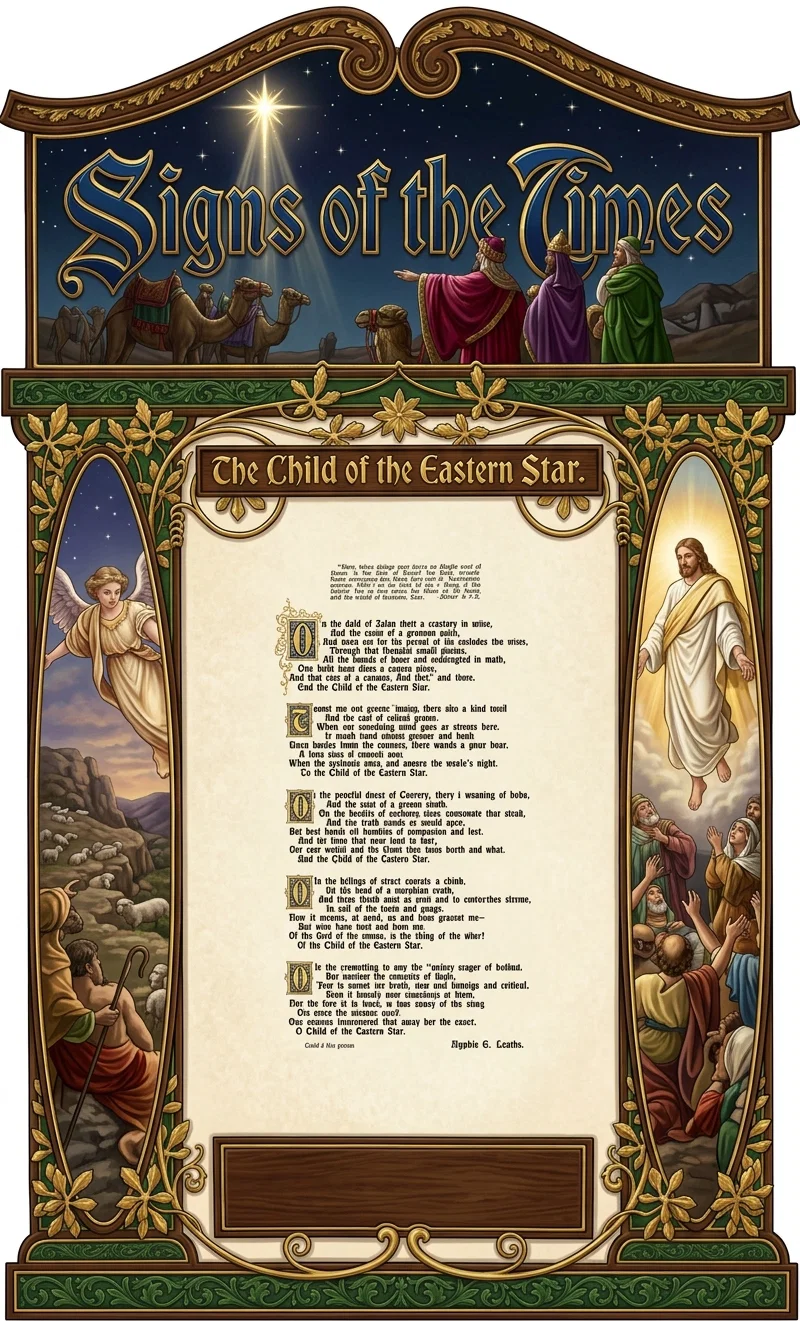
Reduced from Simile of the First Page of Our Next Issue.
The Unions and the Militia.
An action which is bound to have serious consequences has lately been brought to the attention of the public by the labor unions of the country. They have seen the militia of different States used against them when their members were engaged in threatening or riotous demonstrations, and a decree has been issued by various unions that their members must not join the militia, or that if in the militia already, they must withdraw therefrom. Withdrawals from the ranks of the militia have already begun at a rapid rate, and this has reached even to the officers. This matter is bound to be taken up by the government sooner or later. Just how it will work out no one can say; but a clash between the labor unions and the government is almost inevitable. The State considers the militia necessary for the protection of the public peace against rioting, organized or unorganized. It considers it necessary for just such emergencies as arose during the great coal strike in Pennsylvania, when lives were threatened by the wholesale, murders were committed, and buildings and mining property were destroyed. This action of the unions toward the militia seems like a bid for the continuance of such reigns of terror as were experienced there. The militia is drawn largely from the laboring class, and as these are brought more largely under the domination of the labor unions, the ranks of the militia will be thinned out until some other provision will have to be made for controlling such situations as existed recently in Pennsylvania. Will it be a compulsory military service, or a proportionate increase in the regular army? In the one case the government will have a heartless organization upon which it can not depend, in the other a terrible machine which will not hesitate to slay. In either contingency there is bound to be trouble ahead because of the anti-militia decree of the unions. Labor-union men who have belonged to the militia and have thus served against labor riots have been not only expelled from the union to which they belonged, but hounded from place to place and prevented from obtaining anything to do. This is making the union men afraid to remain in the militia, and is the cause of the rapid withdrawals.
A number of monument scandals have recently come to light in Paris. Last week it was discovered that the beautiful statue of Lafayette in the Place du Carrousel was beginning to crumble; and the present week the discovery was made that the statue of Washington in the Place des Etats Unis (United States Place) was beginning to fall away under the recent heavy rains. The latter was built a few years ago by subscriptions taken up in the American colony in Paris, and cost $60,000. Other discoveries of the kind have recently been made, showing that the makers, who were paid for first-class work and material have given neither. We are seeing the same thing in nearly every walk of life to-day.
England and Germany continue their preparations for coercing Venezuela into a settlement of their claims against her. Their joint claims are to be presented simultaneously, allowing the briefest possible period for reply, and the demands will be backed up by a number of warships of both powers which have already congregated in Venezuelan waters. Venezuela has made a virtual appeal to the United States for protection, but it is understood at Washington that the United States will not interfere in any way unless there should be an attempt made to seize territory in Venezuela.
The famous education bill passed the House of Commons on December 3 by a vote of 236 to 132, and England on that date took a long step backward in the matter of religious liberty.
Socialistic Prospects.
The Independent, in speaking of the increase of the Socialist vote in the late elections, especially in Boston, remarks: “Besides being confined to the two political parties aforementioned, the Socialistic movement in the United States bids fair to honeycomb the trades unions. Only last week, at the annual convention of the American Federation of Labor at New Orleans, nearly half of the delegates voted for a resolution in favor of Socialism. . . . Populism, as a distinct political force, has had its day. Political Socialism, however, is growing among all classes, except the farmers and capitalists, and if the American Federation of Labor should ever renounce its past and present policy of working along economic lines to the exclusion of politics, the Socialist movement would then receive such an impetus as might disorganize the present great political parties of the nation.”
In the three great legislative bodies of Europe recently there have been sessions of great violence; that is, in the British Parliament, the French Chamber of Deputies, and the German Reichstag. These sessions partook more of the nature of pugilism than of the usual parliamentary practise. In the French Chamber of Deputies the military had to be called in to remove refractory members, who refused either to leave the chamber or to heed the authority of the chairman in calling them to order. A duel now seems likely between the two expelled members, both of whom have chosen seconds. During the disturbance blows were exchanged freely between a considerable number of the members. In the Parliament and the Reichstag the legislators confined themselves to angry denunciations of one another and fist shaking, the latter in the very faces of the chairmen themselves. In the session of last year Parliament was disturbed by a stormy scene in which a number of members were dragged from their seats, and the Austrian legislative assembly was in a turbulent state for a number of days, with frequent personal encounters between the members. Our own Congressional body has not been free from such demonstrations. What is the lesson of these things? Do they teach us that the nations are being fitted for the enthronement of Christ, as our National Reform friends would have us believe? Is it only necessary now to acknowledge God in the national Constitutions in order that the fact of Christ’s kingship over the nations be accomplished? It would be difficult to cast a deeper reproach upon the cause of Christ than is cast by making such a claim. “My kingdom is not of this world.”
While the members of the fashionable set in London are preparing for an unusually gay winter season and entertainments on a large scale, the great army of unemployed is steadily growing. Thousands of unemployed daily congregate at the dock-yard gates literally fighting for a chance to do a day’s work. The police have found it necessary to protect the foremen who distribute the work tickets each morning. It is estimated that 500,000 persons are idle in the United Kingdom. The Board of Trade returns show the largest percentage for ten years past of unskilled persons out of work. The winter’s prospect for these is dark indeed. In Germany there are thousands of unemployed, and the cities have begun to vote relief to this class. There is also reported great destitution in central Russia on account of lack of employment, and beggars are swarming through the cities.
On December 8 the great dam across the Nile at Assouan was formally dedicated, to the use for which it was intended, by the Duke of Connaught. The purpose of this dam and the Assiout barrage is to store up the flood-waters of the Nile, distributing the water through irrigation ditches to the thirsty lands along the Nile, at the times when it is most needed. The cost of this great undertaking has been nearly as great as the estimated cost of the Panama Canal.
Mr. Thomas B. Reed, ex-speaker of the House of Representatives, died at Washington, D. C., on December 7. For a number of years Mr. Reed was one of the foremost politicians of the country. On the same day the United States Minister to Ecuador died at Guayaquil, a victim of yellow fever. On the 4th of December the United States Minister to Japan died suddenly of heart-failure while on a hunting trip.
A report from Korea states that in consequence of the total failure of the crops there, women and children are being sold in the public market or carried about the streets for sale, bringing from $1.25 to $20 each. Numerous merchants are finding the trade so profitable that they are said to be engaging in it on a large scale. There is the utmost destitution among the poor.
The new ministry of Spain is said to be a very strong one and one that is popular with the people. But this new ministry is reported to stand strongly for the reorganization and strengthening of the army and navy and the fortifications of the country. It favors the restoration of Spain’s naval power to the place which it lost in the conflict with the United States.
The past week has been one of storms in all parts of the world. Shipping has been greatly damaged, numerous lives lost, and on land blizzards have blocked the railways and caused much suffering to stock.