EXAMINATIONS IN CHINA

14%

Pacific Press Publishing Company · Oakland, California · Dec 10, 1902

FromSigns of the Times, Vol. 28, No. 50.

Read the full edition

EXAMINATIONS IN CHINA.

If the American student has cause for dread when the time for examinations is drawing nigh, much more has the youth in China. To be sure, he spends more hours a day in school than the American does, but he has a relatively much harder task than the American, the Briton, the Frank, or the German. He is many years in school before he is even a good reader of his own language, and the task set before him in the examination he must pass before he can enter the public service is very nearly an impossible one. The successful passing of these competitive examinations is the gateway to honor and respect as well as to the civil service. While about 2,000,000 take these examinations annually, only about one per cent. are said to pass. This examination is probably the most nearly prohibitive of any examination held in any country. The strange part of it is that this rigid examination is principally in the Confucian classics. The student must have a thorough understanding of the writings of Confucius. It is as if the United States should require of all its public servants a perfect knowledge of all parts of the Bible, so as to be able to pass a faultless examination in it. But it is that drilling of the teachings and writings of Confucius into the minds of the leading men of China, and in turn their influence upon the uneducated, that makes China the difficult field it is for the Christian missionary.
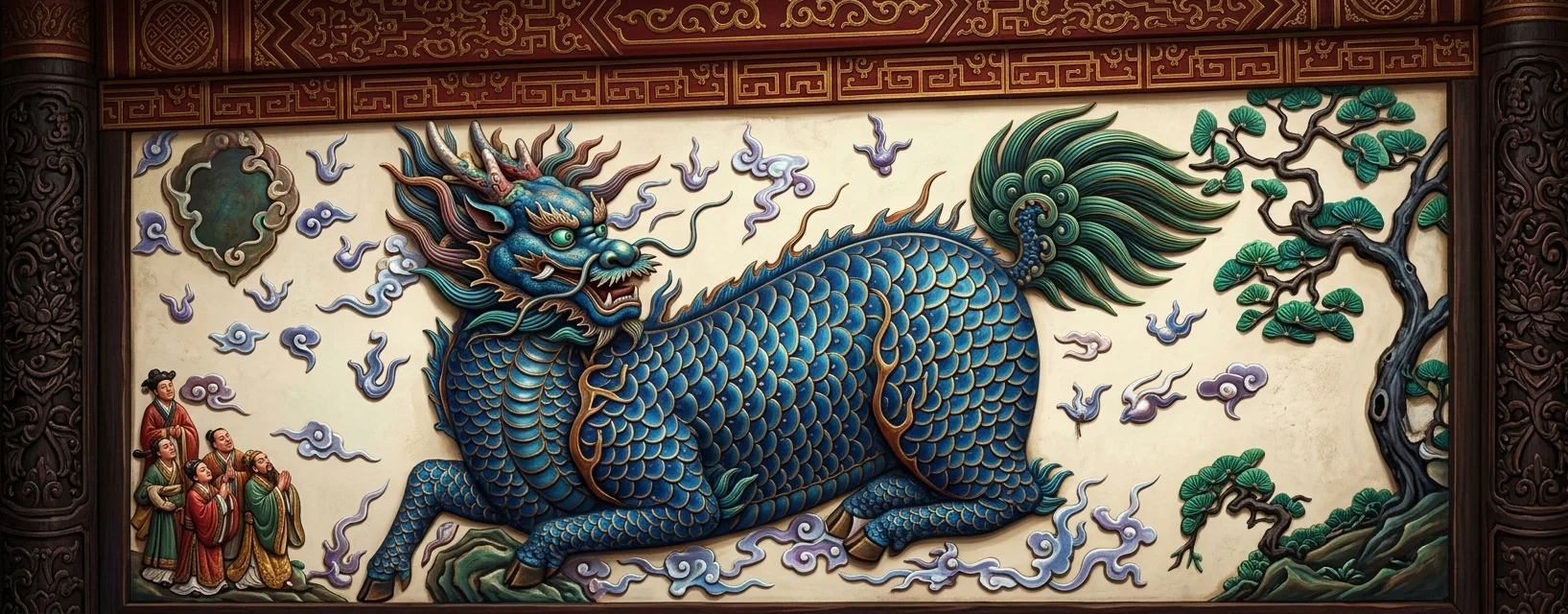
Dragon Picture over Chinese Gateway. Supposed to Frighten away Demons.
Not all Chinese youths are eligible to taking these examinations. Such are the children of the boat people, who practically live and die in their boats.
Almost every river boat has a baby toddling about upon it with a cord tied around its waist with which it can be pulled back if it should chance to fall overboard. The only way open to the children of the boatman to take the competitive examinations is for the father to acquire a residence on land. The children of actors also are subject to the same disadvantage.
In each provincial capital is an examination hall which consists of long rows of cells open at one end, and just large enough to hold one scholar with his bedding, teapot, and food. There are 12,000 cells in the Canton hall. The candidates are all admitted at the same time, assigned to their cells, and the gates are sealed. If a student dies, as often happens, his body is put out through a small hole in the wall. Each examination lasts for twenty-four hours. Then the students are released for two days, only to return for two more sieges. A paper that has been blotted or defaced in any way is thrown out. Here is one of the questions asked the student, and from which it may be gathered that he must be able to do some work outside of Confucius: “The art of war arose under Hwang-ti, forty-four hundred years ago. Different dynasties have since that time adopted different regulations in regard to the use of militia or standing armies, the mode of raising supplies for the army, etc. Can you state these briefly?”
The men who pass these examinations naturally regard their learning as the greatest education in the world; and it is this class that is the most self-satisfied both with their educational attainments and the religion which they have been taught from their youth up. This accounts for the difficulty of reaching the literary men of China as a class with the Gospel message, and their influence in turn upon the less learned and the ignorant becomes an important factor in religious work there.