Perhaps there is no field in the Pacific where so much missionary effort has been put forth as in the Fiji group. For over sixty years missionary operations on a systematic scale have been carried on there, until every little community has its appointed missionary and teacher. Churches and schools are to be seen in every town. So far the government has not undertaken to educate the natives, the matter being solely in the hands of the missionary societies, who receive no State assistance. There is one exception, however, in favor of the Catholics, who conduct one school on a larger scale than others. The natives in the district are taxed to support it, whether of that faith or not. The Wesleyans, I am informed, have resented this, and last year refused to pay.
To see people neatly robed and going to worship carrying their Bibles is a sight that does one good, especially when it is called to mind that a few years past many were cannibals of the worst type. How marked is the contrast! How great the change! What a glorious transformation effected through the Word of God!
But while there is much to admire and be thankful for, there still remains a great work to be done. The people are in need of devoted laborers who will teach them how to be cleanly and refined. They also need literature, that they may investigate for themselves. Here is where there has been a failure in many respects. For years they have been taught a form of belief, a form of public ceremony, and a form of home religion. There is no progression from year's end to year's end. Having but little exercise of thought or reason, the people are apparently lapsing into a form of godliness without the power. The vital spark of godliness is lacking or absent. The same condition that prevails in evangelical churches in civilized countries is also prevalent here, and a revival of genuine faith—which alone comes from God as a result of intelligent service—is the one remedy to save the people from stagnation mentally, morally, and physically. The Third Angel's Message supplies this need.
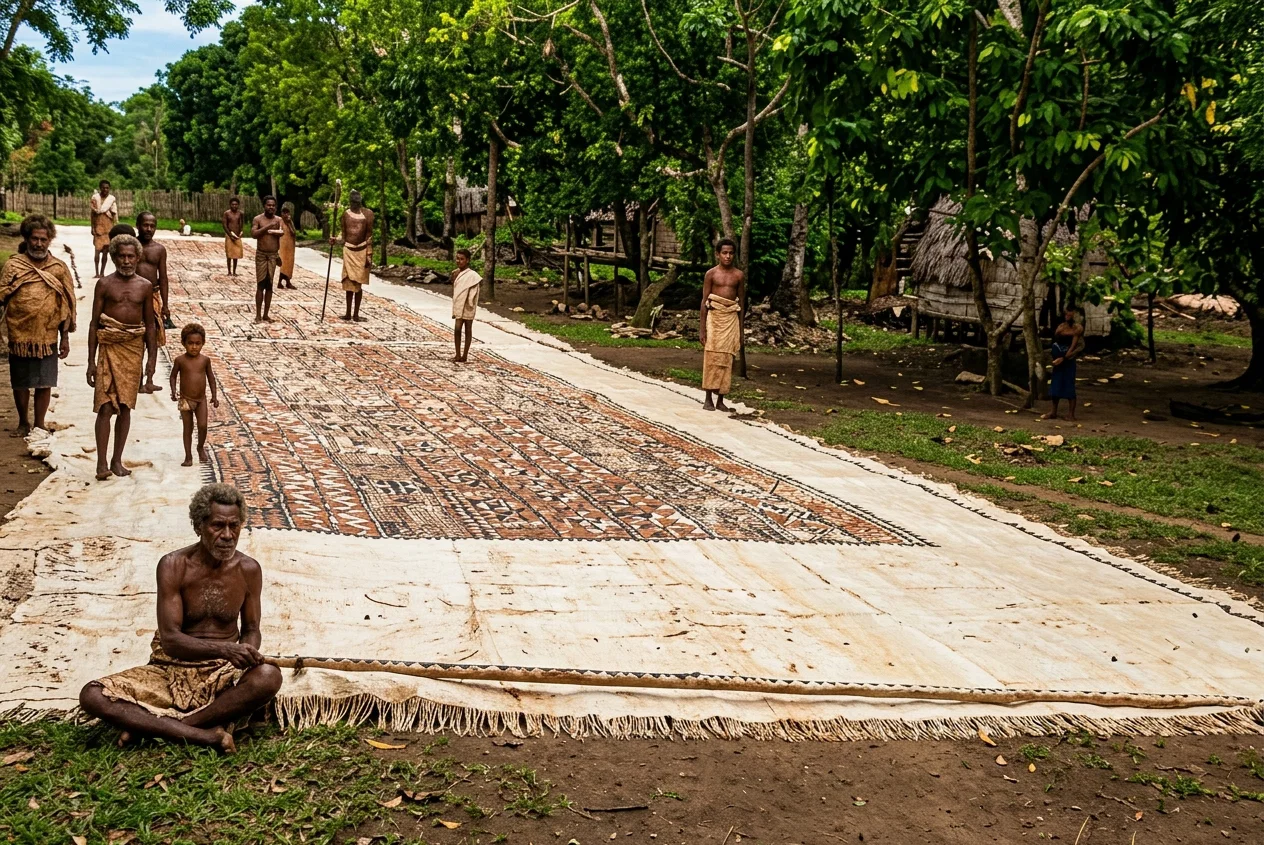
A Piece of Native Cloth Spread Out, 18x75 Feet, Made of the Bark of Trees.
A Scene Near Our Mission.
Recently we have had abundant evidence that God is working in the midst of these people, to make known this message for this time. The Macedonian cry, “Come over and help us,” is coming from several islands, as the following will show:—
Paulisa Bunoa, our native minister, left Suva at the end of the year 1901, to visit his native island in the eastern part of the group, known as Lua. He took his family with him, intending to stay for some time. On arriving at the island of Vanua Balava, he made known his desire to present the truth. The buli of the district invited him to hold meetings in his large house. He did so. Numbers attended, and such an impression was made that in a few weeks over thirty took their stand for the truth. This aroused bitter opposition; pressure was brought to bear on the buli, and he became bitter towards the new lotu (church), refused to allow Brother Bunoa to build a house or church, and ordered him away from the island. This was a step ahead of his rightful authority. However, Brother Bunoa firmly stood for his rights, being a native of the port, and quietly continued his work of preparation for building. One of the new brethren gave a piece of his land for a home for him. The buli, becoming enraged, again ordered him away, and acted very hostile, confiscating illegally some of his property. This hindered the work for a time, but only served to advance the cause of truth later.
In response to a call, Brother Bunoa then visited a small neighboring island—Thikombia—his birthplace. As a result of meetings held there, all but two of the inhabitants accepted the message. This increased the prejudice of the buli. The matter came up before the roko, or highest chief to decide, and a determined effort was made by the opposing faction to exclude the new religion. It was urged that division would be caused, and unpleasantness result. But the roko wisely gave judgment that in matters of religion all were free to believe and act as they chose; there could be no compulsion; it was outside his sphere of rule. “Let the new lotu stay,” he said; “I like new ideas; we need more knowledge. Let them teach us new ideas; it will be for our good to learn.”
The European magistrate, while this was going on, thought best to let things develop to a definite head, so that he could intelligently act in the matter. He waited our arrival, before taking any decided move. Then an appointment was made, and as the result of several inquiries, he determined to administer justice and to see that our rights were respected. Proceedings have since been taken against the buli on a charge of larceny, and a sentence of one month's imprisonment imposed.
At the request of the magistrate, a meeting of our brethren was convened, at which an expression of their wishes was called for and put down in writing, on the receipt of which full liberty and authority to establish and equip a mission in this locality was granted, and the land pegged out.
There is a general desire that we receive justice, and that we stay and carry on the work. The white people have expressed themselves personally as desirous that new life be introduced into the community. Had we a good school here or at Suva, there would be no difficulty in securing students. Several have intimated their desire to see a good school established and are ready to send their children. Shall we not be ahead in this, since the way is opened? Or shall we delay until others take up the work? It is true, “There should be one hundred workers where there is but one.” A. CURROW.